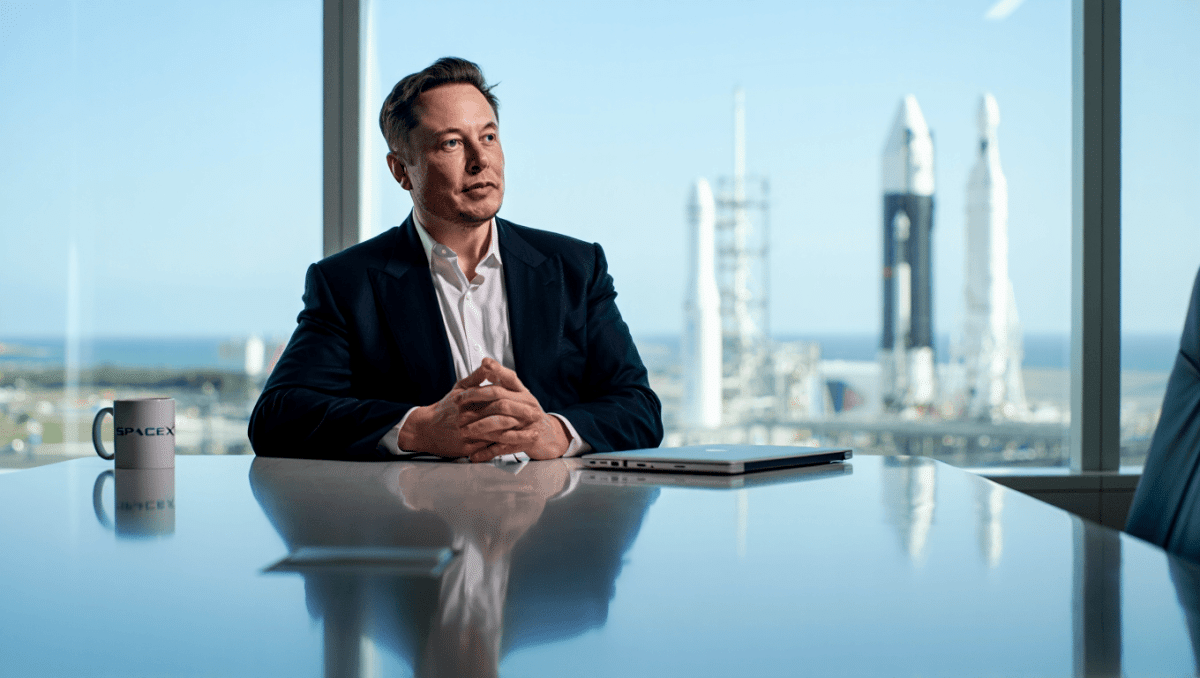
SpaceX has formally filed to take the company public, setting the stage for what could become one of the largest U.S. IPOs in history and signaling a new chapter for Elon Musk’s intertwined space and AI ambitions. The paperwork filed this week with regulators outlines the company’s market opportunity and governance plan — and shows Musk maintaining tight control even as the business opens to public investors.
Why this matters now: if the timetable holds, shares could start trading within weeks, reshaping investor exposure to the commercial space industry, satellite internet services and Musk-led AI projects.
SpaceX’s SEC filing confirms plans to list on Nasdaq under the symbol SPCX, and to also trade on the recently launched Nasdaq Texas exchange where the company is headquartered in Starbase, Texas. The company describes a vast addressable market and highlights several growth engines that underpin its case to investors.
The filing lays out financials that mix rapid revenue growth with heavy investment. Last year SpaceX reported roughly $18.7 billion in revenue, driven largely by its Starlink broadband service, but also recorded a net loss of about $4.9 billion as capital spending surged to roughly $20.7 billion in 2025. By comparison, the company posted a profit of about $791 million in 2024.
Key elements of the IPO filing
The prospectus details governance and strategic moves that investors will want to weigh carefully:
- Dual-class shares: Public investors would receive Class A shares with one vote apiece; Class B shares — controlled by insiders — carry 10 votes each.
- Musk’s control: The filing states Elon Musk would hold about 85.1% of combined voting power after the offering.
- Roadshow and timetable: Company documents indicate a roadshow could begin June 4, with a potential investor sale starting June 11 and a Nasdaq listing as early as June 12, subject to market and regulatory conditions.
- Underwriters: Goldman Sachs is listed as lead underwriter, joined by major investment banks including Morgan Stanley, Bank of America, Citi and JPMorgan.
Beyond rockets and broadband, the filing emphasizes SpaceX’s role in emerging AI infrastructure. The company recently folded Musk’s xAI startup into its operations; the filing acknowledges that xAI is currently loss-making but labels AI developments as central to long-term value. SpaceX also disclosed plans to collaborate with Tesla on advanced semiconductor manufacturing.
How SpaceX sizes the opportunity
Investors were shown a sweeping estimate of total addressable markets across AI, satellite connectivity and space-enabled services — a figure the company values at about $28.5 trillion. The filing breaks that number into several large components.
| Area | Estimated market ($) |
|---|---|
| AI initiatives (total) | $26.5 trillion |
| Enterprise AI applications | $22.7 trillion |
| AI infrastructure | $2.4 trillion |
| Consumer subscriptions | $760 billion |
| Digital advertising | $600 billion |
| Connectivity (Starlink) | $1.6 trillion |
| Space-enabled solutions | $370 billion |
Presenting such a large market is part of SpaceX’s strategy to justify heavy upfront investment. Analysts and bankers will now assess how realistic those addressable-market figures are and what multiple that should translate to in a public valuation.
Market and strategic implications
For investors and industry watchers, the filing raises immediate questions:
- How will public markets value a firm that mixes satellite broadband revenue with a sprawling, capital-intensive launch business and nascent AI operations?
- What are the governance implications of a structure that concentrates voting power with Musk and other insiders?
- Could SpaceX’s consolidation of satellite, launch and AI capabilities accelerate competition — or prompt strategic tie-ups with other Musk ventures?
Some Wall Street analysts noted the potential for closer integration between SpaceX and Tesla following the IPO, pointing to shared AI ambitions and the recent agreement to develop a joint chipmaking facility. Such moves would complicate corporate relations but might also create synergies across transportation, energy and space services.
The IPO would also mark a rare opportunity for public investors to gain direct exposure to orbital infrastructure — an asset class until now dominated by private capital. Retail and institutional portfolios could shift if SpaceX achieves a $1 trillion-plus valuation at listing, but the deal’s dual-class structure means influence over long-term strategy would remain largely in insider hands.
This filing is an important step, not a final promise: the company has not set an offering price and final terms will depend on market conditions and regulator review. Still, the timeline and scope laid out in the prospectus add urgency to discussions about valuation, oversight and the future of commercial space and AI convergence.
Sources: SpaceX SEC prospectus and reporting by major news agencies.