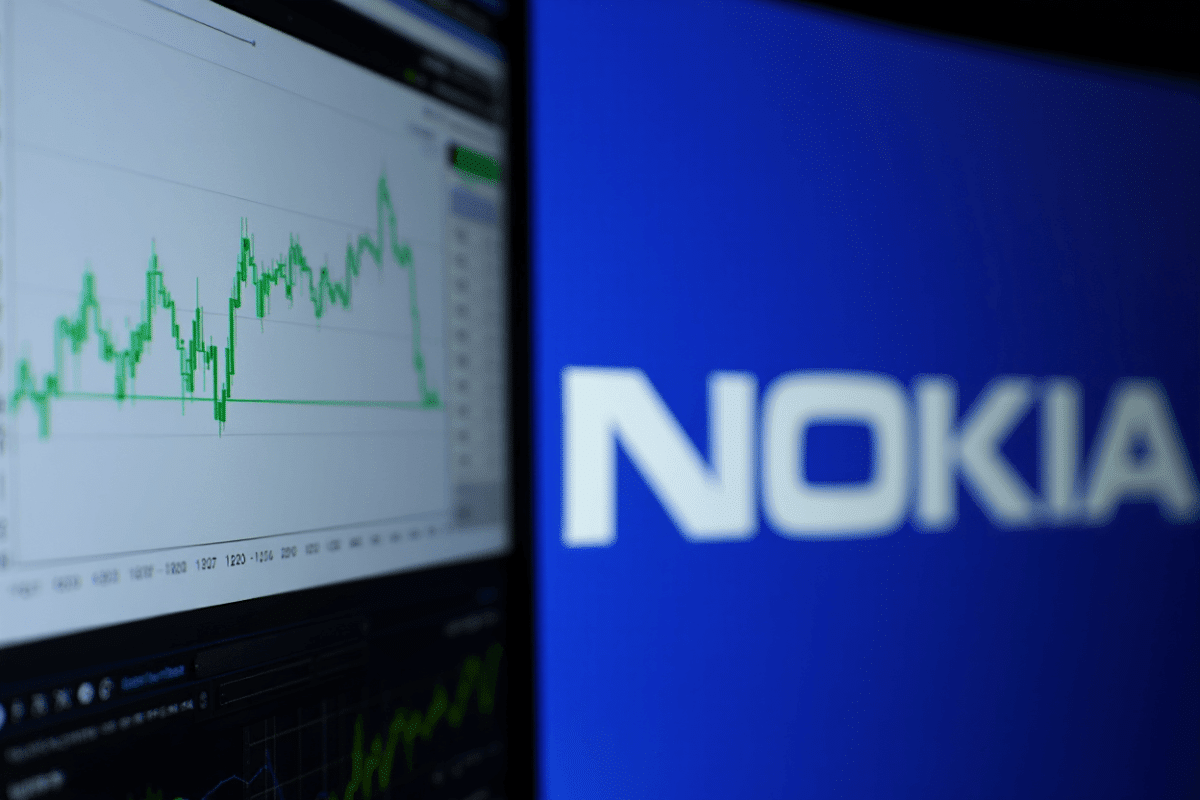
Nokia stock rallied to its 52-week high of $15.32 on May 22, 2026, as multiple analysts raised price targets citing the company’s pivotal shift toward AI-driven network infrastructure. The Finnish telecommunications giant is capturing momentum from enterprise demand for optical networking, cloud integration, and AI-ready platforms—positioning it as a direct beneficiary of the broader tech infrastructure build-out. The surge reflects a significant revaluation from just $8.58 in early April, marking a remarkable 79% gain in seven weeks.
🔥 Quick Facts
- 52-week high of $15.32 reached on May 22, 2026 — marking the stock’s peak valuation this year
- Multiple analyst upgrades in April–May 2026 — Argus raised target to $15.00, Barclays to EUR 8, Raymond James to $12 on €1B AI orders
- Average analyst price target: $9.71 across 18 analysts (some targets outdated before recent upgrades)
- Q1 2026 AI and Cloud demand surged 49% — now accounting for 8% of total net sales but accelerating
- $4 billion U.S. investment commitment in R&D and manufacturing for AI-ready network solutions
Why Analysts Are Revising Nokia’s AI Story Upward
Nokia’s positioning in enterprise networking is fundamentally different from consumer handsets. The company completed its acquisition of optical networking specialist Infinera, combining fiber transmission technology with cloud and AI data center routing. This wasn’t a casual tech deal—it signals Nokia’s bet that data center interconnect, optical switching, and AI-accelerated networking will drive decades of infrastructure spending.
On April 23, 2026, Nokia released Q1 2026 earnings that beat expectations with a revised upward guidance for Network Infrastructure growth of 12%-14% in 2026 and optical/IP revenue surging 18%-20%. These projections converted market skepticism into analyst optimism. The 49% surge in AI and Cloud segment sales wasn’t a one-quarter blip—it reflects accelerating orders from hyperscalers and telecom operators racing to deploy AI clusters.
Analyst Price Targets and the Catalyst Behind Recent Upgrades
Argus Research upgraded Nokia on April 27, 2026, raising the price target to $15.00—a level the stock reached within three weeks. Their thesis centered on structural demand from AI data center expansion and Nokia’s role as a critical infrastructure provider rather than a commodity manufacturer.
Raymond James assigned an Outperform rating and $12.00 price target (raised significantly), citing €1 billion in new AI-related orders. This order visibility—rare in telecom infrastructure—demonstrates that enterprise commitment to AI networking is materializing into real contracts. Prior to these upgrades, analyst consensus was muddled, with estimates ranging from $7.60 to $15.00. The recent clustering of upgrades at the higher end suggests comparable momentum seen in other semiconductor and infrastructure stocks benefiting from AI acceleration.
Market Performance and Valuation Expansion
| Metric | Value | Context |
| 52-Week High | $15.32 (May 22, 2026) | Just achieved |
| 52-Week Low | $4.00 (Aug 2025) | 283% rally from low to high |
| April Low → May High | $8.58 → $15.32 | 79% gain in 7 weeks |
| Average Analyst Target | $9.71 – $13.13 | Some outdated; recent upgrades at $12-$15 |
| Implied Annual Growth (2026) | 12%-14% (Infrastructure), 18%-20% (Optical/IP) | Company guidance, upgraded April 2026 |
The 283% gain from the 52-week low of $4.00 underscores how dramatically market perception has shifted. Investors have moved from viewing Nokia as a legacy telecom vendor to recognizing it as a pure-play optical and AI networking infrastructure leader. This revaluation mirrors broader trends where infrastructure and semiconductor stocks are gaining momentum on AI demand visibility.
Strategic Investments and Competitive Positioning
Nokia’s $4 billion U.S. investment (announced November 2025) commits $3.5 billion to AI-ready R&D at Nokia Bell Labs in New Jersey, plus manufacturing expansion. This isn’t a marketing pledge—it’s capital allocation backing the thesis that optical networking and 5G/6G infrastructure will be AI-critical for the next decade.
Partnerships with Telefónica, Deutsche Telekom, and TIM Brasil show that major carriers are standardizing on Nokia’s optical and edge computing solutions for AI data center connectivity. These relationships validate what analysts see in the order books: telecom operators and cloud providers are co-investing in infrastructure to handle AI workloads. Unlike consumer tech, infrastructure contracts typically span multi-year commitments, providing visibility that justifies analyst confidence.
Is the Stock Overvalued at the 52-Week High?
At $15.32, Nokia is trading above most historical analyst targets, but this reflects a genuine shift in how the market values telecommunications infrastructure in an AI era. The key question: Can 12%-14% Network Infrastructure growth and 18%-20% Optical/IP growth sustain the $15+ valuation? Yes, if Q2 2026 results and order guidance confirm the Q1 momentum. But if analyst upgrades prove premature or competitive pressures from Broadcom, Infinera, or other optical vendors emerge, profit-taking could occur.
The broader context matters. Infrastructure and semiconductor stocks are broadly benefiting from data center AI investment cycles. Nokia’s gains align with this trend, suggesting the move may be justified by improving fundamentals rather than pure speculation.
What the Next Earnings Quarter Will Reveal
Nokia will report Q2 2026 results in July, and analyst expectations will center on three metrics: Actual growth rates for Network Infrastructure and Optical/IP, AI and Cloud segment bookings and backlog, and any revised 2026 guidance. If the company reaffirms or raises expectations, the stock could sustain the $15+ level and even push higher toward the $15.00 analyst targets. Conversely, if order growth slows or customer spending delays materialize, the upside could be capped.
For investors tracking the AI infrastructure story, Nokia’s recent rally and analyst upgrades signal that telecom vendors are finally breaking out of the commoditization trap. The company is no longer competing on price—it’s selling mission-critical AI networking infrastructure at premium valuations.
Sources
- CNBC, MarketBeat, Investing.com — Real-time stock data and analyst ratings
- Nokia Interim Report Q1 2026 — Company guidance and AI/Cloud segment metrics
- Argus Research, Raymond James, Barclays — Analyst upgrades and price targets (April–May 2026)
- QuiverQuant, SeekingAlpha — Analyst consensus and earnings analysis
- Reuters, Wall Street Journal — Nokia partnership announcements and U.S. investment commitments