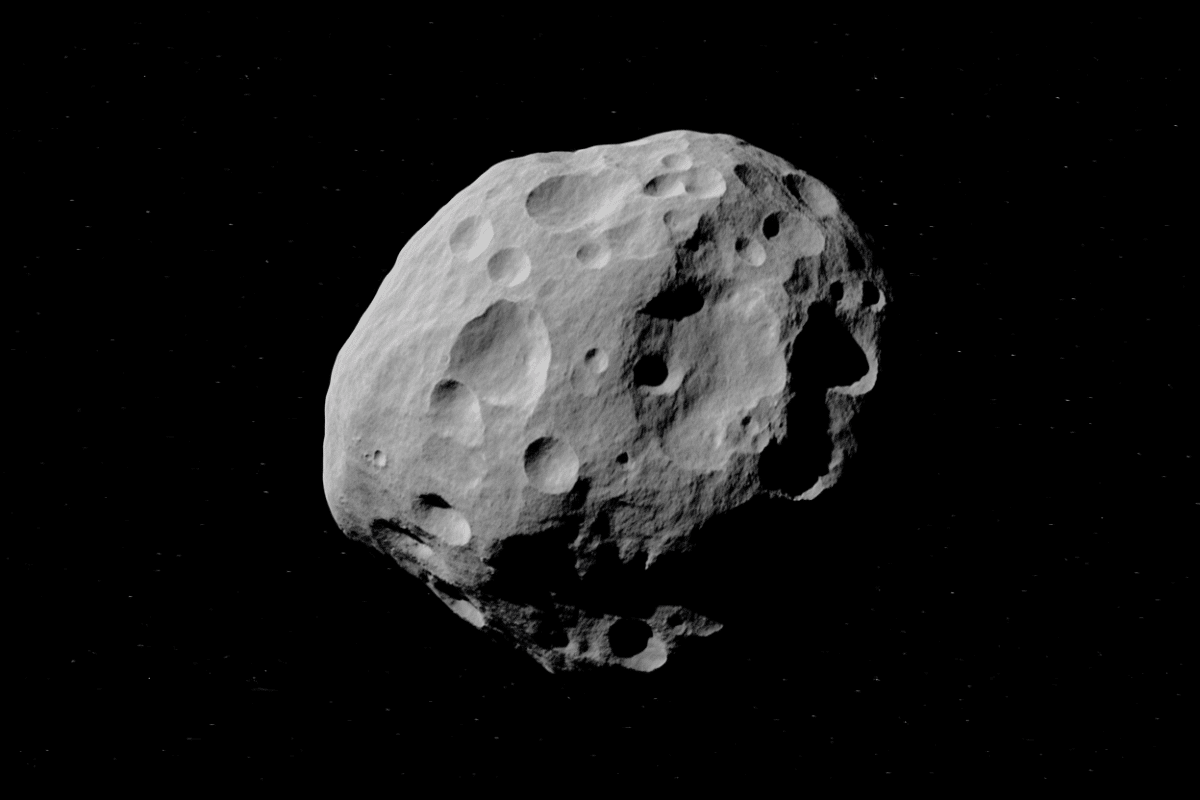
China’s Tianwen-2 spacecraft captured the first close-up photograph of Earth’s quasi-moon Kamo’oalewa from a distance of approximately 20 kilometers (12.5 miles) on July 2, 2026, marking a historic moment in humanity’s exploration of near-Earth objects. The China National Space Administration announced the spacecraft’s arrival at the asteroid on July 4 and released the first image on July 6, 2026, following a 400-day journey covering roughly 620 million miles (1 billion kilometers) from Earth.
Kamo’oalewa, formally designated 2016 HO3, is one of only seven known quasi-satellites of Earth—objects that orbit the Sun independently but remain locked in a gravitational dance that keeps them traveling alongside our planet through space. Discovered by the Pan-STARRS survey at Haleakala Observatory in Hawaii on April 27, 2016, the asteroid measures between 30 and 100 meters (roughly 100 to 330 feet) across, making it potentially the smallest object ever visited by a spacecraft. Its Hawaiian name means “oscillating celestial fragment.”
The quasi-satellite’s orbit began roughly 100 years ago and is expected to persist for about 300 more years, according to mission documentation published in Space Science Reviews. During its orbit, Kamo’oalewa varies in distance from Earth, ranging between 9 million and 25 million miles, never coming close enough to be gravitationally bound as a true moon would be.
Scientists have long speculated about Kamo’oalewa’s origin. Some researchers theorize the asteroid may be a fragment of Earth’s Moon, ejected into space by a massive ancient impact. A 2024 study published in Nature Astronomy proposed that Kamo’oalewa could be material ejected from the lunar surface by the impact that formed the Giordano Bruno crater. Other research suggests the asteroid displays lunar-like silicate material in its composition, lending support to the Moon-fragment hypothesis. However, the exact origin remains unknown, and returned samples could definitively answer the question.
Tianwen-2 carries 11 scientific instruments, including cameras, spectrometers, and radars, and will conduct a series of increasingly close observation passes to map the asteroid’s surface and identify the best sampling site. Three different sampling approaches have been designed to handle varying surface conditions: hovering above the surface to collect particles, briefly touching down with a gas-driven sampling head, and anchoring to the asteroid for harder terrain. After spending roughly 2.5 years at Kamo’oalewa, the spacecraft is expected to continue toward 311P, a main-belt comet beyond Mars, making this a decade-long mission that will visit both an asteroid and a comet if successful.
Sources
- Discover Magazine — Mission timeline, asteroid size, orbital characteristics, and sampling methods
- Space.com — Journey distance, arrival date, and lunar origin hypothesis from 2024 Nature Astronomy study
- Wikipedia (Tianwen-2) — Arrival date of July 4, 2026
- Wikipedia (469219 Kamo’oalewa) — Discovery date and location, asteroid designation
- The Planetary Society — Quasi-satellite classification and orbital characteristics
- The Economic Times — First close-up image announcement and distance
- SpaceNews — CNSA announcement on July 6, 2026