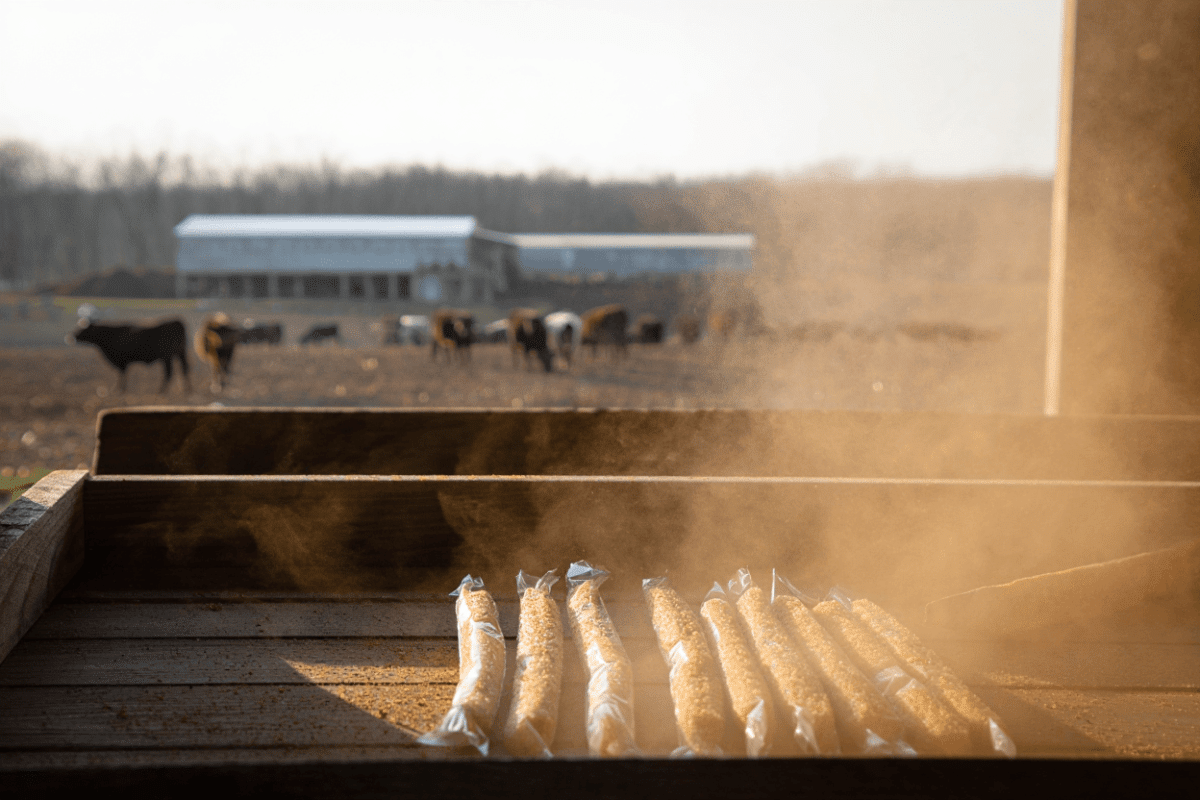
Missouri rancher Steven McBee Jr. has spent a decade building a vertically integrated beef business that cuts out middlemen, producing roughly a million snack sticks a month—just as Washington announced a $500 million federal initiative aimed at helping small and mid-size beef processors navigate an industry dominated by four giant companies.
The contrast highlights two very different approaches to a structural problem: McBee solved it privately through investment and innovation, while the government is now stepping in with the Strengthening Processing for U.S. Ranchers (SPUR) program, announced June 30, 2026, to shore up independent processors struggling with tight cattle supplies and rising costs.
McBee, 33, didn’t inherit land, cattle, or banking relationships. Working alongside his father Steve Sr. and brothers Jesse, Cole, and Brayden on a first-generation family farm in Gallatin, Missouri, he rejected the traditional ranching model: raise cattle, sell into the commodity system, accept the price offered. “Everybody in this industry gets told to raise your cattle, sell them into the commodity system and take the price you’re given,” McBee said in a recent interview. “We looked at that and thought, Why stop there? If we wanted more control over our future, we had to own more of what came next.”
The numbers explain why. The four largest beef packers—Tyson, JBS, Cargill, and National Beef—control roughly 85 percent of U.S. beef processing, according to the U.S. Department of Agriculture’s Economic Research Service. That consolidation leaves independent producers with few options once cattle are ready for market. Rising input costs and unpredictable weather compress margins further, making survival difficult for ranchers without direct market access.
McBee spotted an opportunity in plain sight: Americans were buying more protein, meat snacks were taking off, and very little of that value was flowing back to producers. Meat snack sales have climbed more than 45 percent over the past four years to reach $4.4 billion annually, according to Circana data cited by CoBank analysts in June 2026. McBee had circled the idea since 2017, but scaling it required building parts of the business most ranch families never touch.
The first snack stick brand launched in 2020. Two years later came a production facility. The biggest leap arrived in 2023 with the purchase of the company’s own meat processing plant. After federal inspection and SQF (Safe Quality Food) certification, a fulfillment center followed, built on the farm so every order ships from where the cattle are raised. “We built the ladder one rung at a time, and each step was funded by the one before it,” McBee explained. “Farm, facility, fulfillment. One family, zero middlemen, and we can stand behind exactly what’s in the package and how it got there.”
The timing aligned with booming demand. McBee’s company now ships products directly to consumers and stocks shelves in more than a dozen states, with demand already outpacing current production capacity. A second facility is under construction in Gallatin, expected to create 25 full-time jobs on top of the 30-plus the company already supports locally.
While McBee built his way out of the bottleneck, the federal government is now investing in a broader solution. The USDA’s SPUR program provides up to $500 million in temporary payments to eligible small and mid-size beef processors to help them compete, offset rising cattle procurement costs, and strengthen independent infrastructure. The program opened applications through August 7, 2026, and reflects growing recognition that the beef industry’s extreme consolidation threatens both rural economies and competition.
McBee’s success offers a template: vertical integration, direct-to-consumer sales, and brand ownership can return value to the producer. Yet his path required capital, risk tolerance, and years of learning new business disciplines that not every rancher can access. The SPUR program aims to help those without McBee’s resources or risk appetite stay viable until the market dynamics shift. The real test will be whether government aid can level a playing field tilted by decades of consolidation, or whether only entrepreneurs willing to reinvent their business model entirely can survive.
Sources
- Entrepreneur — Steven McBee Jr.’s vertically integrated beef business model, snack stick production, and quotes on building a family farm without inherited advantages (July 8, 2026)
- USDA — SPUR program announcement and details on $500 million in support for small and mid-size beef processors (June 30, 2026)
- USDA Economic Research Service — Four largest beef packers control 85 percent of U.S. beef processing (January 2024)
- Bravo TV — McBee family production capacity of approximately one million snack sticks monthly (September 2024)
- CoBank — Meat snack sales growth of 45 percent over four years to $4.4 billion (June 2, 2026)