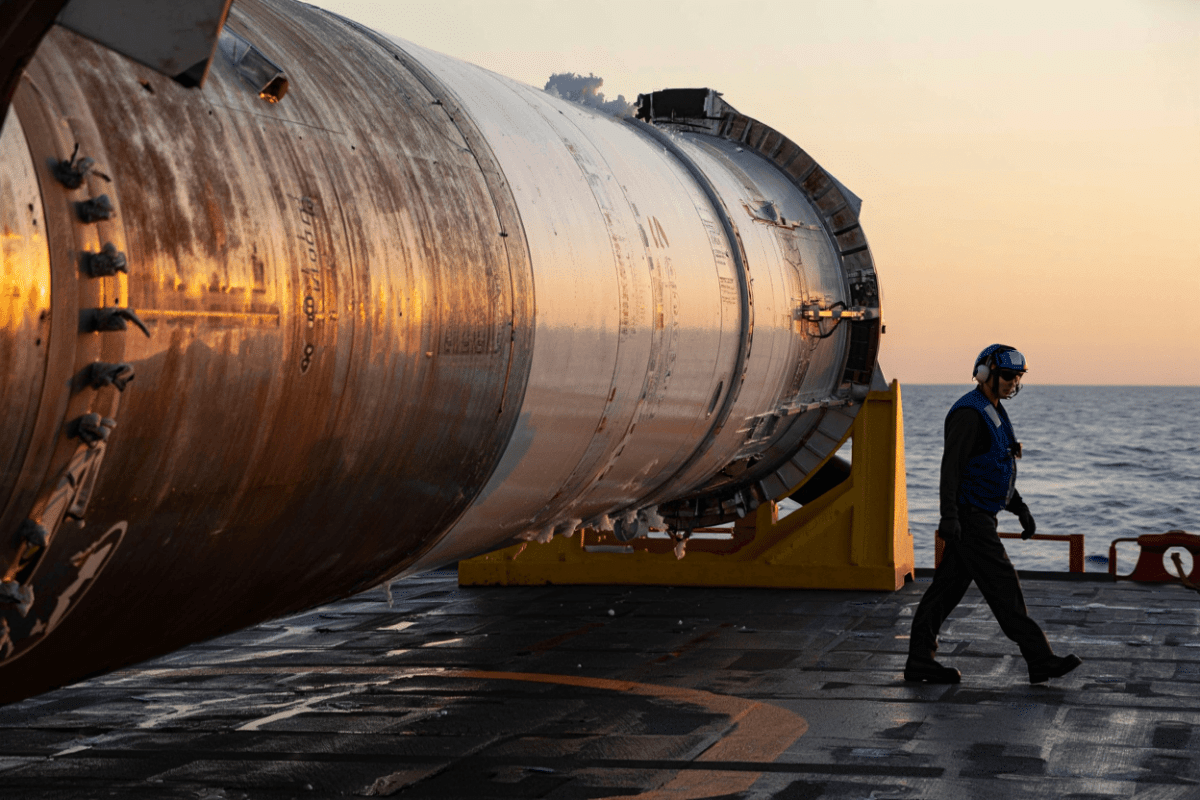
SpaceX’s Falcon 9 booster B1067 completed its record-breaking 36th flight on July 9, 2026, launching 29 Starlink internet satellites from Cape Canaveral Space Force Station in Florida, marking the first time any rocket booster has reached that milestone.
The booster lifted off at 5:25 a.m. EDT from Space Launch Complex 40, carrying the Starlink 10-42 mission into low Earth orbit. B1067 then landed safely on the drone ship A Shortfall of Gravitas in the Atlantic Ocean, completing another successful mission in a five-year operational career that has redefined what’s possible for rocket reusability.
B1067 first flew in June 2021, initially supporting a Cargo Dragon mission to the International Space Station. Since then, it has flown mostly Starlink missions, sometimes launching twice in a single month. The booster’s rapid turnaround between flights demonstrates the reliability and efficiency SpaceX has achieved with Falcon 9 first-stage recovery and refurbishment.
The achievement underscores how thoroughly SpaceX has transformed space launch economics. When B1067 made its debut five years ago, the idea of a booster flying 36 times seemed implausible. Yet the booster has now launched more mass into orbit than more than two dozen expendable rockets operated by SpaceX’s competitors over the same period. According to reporting from Ars Technica, since B1067’s debut in June 2021, United Launch Alliance flew its Atlas V rocket 22 times, the Vulcan rocket four times, and the Delta IV Heavy three times—a combined 29 launches versus this single booster’s 36.
The record-setting cadence of reused Falcon 9 boosters has been central to SpaceX’s rise as a spaceflight leader. Ars Technica noted that the company’s ability to deploy its Starlink mega-constellation through rapid booster reuse ultimately enabled SpaceX to reach profitability, a milestone that has shaped its valuation ahead of a planned IPO.
SpaceX has publicly stated a goal of qualifying Falcon 9 first stages to support 40 missions each. With B1067 now at 36 flights, that target appears within reach, though the company may extend the booster’s operational life further given its proven track record.
Sources
- Spaceflight Now — live coverage details, booster history, launch specifics, and landing information for July 9, 2026 Starlink 10-42 mission
- Ars Technica — booster operational history, profitability context, and comparison with United Launch Alliance launches since June 2021