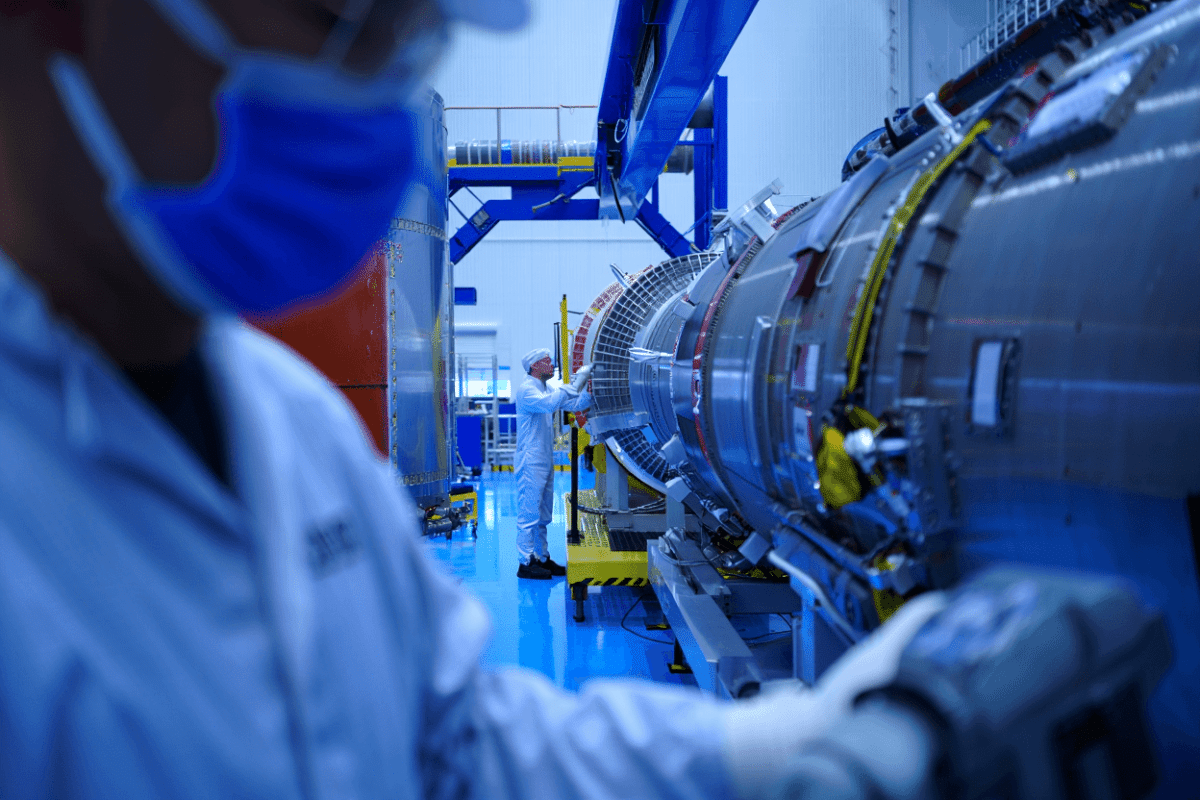
Blue Origin is weighing external funding for the first time in its 25-year history, marking a watershed moment for Jeff Bezos‘s space venture. The move comes as the company aims to accelerate its launch cadence and compete with SpaceX‘s imminent $1.75 trillion IPO. While company leadership has ruled out immediate public offering plans, the decision to explore outside investment signals a strategic shift toward growth capital and eventual path to public markets.
🔥 Quick Facts
- Blue Origin founded in 2000 by Jeff Bezos
- Company has been solely funded by Bezos‘s personal wealth through Amazon stock sales for 25 years
- Estimated annual spending reaches $4.8 billion in 2026
- SpaceX IPO valued at approximately $1.75 trillion as catalyst for industry dynamics
- CEO Dave Limp stated company unlikely to be sold; no immediate IPO timeline
A Quarter-Century of Solo Funding: How Bezos Built Blue Origin Alone
Blue Origin represents a unique funding model in aerospace: a company backed entirely by one individual’s personal wealth. Since 2000, Bezos has financed every rocket launch, test flight, and facility expansion using proceeds from selling Amazon stock. According to Financial Times reporting from May 12, 2026, Bezos owns approximately 9 percent of Amazon and has executed a deliberate strategy of liquidating shares to fund Blue Origin‘s operations.
In 2017, Bezos publicly disclosed his funding method, stating he would “sell about $1 billion a year of Amazon stock” and invest the proceeds into Blue Origin. This approach guaranteed complete control over company strategy without external pressure from investors or boards. For 25 years, this model proved viable. Industry analysts estimate Blue Origin‘s annual revenue remains under $1 billion, while annual spending now approaches $4.8 billion—creating a capital gap that personal Amazon stock sales alone may struggle to sustain.
Why External Funding Now? The Scale Problem and Launch Cadence
Blue Origin‘s leadership began exploring outside capital as the company pursues more ambitious aerospace objectives. The New Glenn heavy-lift rocket program and plans for increased launch cadence require capital investments that exceed Bezos‘s comfortable annual draw from Amazon. May 13, 2026 reports from Financial Times attributed to inside sources indicate external fundraising is “needed to support increased launch cadence.”
CEO Dave Limp addressed staff in May 2026, explaining that Blue Origin targets between 8 to 12 launches this year using New Glenn, with aspirations for 14 launches annually. Achieving this pace demands capital for manufacturing, ground infrastructure, and operational scaling. Additionally, Blue Origin‘s planned satellite constellation project envisions deploying 51,600 satellites into low Earth orbit—a multi-billion-dollar commitment that strains solo-founder financing models.
The SpaceX IPO Effect and Competitive Timing
SpaceX‘s announcement of a $1.75 trillion public offering intensified focus on Blue Origin‘s capital position. Elon Musk‘s company is pursuing an unprecedented valuation that reflects investor appetite for space infrastructure plays. This IPO appetizer creates both pressure and opportunity for Blue Origin: pressure to prove competitiveness through funding and capability announcements, and opportunity to capitalize on investor enthusiasm for commercial spaceflight stocks.
Bezos publicly acknowledged SpaceX‘s IPO as a positive for the entire industry, stating it could elevate sector perception and attract capital to space ventures broadly. However, Blue Origin‘s path diverges from immediate public markets. While SpaceX filed for its IPO in May 2026, Blue Origin told employees it has “no immediate plans for an IPO” and is “unlikely to ever be sold.” This positioning suggests a intermediate step: strategic external fundraising without full public market exposure.
Revenue Streams and Financial Details
| Financial Metric | Details |
| Annual Revenue (Est.) | Under $1 billion |
| Annual Spending (2026) | $4.8 billion |
| New Shepard Per-Flight Revenue | $12-18 million (est. $2-3M per seat) |
| Prior Funding Raised | $167.4 million (3 rounds; as of Dec 2021) |
| Key Revenue Source | NASA contracts, private spaceflight, engines |
| Founding Year | 2000 (25+ years of operation) |
Blue Origin‘s financial foundation reveals the scale of its capital requirements. New Shepard suborbital flights generate between $12 million to $18 million per launch, assuming $2-3 million per passenger seat. While this revenue is substantial, it pales against annual spending that now exceeds $4.8 billion. The gap underscores why Bezos‘s $1 billion annual Amazon stock sales no longer suffice. Government contracts with NASA and private orbital services provide supplementary revenue, but funding the satellite constellation requires external capital injection.
“Space is going to be a gigantic industry. I think the more companies participating in space, the better it is for all of us. I wish SpaceX well. More competition is good.”
— Jeff Bezos, on SpaceX’s IPO plans, May 20, 2026
What External Funding Means: The Path Toward Public Offering
External investment in Blue Origin does not immediately signal an IPO timeline. Historical precedent suggests a multi-stage approach: private external rounds first, then possible transition to public markets years later. SpaceX followed this exact trajectory, raising capital from venture and growth equity investors before filing for public offering. Blue Origin could pursue $5-10 billion in external funding through sovereign wealth funds, aerospace industry investors, or strategic technology firms seeking exposure to space infrastructure.
The decision to accept outside capital carries implications beyond cash. External shareholders demand governance, transparency, and eventual returns—either through acquisition, strategic exit, or public markets. Bezos‘s explicit statement that Blue Origin is “unlikely to ever be sold” suggests he intends to retain control even with external partners. This middle path—taking outside capital while maintaining founder control—resembles models pioneered by Elon Musk at SpaceX and Mark Zuckerberg at Meta.
What Happens Next? Timeline and Industry Implications
Industry observers project Blue Origin will announce initial external funding rounds within 6-12 months. These rounds could include strategic investments from sovereign wealth funds, aerospace contractors, or technology conglomerates seeking exposure to commercial space. The announcement itself would trigger employee stock option revaluations—a concern Bezos addressed in May 2026 by restructuring Blue Origin‘s employee equity package to boost morale amid external funding talks.
Public offering probability within the next 3-5 years remains uncertain. Dave Limp‘s statement—”unlikely to be sold, no immediate IPO plans”—leaves the door open for long-term strategic flexibility. Bezos may prefer maintaining private control indefinitely, using external capital to fund growth while avoiding public market scrutiny. Alternatively, if SpaceX‘s IPO succeeds spectacularly, Blue Origin could pivot quickly toward public market debut to capitalize on investor enthusiasm and hire top talent with liquid equity options.
Should Investors Watch Blue Origin Stock Prospects?
Blue Origin remains inaccessible to typical public market investors. Pre-IPO trading on platforms like EquityZen and secondary markets exists for accredited investors holding existing shares, but no public stock ticker exists. The external funding announcement—when it comes—will reveal valuation data that shapes future IPO expectations. Market observers watch for $50-100 billion valuation ranges, though Bezos could command far higher multiples given SpaceX‘s $1.75 trillion price tag and the expansion of space economy opportunities.
For now, Blue Origin employees and early investors hold the inside position. Bezos‘s restructured equity plan granted them enhanced stakes in anticipation of external funding dilution—a signal the founder expects significant capital events within 24 months. Each external funding announcement will add clarity to the timeline and valuation trajectory toward eventual public markets.
Sources
- Financial Times (May 12 & 13, 2026) – Extensive reporting on Blue Origin funding plans and Bezos‘s historical funding strategy
- GeekWire (May 13, 2026) – Blue Origin considering external investment for launch cadence acceleration
- The Next Web (May 14, 2026) – Analysis of Blue Origin‘s external funding within SpaceX IPO context
- U.S. News & Money (May 6, 2026) – Jeff Bezos staff incentives restructuring preceding funding announcements
- Brownstone Research (Feb 5, 2026) – New Shepard revenue modeling and commercial spaceflight economics
- Space Tourism Market Analysis – Growth projections and Blue Origin‘s addressable market