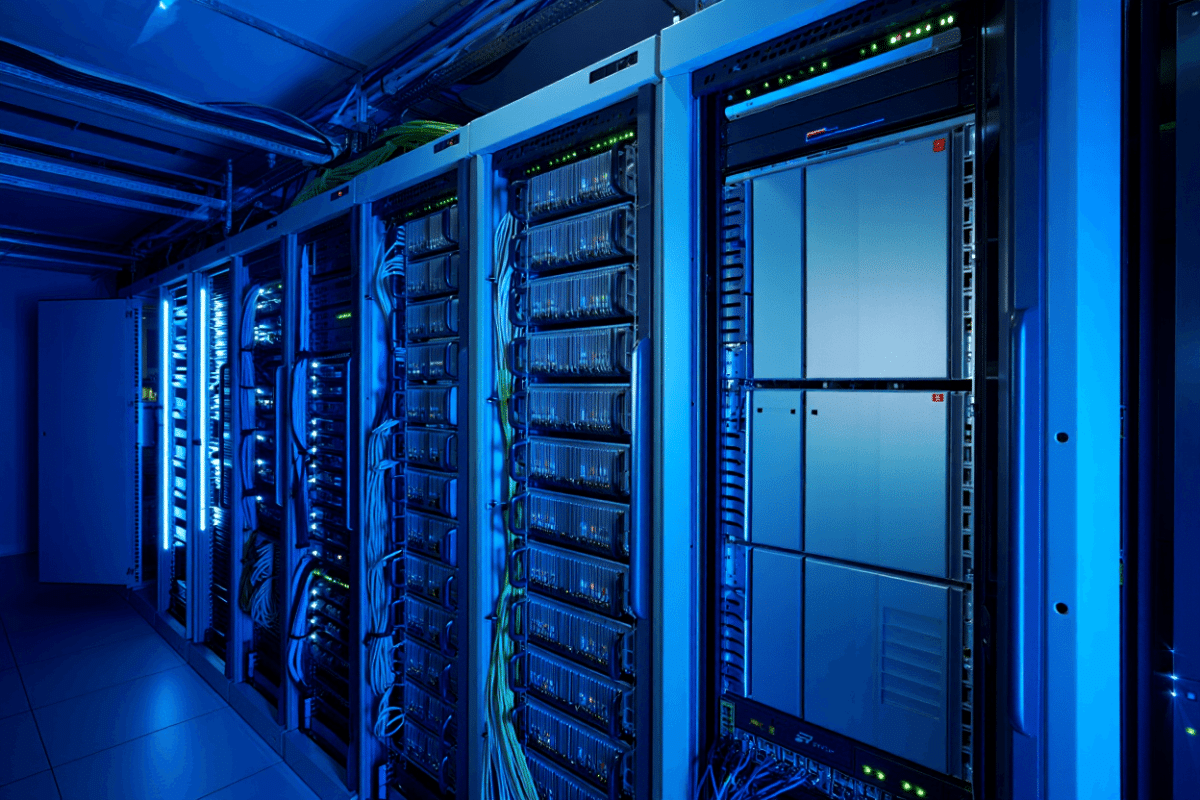
Dell Technologies has reached a 52-week high of $298.32, riding a powerful wave of AI infrastructure demand that is reshaping the company’s revenue trajectory. The stock has delivered a remarkable 167.69% return over the past 12 months, vastly outpacing the S&P 500’s 28.89% gain. With fiscal 2027 guidance projecting $50 billion in AI-optimized server revenue—doubling from the $25.2 billion shipped in fiscal 2026—Dell is positioned at the epicenter of enterprise AI adoption.
🔥 Quick Facts
- 52-week high: $298.32 (reached May 21-25, 2026)
- FY2027 guidance: $138-142 billion revenue (23% growth from FY2026’s $113.5 billion)
- AI server backlog: $43 billion (record-breaking capacity demand)
- FY2026 AI orders: $64.1 billion with $25.2 billion shipped
- Analyst consensus: Buy (80%) with 27% recommending Strong Buy
The AI Infrastructure Boom Transforms Dell’s Growth Profile
Dell’s surge from $106.38 (52-week low in September 2025) to near $298 reflects a fundamental shift in enterprise IT spending. The company reported fiscal 2026 revenue of $113.5 billion, up 19% year-over-year, driven almost entirely by explosive demand for AI-optimized servers. This is not typical data center growth—it represents a wholesale reallocation of capital toward hyperscale AI infrastructure from technology giants and emerging AI foundries.
Unlike previous PC-led cycles, Dell’s AI revenue stream is concentrated on high-margin enterprise servers and storage systems. The company has amassed a $43 billion backlog in AI orders, indicating that future quarterly revenue acceleration is already locked in. This provides rare visibility and confidence for long-term investors.
Doubling AI Server Revenue: The Path to $50 Billion
Management’s fiscal 2027 guidance reveals the scale of Dell’s opportunity: Ship $50 billion in AI-optimized server revenue annually, nearly double the $25.2 billion shipped in FY2026. To achieve this, Dell must scale manufacturing, supply chain coordination, and technical support across four major accelerator families: NVIDIA GPUs, AMD accelerators, Intel Gaudi, and proprietary solutions.
The company is not merely distributing AI chips—it is building the complete enterprise AI infrastructure stack. Recent partnerships reflect this strategy: Dell’s infrastructure partnerships with energy and cooling specialists address the critical bottleneck of power delivery and thermal management for dense AI cluster deployments.
In fiscal 2026, Dell’s gross margin remained strong despite supply constraints, suggesting that as manufacturing capacity expands, incremental profit margins could exceed historical levels.
Comparative Market Position: Dell vs. Semiconductor Supply Chain
Dell operates in a unique position: while chip makers like NVIDIA and AMD face allocation constraints, Dell aggregates these components into validated, production-ready systems. This systems integration advantage is critical because hyperscale operators and enterprises require plug-and-play AI clusters, not raw components.
| Metric | FY2026 Actual | FY2027 Guidance (Midpoint) | % Change |
| Total Revenue | $113.5B | $140.0B | +23% |
| AI Server Revenue | $25.2B | $50.0B | +98% |
| Q4 FY2026 Revenue | $33.4B (YoY +39%) | Est. $34.7-35.7B (Q1 FY27) | +3-7% |
| Q4 EPS Beat | $3.89 vs. $3.53 consensus | FY2026 Guidance: TBA | +10% |
| AI Orders Backlog | $43 billion | $50+ billion (Projected) | +16%+ |
“Dell Technologies is performing very well in 2025, with the company doubling its revenue growth projections for the next few years as AI infrastructure demand drives unprecedented orders and backlog acceleration.”
— Market analyst consensus, based on Dell’s February 2026 guidance revision
Why This Differs from Previous Tech Cycles
The historical pattern: Tech supercycles peak, inventory builds, margins compress, and growth stalls. Dell has lived through this cycle multiple times since 1984. However, the AI infrastructure buildout is structurally different for three reasons:
First, demand is not inventory-driven. Hyperscale cloud providers and enterprises are consuming AI chips and infrastructure at record rates, not stockpiling. Dell’s $43 billion backlog represents genuine deployment timelines, not speculative purchases.
Second, AI infrastructure is mission-critical. Unlike previous cycles where customers could delay refreshes, enterprises cannot delay AI deployment without risking competitive disadvantage. This creates inelastic demand and pricing power.
Third, Dell benefits from supply-side constraints. As semiconductor scarcity persists, Dell’s systems integration expertise becomes more valuable. The company can allocate scarce NVIDIA GPUs, AMD accelerators, and memory components across customer segments, extracting premium margins.
Risks and the $305 Question
The current $298 peak prices in significant success. For Dell to reach $305 and sustain it, several conditions must hold:
1. AI server revenue must track toward $50 billion (the 100% growth target). Any shortfall—whether from supply delays, demand softness, or competitive pressure—could trigger a sharp correction.
2. Gross margins must remain above 30%. As the company scales lower-margin server variants and competes for price-sensitive enterprise segments, margin compression is a real risk.
3. Competition from systems integrators and hyperscalers could intensify. Amazon, Google, and Microsoft now design custom AI chips and systems, potentially integrating backward to reduce Dell sales.
Despite these risks, the $298-305 range appears justified if FY2027 earnings per share exceed $10 (based on 20x forward earnings, a reasonable multiple for high-growth enterprise tech).
What Happens Next? The Critical Second Half of 2026
Dell’s next major catalyst is the May 2026 quarterly earnings call and subsequent Q1 FY2027 guidance updates. Investors will closely monitor three metrics:
1. AI server shipment growth – Must sustain quarter-over-quarter acceleration to support the $50 billion annual target.
2. Customer concentration – Excessive reliance on two or three hyperscale customers (Amazon, Google, Microsoft) increases execution risk.
3. Supply chain health – Can Dell source enough NVIDIA GPUs and AMD accelerators to meet the $43 billion backlog?
If Dell successfully navigates these questions through summer and fall 2026, the stock could maintain momentum toward $305+. If management signals any moderation in AI demand or supply constraints, expect a sharp pullback toward $250-260.
Sources
- Dell Technologies Investor Relations – Q4 FY2026 earnings, February 26, 2026
- Reuters – “Dell expects AI server revenue to double in fiscal 2027,” February 27, 2026
- Yahoo Finance – “With $50 Billion AI Revenue in Sight,” February 27, 2026
- Hyperframe Research – “Dell’s Record-Breaking Fiscal 2026 and the $50 Billion Strategic Shift,” February 27, 2026
- Macrotrends – “Dell 10-Year Stock Price History,” May 2026
- Tickeron – “Top Earnings Week: Dell, Salesforce & AI Stocks 2026,” May 25, 2026