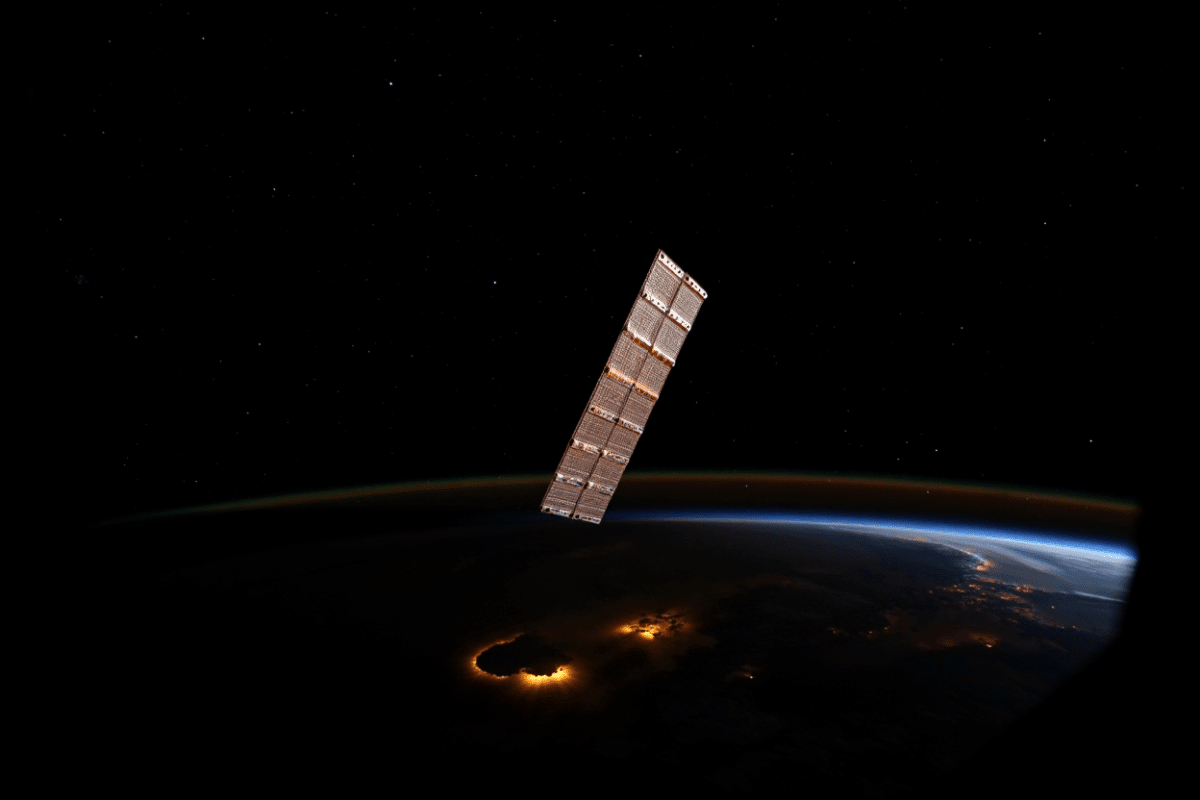
The Federal Communications Commission approved Reflect Orbital’s request to launch a mirror satellite that would reflect sunlight to Earth on July 9, marking the first regulatory green light for a company aiming to provide “sunlight on demand” from space.
Reflect Orbital of Hawthorne, California, received the FCC’s authorization to build, launch, and operate the experimental satellite Eärendil-1 in low Earth orbit. The company plans to launch the satellite by the end of 2026 using SpaceX’s Falcon 9 rocket, according to SpaceNews.
The satellite will carry an 18-meter (60-foot) square mirror and weigh 142 kilograms, according to SpaceNews. Once deployed at an altitude of 600 to 650 kilometers, the reflector will illuminate areas roughly 5 kilometers in diameter for brief periods, casting what the company describes as natural daylight conditions onto targeted ground locations.
Reflect Orbital argues the technology could extend solar power generation beyond sunset, support emergency response operations, and light remote industrial worksites. The company stated on its website that the reflected light would be “diffuse and nearly identical to natural daylight conditions” and would not involve concentrated solar power, lasers, or artificial lighting.
The company’s long-term vision is far more ambitious. Reflect Orbital aims to deploy 50,000 satellites by 2035, according to multiple sources including the European Southern Observatory and Space.com. The company received more than 260,000 customer inquiries before the FCC approval, according to reporting on the company’s venture capital interest.
The approval drew swift criticism from the astronomical and environmental communities. The American Astronomical Society, the Royal Astronomical Society, and DarkSky International all filed objections during the FCC’s regulatory review, which received nearly 2,000 public comments.
DarkSky International warned that the satellite poses risks to wildlife, astronomy, and human wellbeing. The organization stated that moving beams of light from space-based mirrors could create sudden flashes, glare, or sweeping illumination patterns if systems malfunction, posing risks to night vision, aircraft operations, and drivers. It also cautioned that reflected light could degrade nocturnal ecosystems, interrupt animal sleep cycles, and disrupt sensitive astronomical observations. According to the European Southern Observatory, if the company deploys its full constellation of 50,000 satellites, the night sky could become three to four times brighter overall.
DarkSky noted that the FCC concluded it lacks authority to evaluate the environmental impacts of orbital solar reflectors, limiting its review to radiofrequency spectrum issues. This regulatory gap, the organization argued, leaves critical concerns about wildlife, astronomy, public safety, and the nighttime environment largely unaddressed.
Space mirror concepts are not new. The idea was first theorized in 1923 by physicist Hermann Oberth, according to Wikipedia. In 1993, Russia launched Znamya 1, an experimental space mirror designed to test whether sunlight could be reflected to illuminate nighttime regions on Earth. The prototype was later abandoned due to technical challenges and international concerns.
Reflect Orbital stated in a company announcement that the ruling “reflects America’s leadership in testing innovative space technology” and that the company is “excited to validate the guardrails we have built into our technology to mindfully operate our test satellite.” The company emphasized that “being good stewards of space is critical to the success of this incredible technology.”
Sources
- The Hill — FCC approval on July 9, 2026, company statement, satellite specifications, and opposition from astronomical societies
- SpaceNews — Satellite weight (142 kg), orbital altitude (600-650 km), and planned launch timeline (end of 2026)
- Wired — Mirror size (18 meters) and illumination area (5-6 km diameter)
- Wikipedia — Space mirror concept history (first theorized 1923 by Hermann Oberth)
- European Southern Observatory — Full constellation impact on night sky brightness (three to four times brighter)
- Space.com — Company’s 50,000-satellite goal by 2035
- DarkSky International — Environmental and safety concerns, regulatory gaps