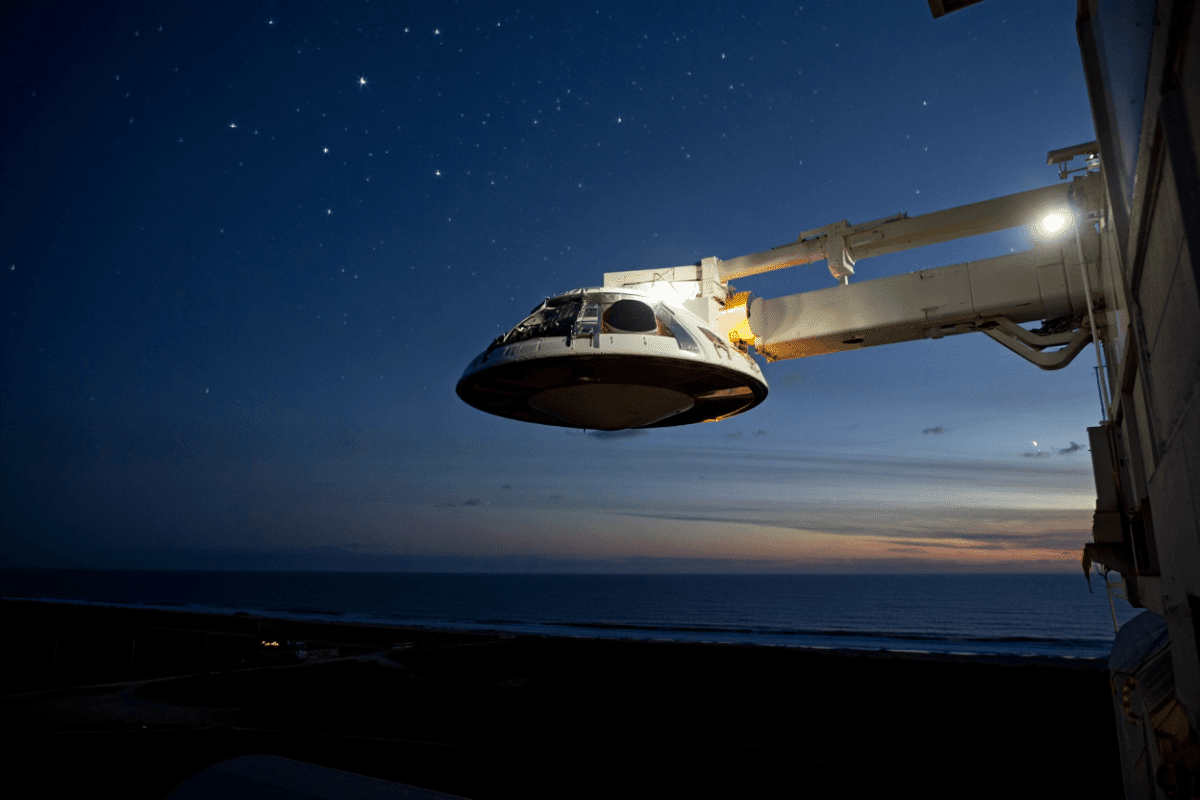
SpaceX is launching its first Starfall reentry capsule today from Cape Canaveral, testing a flat disk-shaped cargo return vehicle designed to revolutionize how goods move between orbit and Earth. The Falcon 9 rocket is scheduled to lift off at 6:43 a.m. EDT on June 23, 2026, from Space Launch Complex 40, carrying the uncrewed prototype on a demonstration mission that could reshape the economics of in-space manufacturing.
Starfall represents a departure from traditional conical spacecraft design. The vehicle measures 3.1 meters (10.2 feet) in diameter and just 0.75 meters (2.5 feet) tall, with a total dry mass of approximately 2,100 kilograms. It consists of two main parts: a 1,400-kilogram aluminum top plate and a 700-kilogram carbon-fiber heat shield. The capsule can carry up to 1,000 kilograms of payload in an internal bay measuring 2.5 by 1.5 by 0.5 meters, according to FAA regulatory documents.
The Federal Aviation Administration approved two Starfall reentry test flights in May 2026, concluding they would pose no significant environmental impacts. The approved landing zone sits in international waters in the Pacific Ocean, approximately 1,300 kilometers off the coasts of California and Mexico. After splashdown, the heat shield will jettison and recovery teams will retrieve the capsule by boat.
Unlike traditional cargo return vehicles, Starfall lacks a dedicated chemical propulsion system for independent deorbit maneuvers. Instead, the launch vehicle or an external kick-stage will push it into a reentry trajectory. Once descending, the capsule will use cold-gas nitrogen thrusters for attitude control and deploy pilot, drogue, and main parachutes to slow its descent. FCC filings reveal SpaceX will mount Starlink Earth stations directly onto the prototypes to test real-time telemetry streaming through the plasma blackout phase during reentry—a communications barrier that typically blocks signals.
SpaceX designed Starfall to enable two primary functions: point-to-point cargo delivery on rapid timelines and support for a self-sustaining commercial in-space manufacturing market. The FAA’s record of decision states the vehicle would “create a self-sustaining manufacturing economy in space” by offering access to microgravity, vacuum environments, loiter time on orbit, and safe return as a service at scale. The capsule is intended to serve as a “proliferated successor” to the International Space Station for commercial production, according to regulatory filings.
The project positions SpaceX in direct competition with companies that currently rely on its launch services. Varda Space Industries, which has flown six of its W-series spacecraft on SpaceX rideshare missions, performs microgravity research and manufacturing with capsules that have landed in Utah and Australia. Inversion Space flew its first reentry vehicle, Ray, on a SpaceX rideshare mission in 2025, and Atmos Space Cargo, a European startup, launched its first reentry vehicle on a SpaceX rideshare in 2025. By vertically integrating both the rocket and cargo return capsule, SpaceX can offer end-to-end orbital manufacturing logistics independent of third-party competitors.
Sources
- SpaceX — Official launch schedule and Starfall Demo Mission page confirming June 23, 2026 launch at 6:43 a.m. EDT from Cape Canaveral SLC-40
- SpaceNews — FAA environmental assessment and record of decision detailing Starfall specifications, payload capacity, propulsion design, and intended uses
- SatNews — FAA approval details, vehicle dimensions (3.1 m diameter, 0.75 m height), mass (2,100 kg), payload capacity (1,000 kg), and competitive market implications
- Space.com and Spaceflight Now — Launch window timing and Cape Canaveral location confirmation