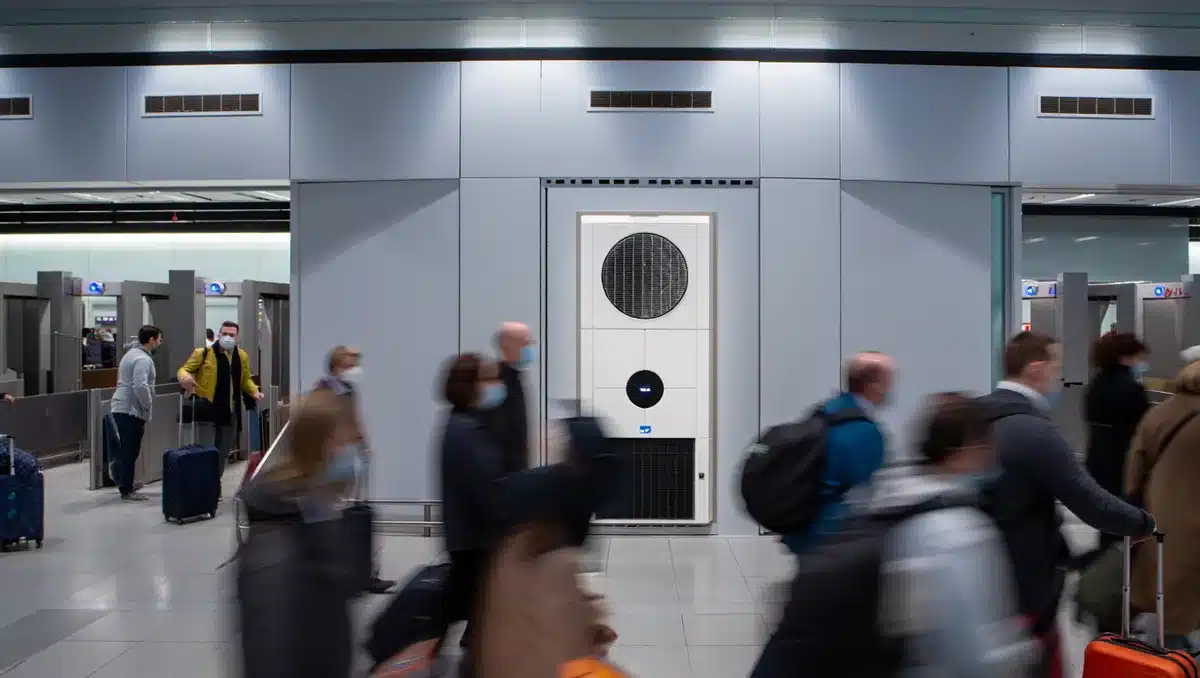
Miami International Airport has become the first U.S. airport to deploy a dual-layer air quality improvement system, combining localized air cleaners with advanced HVAC filtration technology to enhance indoor air quality for travelers and employees across its North Terminal.
The airport announced the deployment on August 7, 2026, installing C-POLAR’s patented NanoFlashing technology in a two-pronged approach. The system pairs InHalo art-integrated air cleaning units with VOLZ NanoFlashing HVAC filters that treat air through the terminal’s existing building systems.

Testing in both passenger terminal and office areas demonstrated the effectiveness of the approach, with results showing more than 75 percent reduction in airborne particulates and bioaerosols, according to Miami-Dade Aviation Department officials. The airport installed 50 InHalo units in waiting rooms and employee work areas earlier in 2026, with plans to deploy approximately 100 additional units across targeted passenger and employee spaces by the end of the year.
Miami-Dade County Mayor Daniella Levine Cava framed the initiative as part of the airport’s larger modernization effort. “As part of our $14 billion Modernization in Action Plan to holistically transform the airport experience over the next 5-10 years, we’re also improving the air quality for employees and visitors at MIA,” Cava said in a statement. “These innovative air filtration systems create a cleaner, healthier, and more welcoming airport, while enhancing its overall appearance and ambiance.”

C-POLAR Technologies CEO Ted Venners emphasized the dual-layer strategy as a model for other facilities. “We commend Miami International Airport for its vision and leadership in adopting C-POLAR’s patented NanoFlashing technology through two complementary deployment platforms,” Venners said. “By integrating NanoFlashing technology into both InHalo art-integrated air cleaners and VOLZ NanoFlashing Filters, MIA is demonstrating how a layered deployment strategy can enhance indoor environmental quality while creating a scalable model for airports and other large public facilities.”
The NanoFlashing technology functions as an electrostatic barrier designed to capture and reduce airborne pathogens and particulates. The dual-layer approach addresses air quality at two levels: localized cleaning in high-traffic waiting areas and filtration integrated into the terminal’s HVAC system, which recirculates air across the facility. North Terminal D, where the system is concentrated, handles significant international and connecting passenger traffic, making it a key focal point for the airport’s air quality investment.
Air quality improvements at airports have become increasingly important as travelers and workers spend extended periods in terminal environments. The Miami airport’s deployment reflects broader industry attention to indoor air quality, particularly following heightened awareness of airborne transmission concerns and passenger health expectations. The airport’s commitment to infrastructure upgrades positions it among leading facilities investing in passenger health and terminal environment standards.
Sources
- Miami International Airport Newsroom — Official announcement of dual-layer C-POLAR NanoFlashing air quality technology deployment, August 7, 2026, including Mayor Cava’s statement and deployment timeline
- Deep Arrival — Technical breakdown of the dual-layer system, test results showing 75% particulate and bioaerosol reduction, and C-POLAR CEO commentary
- FiltrSep — Confirmation of MIA as first U.S. airport to deploy dual-layer indoor air quality strategy using C-POLAR NanoFlashing technology, July 29, 2026