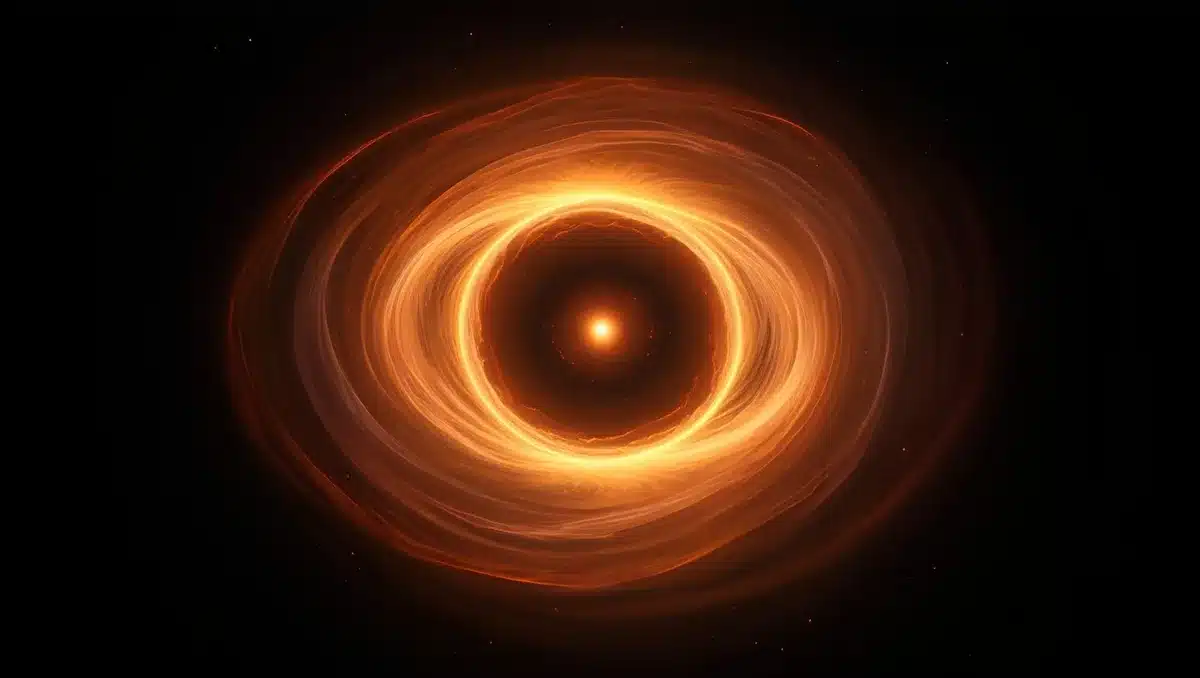
Astronomers have discovered the first direct evidence that a dying star’s pre-death mass loss can strangle its own gamma-ray burst, according to research published in August 2026 based on observations of supernova SN 2026gzf. The finding reshapes understanding of why some massive stellar explosions produce the universe’s most energetic jets while others fail, suggesting that circumstellar material built up years before the explosion, not just the star’s metallicity, determines whether a gamma-ray burst will form.
On March 21, 2026, the Einstein Probe detected a seven-minute burst of soft X-rays from a Wolf-Rayet star about 500 million light-years away, triggering a worldwide observing campaign. The initial X-ray flash, dubbed EP260321a, was the moment a shockwave burst through the star’s surface—a phenomenon called shock breakout that is expected in all supernovae but rarely observed because it lasts only seconds to hours. This was only the second confirmed X-ray shock breakout detected in over two decades of observations, the first being SN 2008D in 2008.
What made SN 2026gzf extraordinary was what followed the shock breakout. The explosion itself was energetic: it was a broad-lined Type Ic supernova with ejecta velocities above 30,000 kilometers per second and a kinetic energy of roughly 9.9×10⁵¹ ergs—figures that typically accompany gamma-ray bursts. Yet multiwavelength observations from NASA’s Chandra X-ray Observatory, the Very Large Array, and other facilities found no evidence of a relativistic jet, no gamma-ray burst, and no afterglow. “SN 2026gzf looks remarkably similar to other energetic supernovae that have been previously linked to gamma-ray bursts,” said Brendan O’Connor, lead author of one of two papers published in The Astrophysical Journal Letters. “Yet multiwavelength follow-up observations using the most sensitive facilities found no evidence for a relativistic jet or an afterglow.”
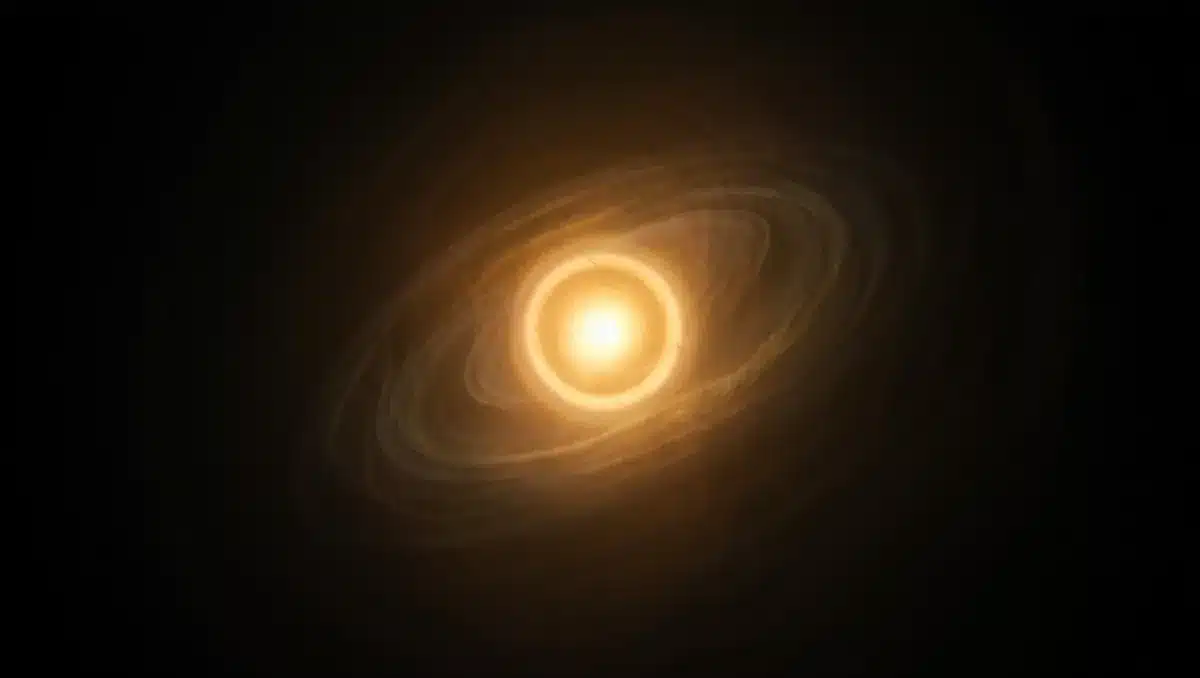
The key to understanding the suppressed gamma-ray burst lay in mapping the star’s environment before it died. Using archival imaging from the Dark Energy Camera going back to 2013, combined with recent data from the NSF-DOE Vera C. Rubin Observatory, researchers traced the progenitor’s violent final decade. The Wolf-Rayet star—a hydrogen-depleted stellar remnant born with about 20 times the Sun’s mass—underwent irregular, accelerating episodes of mass loss in its final years. These ejections created multiple shells of material surrounding the star: a compact inner shell extending to roughly 300 solar radii, and an extended, asymmetric outer shell further out.
When the star collapsed and launched its jet, that circumstellar material proved too dense to penetrate. The jet deposited its energy into a mildly relativistic cocoon instead of breaking free as a classical gamma-ray burst. Evidence from the observations suggests a jet did form—the explosion’s nickel-56 mass and ejecta composition matched those of GRB-associated supernovae, implying an accretion disk had formed around the newborn black hole. But the jet never escaped. Deep X-ray observations found no X-ray afterglow, and radio observations detected no source above detection limits, constraining any jet that formed to have a Lorentz factor below 30 and kinetic energy below 10⁴⁹ ergs—three to four orders of magnitude weaker than classical gamma-ray burst jets.
“This is the first time we’ve mapped out the pre-explosion environment of a star that has been stripped of hydrogen and helium,” said Gokul Srinivasaragavan, a member of the research team led by Jillian Rastinejad at the University of Maryland. “Going forward, I’m excited to observe more shock breakout events in similar detail to test if all stripped stars have a similar ‘lifestyle’ prior to collapse and what, if any, differences we see.”
The discovery challenges a long-standing assumption in the field: that metallicity—the abundance of heavy elements in a star’s environment—is the primary factor determining whether a massive star produces a gamma-ray burst. SN 2026gzf exploded in one of the most metal-poor environments ever measured for its class, with only 15 to 20 percent of the Sun’s metallicity, comparable to the Small Magellanic Cloud. Such metal-poor environments are thought to favor faster stellar rotation and gamma-ray burst formation. Yet no burst occurred. Instead, the deciding factor was the circumstellar structure built by the star’s own pre-death mass loss.
The finding positions SN 2026gzf as a unique bridge between ordinary supernova shock breakouts and the more extreme explosions that produce low-luminosity gamma-ray bursts. Researchers describe it as a new observational class: an energetic, stripped-envelope supernova with a detectable X-ray shock breakout and a luminous optical explosion, but no relativistic jet. As the Einstein Probe continues detecting X-ray transients and the Rubin Observatory generates thousands of alerts per night, additional events like SN 2026gzf are expected to be identified. A statistical sample of such events could allow astrophysicists to determine how commonly massive star deaths produce successful jets, choked jets, or no relativistic outflow at all—and whether the circumstellar structure built by pre-death mass loss is more predictive than metallicity alone in determining a gamma-ray burst’s fate.
Sources
- NOIRLab — Official announcement of SN 2026gzf shock breakout discovery, research team details, and observational methodology.
- Phys.org — Multi-wavelength observations, progenitor characterization as Wolf-Rayet star, and circumstellar shell structure.
- TechTimes — Pre-death mass loss timeline, jet choking mechanism, circumstellar material density analysis, and comparison to prior shock breakout SN 2008D.