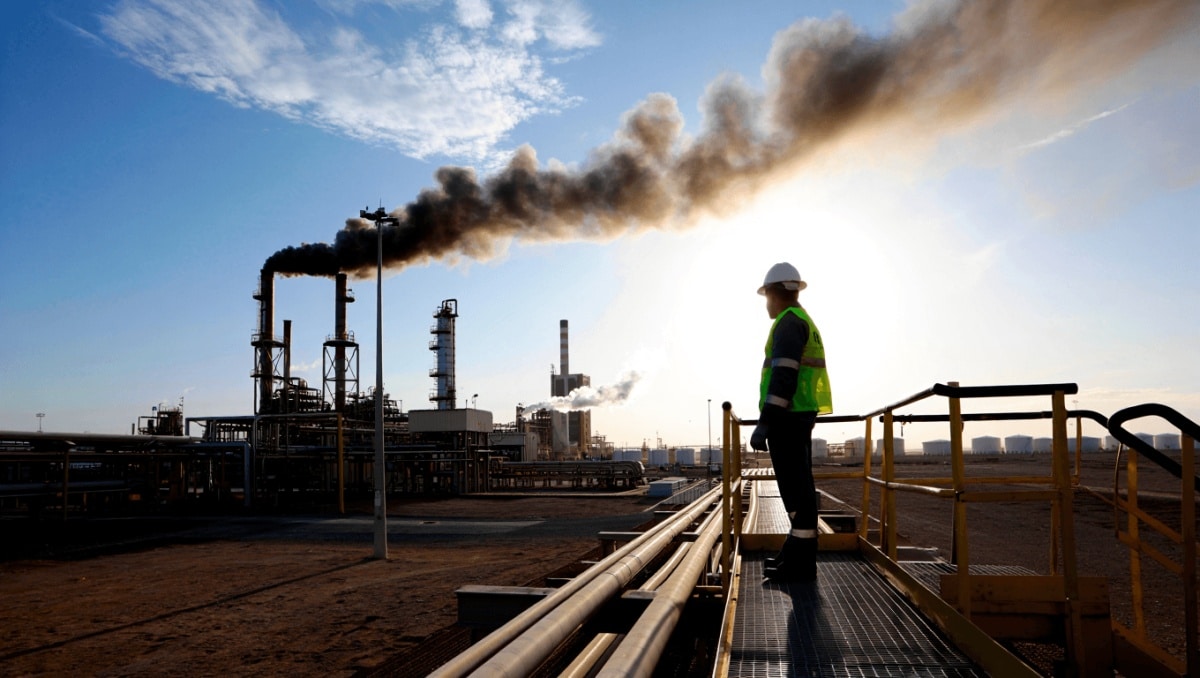
Rising tensions around Iran are already reshaping global energy markets and could lift inflation in the United States, complicating decisions at the Federal Reserve about whether and when to cut interest rates. New estimates from economists at Goldman Sachs show a range of possible oil-price and inflation outcomes depending on how long shipping through the Strait of Hormuz remains constrained.
Goldman Sachs models three main disruption scenarios, each with different implications for crude prices and consumer inflation. Under a limited-disruption baseline—where shipments stay very low for six weeks—the bank expects Brent crude to average about $105 a barrel in March and $115 in April before easing toward roughly $80 by late 2026. Longer or more destructive interruptions push those peaks substantially higher.
How high could crude go?
The analysis outlines two tougher outcomes: a 10-week stoppage would likely send Brent to about $140 at peak and keep prices near $100 into the fourth quarter of 2026. If flows are impaired for 10 weeks and oil infrastructure suffers lasting damage, Brent could spike toward $160 before settling closer to $115 in late 2026.
Goldman’s team notes that most of the immediate inflation pressure would come from higher energy costs, particularly transport. Their estimates imply that each 10% rise in crude translates into around a 0.2 percentage-point upward move in headline PCE inflation and roughly 0.04 percentage point in core PCE—figures that feed directly into consumers’ pocketbooks and into the Fed’s policy calculus.
Wider price effects and the Fed’s dilemma
Beyond gasoline, disruptions in Gulf exports could lift prices for other commodities. The bank flags fertilizers as a channel to higher food costs, estimating fertilizers could lift food prices by about 1.5% this year—adding roughly 0.1 percentage point to headline inflation.
There are also potential second-round effects. If inflation expectations drift up, Goldman estimates an additional increase to inflation of about 0.1 percentage point by end-2026 in its baseline scenario, or 0.4 percentage point in a severely adverse outcome.
- Baseline: December 2026 headline PCE rises to about 3.1% (0.2pp higher than prior estimates); core PCE around 2.5%.
- Adverse (10-week disruption): headline PCE peaks near 4.6% in spring and ends 2026 at 3.6%; core PCE about 2.6%.
- Severely adverse (10 weeks + infrastructure damage): headline PCE peaks near 4.9% and finishes 2026 around 4.0%; core PCE about 2.6%.
Those estimates arrive as January’s official readings already showed headline PCE up about 2.8% year-over-year and core PCE at roughly 3.1%—both above the Fed’s long-run 2% target. That gap helps explain why policymakers passed on rate cuts at their recent meetings.
Economic growth and recession odds
Goldman also trimmed its growth outlook. Under the baseline disruption, fourth-quarter-to-fourth-quarter GDP growth in 2026 is now seen near 2.1% (about 2.4% on a full-year basis previously). The adverse and severely adverse paths cut that to roughly 1.9% and 1.8%, respectively.
The bank raised its estimated chance of a U.S. recession in the next 12 months by 5 percentage points to about 30%, reflecting the combination of higher inflation and slower growth in the tougher scenarios.
Despite these revisions, Goldman did not change its baseline timetable for Fed rate cuts: two quarter-point reductions expected in September and December of 2026. Still, the firm now assigns a somewhat higher probability that the Fed will hold policy steady through the year (up to about 25%) and lowered the odds of precautionary “insurance” cuts (now about 10%), given the inflationary pressures it forecasts.
For consumers and markets, the takeaway is straightforward: even a temporary squeeze on Middle East oil flows can ripple through prices, economic growth and central-bank decisions. How long the disruptions last—and whether they damage production infrastructure—will determine how large and persistent those effects are.