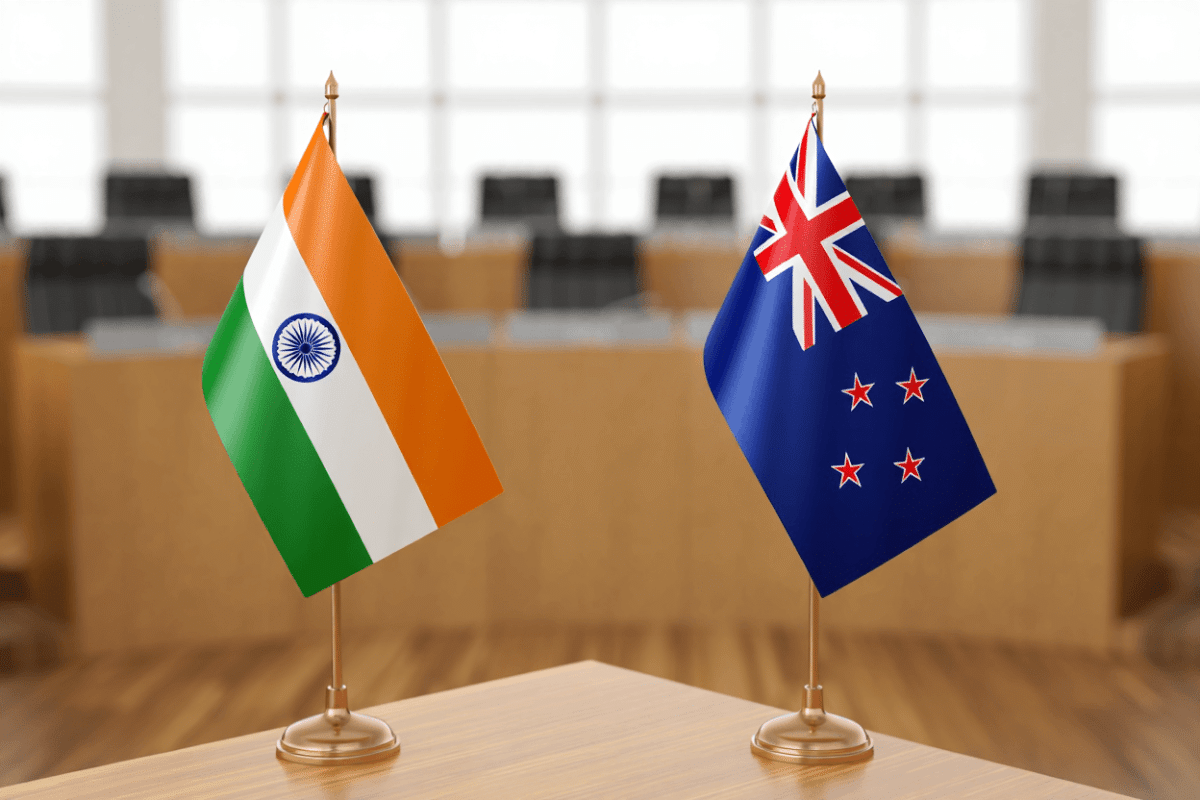
India and New Zealand elevated their bilateral ties to a strategic partnership on July 11, 2026, marking a historic milestone during Prime Minister Narendra Modi’s first official visit to the country in 40 years. The two nations signed 18 outcomes across defence, trade, security, and maritime cooperation, and agreed to double bilateral two-way trade to NZ$7 billion (approximately ₹35,000 crore) by 2030.
Modi’s visit to Auckland came at the invitation of New Zealand Prime Minister Christopher Luxon and represented the first visit by an Indian PM to the country since 1986. During bilateral discussions, the two leaders endorsed the India-New Zealand Strategic Partnership: Roadmap to 2030 as a framework to guide joint action over the next four years.
Defence and Maritime Cooperation
The strategic partnership centred heavily on strengthening defence and security ties. India and New Zealand signed a Maritime Cooperation Arrangement alongside an Implementing Arrangement on Cooperation in Matters of Hydrography and Nautical Cartography. A Mutual Logistics Support Arrangement focused on the maritime domain was also concluded, allowing both nations’ forces to use each other’s bases and facilities for refuelling, repairs, and replenishment during operations.
The two countries established an annual Maritime Security Dialogue to strengthen cooperation, coordination, and information exchange. As maritime nations with shared interests in a free, open, and peaceful Indo-Pacific, both sides agreed to strengthen cooperation including through bilateral naval exercises. India welcomed New Zealand’s nomination of Maritime Security as its priority pillar under the Indo-Pacific Oceans Initiative.
The Prime Ministers welcomed progress in defence cooperation, including implementation of the 2025 India-New Zealand Memorandum of Understanding on Defence Cooperation. They reaffirmed their shared commitment to countering terrorism, cyber security, and organised crime, including illicit drug trafficking and people smuggling.
Trade and Economic Expansion
The two leaders welcomed the conclusion and signature of the India-New Zealand Free Trade Agreement, which they agreed to work toward implementing. The FTA ensures 100 per cent duty-free access for Indian exports across 8,284 tariff lines. The ambitious goal of doubling bilateral trade reflects recognition that significant room for growth exists in the economic relationship.
The partnership extends to agriculture, where cooperation draws on New Zealand’s expertise in productivity, food safety, sustainability, and value chain development. The two countries welcomed an Agricultural Productivity Partnership under the FTA as a key platform for practical cooperation, including work on kiwifruit, apples, and honey production. A Memorandum of Cooperation on Animal Husbandry and Dairying was also concluded.
Tourism was recognised as a tool for economic growth and cultural understanding, with the two nations signing a Memorandum of Arrangement on Tourism. The Prime Ministers again encouraged airlines to commence direct non-stop flights between India and New Zealand.
Broader Strategic Engagement
The two leaders agreed to establish a regular Foreign Ministers’ Dialogue and consolidate annual senior officials’ meetings between India’s Ministry of External Affairs and New Zealand’s Ministry of Foreign Affairs and Trade to provide strategic guidance and review progress under the 2030 roadmap.
On regional and multilateral matters, both sides reaffirmed their commitment to a free, open, peaceful, and prosperous Indo-Pacific region where sovereignty is respected and the rules-based international order is upheld. They emphasised the importance of working together toward security and prosperity in the region. New Zealand reaffirmed its support for India’s permanent membership of a reformed and expanded United Nations Security Council.
The partnership also encompasses education, research, science, and technology cooperation. The Prime Ministers recognised education as a central pillar, encouraging government officials, institutions, and industry to scope partnerships in agriculture, climate, digital transformation, and innovation. They welcomed the growing connections between educational institutions and agreed to strengthen cooperation in ways that support student mobility and institutional partnerships.
Sources
- Ministry of External Affairs — India-New Zealand Joint Statement (July 11, 2026), official bilateral document detailing all outcomes and agreements
- The Times of India — Coverage of 18 pacts signed across defence, trade, and security; trade target of ₹35,000 crore by 2030
- The New Indian Express — Details on maritime and defence initiatives, FTA implementation, and outcomes announced
- RNZ — Confirmation of Modi’s first official visit to New Zealand in 40 years, July 10-11, 2026
- Bloomberg — Reporting on strategic partnership elevation and maritime security cooperation framework