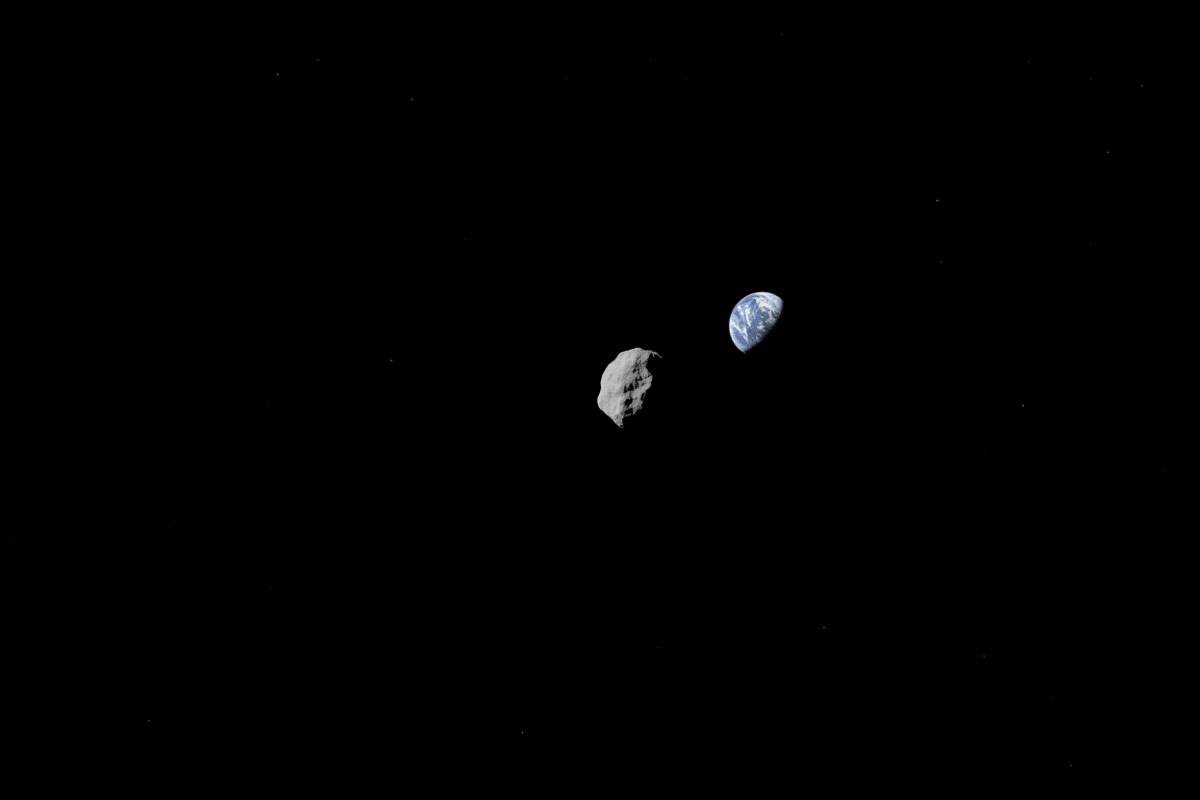
Earth’s quasi-moon 2025 PN7 will continue its synchronized orbit alongside our planet until approximately 2083, according to astronomers who discovered the 19-meter-wide asteroid on August 2, 2025, using the Pan-STARRS1 telescope in Hawaii.
The asteroid, which belongs to the Arjuna group of near-Earth objects, has been traveling with Earth since the 1960s in what scientists call a quasi-satellite orbit. Unlike Earth’s true Moon, 2025 PN7 orbits the Sun rather than being gravitationally bound to our planet, creating the illusion from our perspective that it circles Earth.
The discovery reveals that 2025 PN7 is exceedingly dim—magnitude 26—making it entirely invisible to the naked eye and detectable only through professional observatories during rare alignment windows. At its closest approach, the asteroid comes within about 4 million kilometers (2.5 million miles) of Earth, roughly 10 times the distance to our actual Moon, and poses no threat to our planet.
Quasi-moons like 2025 PN7 belong to a special class of asteroids that share nearly identical orbits with Earth around the Sun. Over time, its orbital path shifts between a “quasi-satellite” state and a “horseshoe” orbit, where it appears to trace a horseshoe shape in the sky from Earth’s perspective. The Arjuna asteroid group contains more than a hundred known members, though only a handful have entered this co-orbital pattern with Earth.
The phenomenon is rare enough that astronomers have identified only about eight quasi-moons total. Another well-known example is Kamoʻoalewa, which China’s Tianwen-2 spacecraft recently visited, offering scientists a rare opportunity to study these enigmatic companions. Kamoʻoalewa, discovered in 2016, is thought to possibly be a fragment ejected from the Moon itself, while 2025 PN7’s composition suggests a different origin.
When 2025 PN7 eventually departs Earth’s vicinity around 2083, it will be tugged away by gravitational forces and resume a more solitary orbit around the Sun. Until then, this tiny silent traveler will remain one of Earth’s most elusive celestial neighbors, a reminder that our planet’s cosmic company extends far beyond the Moon.
Sources
- Liberty Science Center — confirmed 2025 PN7 will remain a quasi-moon until 2083 and provided size and distance details
- Wikipedia — documented first observation on August 2, 2025, by Pan-STARRS 1 at Haleakala Observatory
- IOPscience — peer-reviewed research paper on 2025 PN7 as newest Arjuna quasi-satellite
- EarthSky — described orbital dynamics, Arjuna group membership, and horseshoe orbit pattern
- Northeastern Global News — reported NASA confirmation and existence of at least six other quasi-moons
- The New York Times — provided distance measurement and historical orbital data
- DOGO News — confirmed discovery date and visibility characteristics