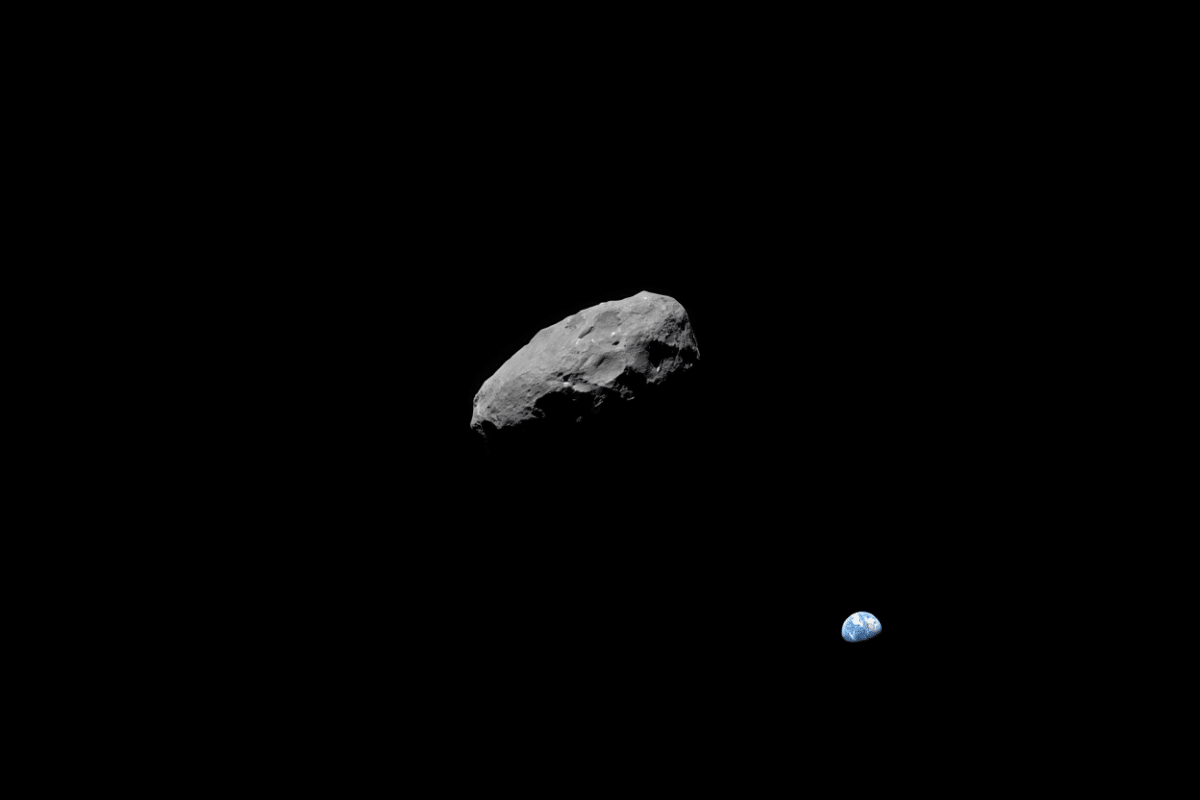
China’s Tianwen-2 spacecraft released the first close-up photograph of Kamoʻoalewa, Earth’s quasi-moon, on July 2, 2026, after traveling 620 million miles over 400 days through space. The image, captured from approximately 12 miles (20 kilometers) away, marks the first time any spacecraft has photographed this rare near-Earth asteroid in detail.
Kamoʻoalewa was discovered by the Pan-STARRS survey telescope in Hawaii on April 27, 2016, and given a Hawaiian name meaning “oscillating celestial fragment.” The asteroid is between 40 and 100 meters across and rotates once every 27 to 30.5 minutes, making it a fast spinner. Unlike Earth’s moon, Kamoʻoalewa is not gravitationally bound to our planet—instead, it orbits the Sun while maintaining a close orbital path that keeps it roughly 9 million miles away, classifying it as one of only seven known Earth quasi-satellites.
The Tianwen-2 mission, which launched from the Xichang Satellite Launch Center on May 29, 2025, represents China’s first spacecraft to reach a quasi-satellite and the first to attempt collecting samples from one. The China National Space Administration announced the spacecraft’s arrival on July 6, 2026, following a series of approach maneuvers and course corrections that brought it from initial detection on June 6 to the close-up imaging distance by July 2.
Scientists have long speculated that Kamoʻoalewa may be a fragment of Earth’s moon. In 2021, researchers found that the asteroid’s composition matched lunar rocks collected during NASA’s Apollo missions. A 2024 study suggested the asteroid could have been ejected from the Moon by the same impact that created the Giordano Bruno crater between 1 million and 10 million years ago. If confirmed through sample analysis, Kamoʻoalewa would represent a piece of lunar material that has been traveling through space independently for millions of years.
Tianwen-2 carries 11 scientific instruments, including cameras, spectrometers, radars, a magnetometer, and particle analyzers. The spacecraft will conduct a detailed survey of the asteroid at progressively closer distances—approaching to about 1.9 miles, then 600 meters, and finally 300 meters—to build a detailed map and select optimal sampling sites. The mission is equipped with three different sampling techniques to handle various surface conditions: hovering above the surface to collect particles, brief touch-and-go contact with a gas-driven sampling head, and anchoring to the asteroid for harder terrain.
The spacecraft is expected to collect between 20 and 100 milligrams of material from Kamoʻoalewa’s surface and return it to Earth in April 2027. After completing its work at the quasi-moon—a process expected to take roughly 2.5 years—Tianwen-2 will continue toward 311P, a main-belt comet beyond Mars, making it the first mission to visit both an asteroid and a main-belt comet if successful. The total mission duration is expected to span roughly a decade.
Sources
- Discover Magazine — detailed mission timeline, spacecraft specifications, and sampling methodology
- Gizmodo — Kamoʻoalewa composition analysis, lunar origin theory, and sampling techniques
- Wikipedia — mission arrival date and quasi-satellite orbit details