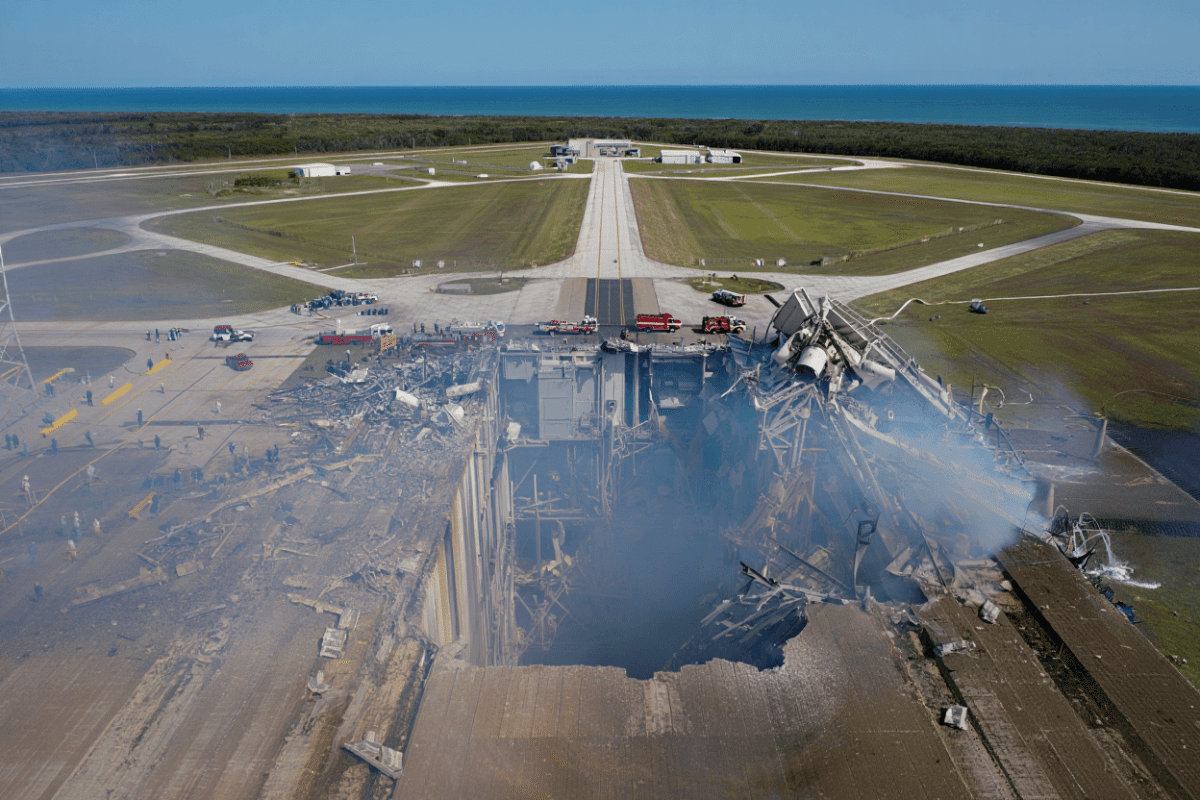
Blue Origin’s New Glenn rocket experienced a catastrophic structural failure on May 29, 2026, exploding during a pre-flight hotfire test at Launch Complex 36 near Cape Canaveral, Florida. The incident occurred at approximately 9:00 PM Eastern Time, destroying the 320-foot booster and damaging launchpad infrastructure. No personnel were present during the unmanned test, and no injuries were reported. The explosion marks Blue Origin’s first catastrophic launch failure since commercial operations began.
🔥 Quick Facts
- New Glenn orbital booster destroyed during hotfire engine-firing test on May 29, 2026
- 320-foot rocket destroyed at Space Launch Complex 36, Cape Canaveral Space Force Station
- Blue Origin calls incident an “anomaly” but confirms total loss of the launch vehicle
- No injuries reported — all personnel secured in safe zone before test began
- This is Blue Origin’s second setback in five months after April engine failure left satellite in wrong orbit
What Happened: The Hotfire Test Failure
A hotfire test — also called a static fire or integrated launch vehicle test — is a critical pre-flight procedure where engineers ignite rocket engines while the vehicle remains bolted to the launch pad. The test validates engine performance, fuel systems, avionics, and structural integrity before actual launch. Blue Origin had scheduled this test in preparation for a Telesat internet satellite mission on Late May 2026.
According to U.S. Space Force officials, the New Glenn booster experienced an uncontrolled structural malfunction seconds after engine ignition. Telemetry data indicates the vehicle’s structural systems failed catastrophically, triggering a massive detonation visible for miles. A fireball engulfed the launchpad, lighting the night sky across Florida’s Space Coast. Safety personnel had evacuated the launch area before the test commenced, following standard protocol for uncrewed engine tests at this magnitude.
The New Glenn Program: Context and History
New Glenn represents Blue Origin’s most ambitious rocket to date, designed to compete with SpaceX’s Falcon 9 and Heavy Lift Launch Systems. The booster stands 320 feet tall and features seven BE-4 engines producing approximately 3.85 million pounds of thrust. The vehicle was engineered to carry 45-metric-ton payloads to low Earth orbit, with plans for geosynchronous orbit and beyond Earth orbit missions.
New Glenn’s commercial deployment timeline has faced multiple delays and technical challenges, with the program now spanning over four years of development. The rocket completed successful hotfire tests in December 2024 and launched three operational missions through April 2026 — indicating the May 29 test represented a new build or refurbished vehicle, not a flight-proven booster.
Technical Analysis: Possible Failure Modes
While Blue Origin has not disclosed the root cause, aerospace engineers point to three primary failure mechanisms in liquid-fueled rockets during hotfire tests: combustion instability in the engine nozzle, structural load mismanagement in the interstage connector, or flight termination system failure during an anomalous power surge. The explosion’s violence — visible in footage from over 20 miles away — suggests the vehicle’s internal tanks ruptured catastrophically rather than a controlled shutdown.
| Aspect | Details |
| Vehicle | New Glenn orbital booster (first stage) |
| Location | Launch Complex 36, Cape Canaveral Space Force Station |
| Test Type | Hotfire (integrated launch vehicle engine test) |
| Date & Time | May 29, 2026 at 9:00 PM ET |
| Personnel on Pad | None (unmanned test) |
| Injuries | Zero |
| Result | Total loss of vehicle; launchpad damage assessed |
“We experienced an anomaly during our hotfire test. All personnel were safely secured in designated areas, and there were no injuries. We are conducting a comprehensive investigation into the root cause.”
— Blue Origin Official Statement, representing company leadership
Industry Implications: How This Impacts Competitors and NASA
Blue Origin’s setback ripples across the commercial space industry. The company had been positioning New Glenn as a critical alternative to SpaceX’s Falcon 9 for government contracts, including NASA’s Artemis Moon program and U.S. Space Force missions. Several satellites and payloads awaiting launch have now entered scheduling limbo. Blue Origin’s path toward external funding and potential public ownership has been complicated by questions over technical execution.
The failure also affects United Launch Alliance (ULA), which intends to use Blue Origin’s BE-4 engines on its next-generation Vulcan rocket. While ULA’s engines are manufactured separately, scrutiny of BE-4 reliability will intensify. Additionally, Amazon’s Project Kuiper satellite internet constellation — also owned by Jeff Bezos — depends on New Glenn launches, adding financial pressure to Blue Origin’s recovery timeline.
What Comes Next: Recovery Timeline and Investigation
Investigation teams will dissect telemetry records, video analysis, and remaining hardware fragments to identify system failures. NASA and the U.S. Space Force typically coordinate with companies on anomaly investigations for Launch Complex 36 operations. Historical precedent suggests 3-6 months for detailed failure analysis on hotfire tests, followed by 6-12 months for corrective redesign and validation. Blue Origin’s planned $600M rocket manufacturing expansion at Cape Canaveral may now face delays or budget reallocation toward incident recovery.
The company faces critical decisions: whether to rebuild the lost vehicle, modify designs based on investigation findings, or accelerate alternative launch pad readiness at other facilities. Bezos and Blue Origin leadership have historically prioritized engineering resilience over speed, suggesting a thorough rather than rushed recovery process.
How Will This Shape the Future of Commercial Spaceflight?
The New Glenn failure underscores a fundamental reality: developing operational heavy-lift rockets remains extraordinarily difficult, even for well-funded companies. While SpaceX achieved reusable Falcon 9 flights after multiple failures between 2006-2015, and while space is inherently risky, investors and government agencies will scrutinize Blue Origin’s technical roadmap more closely. The company’s ability to maintain customer confidence — and launch cadence — now depends entirely on transparent investigation findings and credible corrective actions. Will the company emerge stronger, or does this failure accelerate questions about Blue Origin’s competitive trajectory?
Sources
- CNN — Real-time coverage and U.S. Space Force confirmation of anomaly
- BBC News — Engineering analysis and industry impact assessment
- Reuters — Blue Origin official statements and timeline
- Spaceflight Now — Technical specifications and mission history for New Glenn program
- Al Jazeera — International perspective and satellite imagery
- The Guardian — Industry context and funding implications
- The New York Times — Breaking news and subsequent analysis
- Florida Today — Local reporting and launch complex operational details