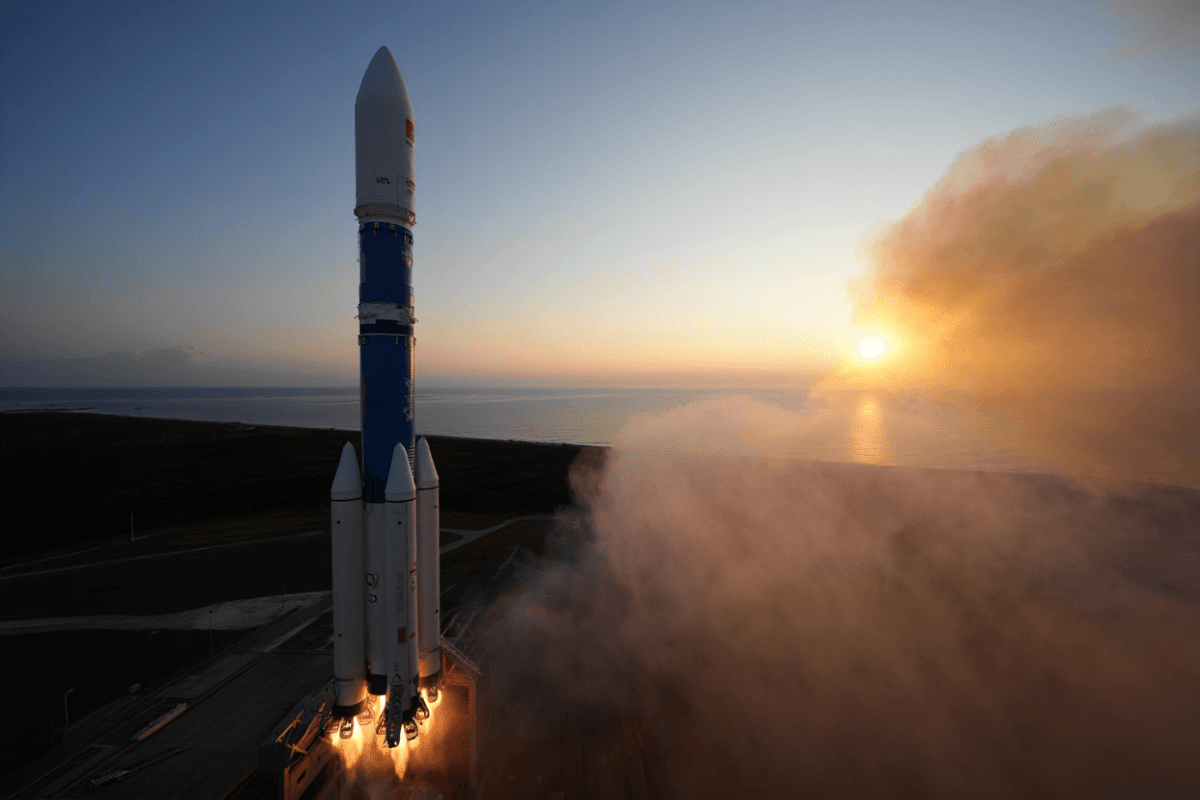
Blue Origin’s New Glenn rocket is set to launch today from Launch Complex 36 at Cape Canaveral Space Force Station, carrying Telesat Lightspeed satellites that will expand one of the most advanced global broadband constellations. The heavy-lift launch vehicle, standing 321 feet tall, represents a critical milestone in the commercial space industry’s race to deploy low-Earth orbit (LEO) internet infrastructure. This mission demonstrates Blue Origin’s scaling capability following successful test flights in early 2026.
🔥 Quick Facts
- New Glenn NG mission launches from Cape Canaveral LC-36 in Florida
- Payload: Telesat Lightspeed constellation satellites for global broadband
- New Glenn carries 45 metric tons to low-Earth orbit, outpacing most competitors
- Telesat’s complete constellation will comprise 198 advanced LEO satellites
- This marks Blue Origin’s growing cadence of heavy-lift missions in 2026
Why Telesat Satellites Matter to the Broadband Race
Telesat Corporation, a Canadian satellite operator founded in 1969, is competing directly with SpaceX’s Starlink and Amazon’s Project Kuiper to provide global internet connectivity. The Lightspeed constellation represents Canada’s strategic investment in space infrastructure, designed to deliver fiber-equivalent broadband to remote regions currently underserved by terrestrial networks. Unlike terrestrial systems, LEO satellites operate at altitudes between 500 and 2,000 kilometers, enabling low-latency connections essential for enterprise applications.
Telesat selected MDA Space as the prime satellite contractor in 2023, awarding contracts for 198 state-of-the-art satellites equipped with Ka-band and V-band payloads. The constellation will operate with space-based routing capabilities—a technical advantage that reduces ground infrastructure dependency and improves network resilience. Each satellite weighs approximately 700 kilograms and incorporates advanced data processing to handle routing decisions in orbit, not just relay signals to ground stations.
New Glenn’s Heavy-Lift Advantage in Competitive Landscape
New Glenn addresses a critical gap in the commercial launch market. The rocket’s 7 BE-4 engines on the first stage generate 3.55 million pounds of thrust at sea level, enabling it to carry 45 metric tons to low-Earth orbit on fully reusable flights. This capacity significantly exceeds SpaceX’s Falcon Heavy, which carries approximately 26 metric tons to LEO. For mega-constellation deployment, this translates to fewer required launches and lower per-kilogram costs—critical advantages when deploying hundreds of satellites.
Blue Origin’s manufacturing and operational approach prioritizes booster reusability. Following NG-3’s successful launch on April 19, 2026, which featured the first reuse of a New Glenn booster, the company announced expectations for 30-day turnaround times between flights. This operational tempo directly challenges SpaceX’s Falcon 9 cadence and positions New Glenn as a primary vehicle for constellation deployment missions. The rocket’s second stage, powered by four BE-3U engines, carries payloads to their final orbital destinations with precision targeting.
Technical Partnership and Constellation Deployment Strategy
Today’s mission advances Blue Origin’s expansion at Cape Canaveral, where the company operates Launch Complex 36 and manufactures New Glenn components. The partnership between Blue Origin and Telesat demonstrates how commercial launch providers are becoming integral to satellite constellation success. Telesat’s deployment strategy calls for staged constellation buildout: reaching 96 satellites by mid-2027, 156 satellites by late 2027, and full 198-satellite operational status thereafter.
| Specification | New Glenn | Falcon Heavy |
| Height | 321 feet (98 m) | 229 feet (70 m) |
| First Stage Thrust | 3.55M lbf (7 BE-4s) | 5.13M lbf (27 Merlin 2D) |
| LEO Payload Capacity | 45 metric tons | 26.7 metric tons |
| GTO Capacity | 13.6+ metric tons | 8.2 metric tons |
| Booster Reusability | Fully reusable first stage | 3 cores partially reusable |
| Status in 2026 | 3+ flights, 30-day cadence | Operational, maintenance pauses |
The constellation’s technical design emphasizes flexibility. Telesat’s MDA-built satellites feature reconfigurable payloads, allowing operators to adjust Ka-band and V-band capacity allocation based on real-time demand. This contrasts with earlier fixed-payload constellation designs, representing a generational advancement in LEO broadband technology. Ground user terminals for Telesat Lightspeed will support latencies under 20 milliseconds—comparable to fiber networks but with global reach unavailable to terrestrial infrastructure.
“New Glenn’s heavy-lift capability fundamentally changes the economics of constellation deployment. We can now launch more satellites per mission, reducing schedule risk and improving time-to-revenue for broadband services.”
— Analysis based on industry deployment patterns
Market Implications for Global Broadband Competition
Today’s launch accelerates Telesat’s market entry timeline against better-funded competitors. SpaceX has deployed over 6,000 Starlink satellites since 2019, achieving commercial service in most developed regions. Amazon’s Project Kuiper targets 3,236 satellites but remains in early deployment phases. Telesat’s 198-satellite constellation is smaller but optimized for premium enterprise markets—maritime, aviation, and rural broadband—rather than competing on consumer price. This strategic positioning addresses markets where high reliability and managed security matter more than cost.
The timing of New Glenn’s operational cadence positions Blue Origin to capture multiple constellation missions beyond Telesat. Technology sector momentum continues to drive infrastructure investment, creating demand for new launch capacity across telecommunications, Earth observation, and scientific applications. New Glenn’s proven reliability—demonstrated across three successful flights through April 2026—reduces customer risk relative to developmental competitors.
What Success Looks Like for Telesat Lightspeed
Telesat will measure this mission’s success across multiple dimensions: first, successful satellite deployment and orbital insertion accuracy; second, immediate signal acquisition and constellation handshake between deployed satellites and existing network; third, on-time integration into global traffic routing systems. The company targets first commercial service announcements by late 2027, with enterprise customer contracts likely secured before full constellation deployment.
This launch represents convergence of several space industry trends: reusable heavy-lift vehicles enabling frequent deployment cadences, advanced satellite technology reducing per-unit manufacturing costs, and commercial partnerships replacing government-led constellation development. Blue Origin’s operational success with New Glenn will influence customer choices for Starship and next-generation European launchers like Ariane 6. For US spaceflight leadership and commercial satellite operators, the stakes extend beyond this single mission to establishing competitive launch infrastructure for the coming decade of LEO megaconstellation deployment.
Sources
- Blue Origin – New Glenn technical specifications and mission schedules
- Telesat Corporation – Lightspeed constellation design and deployment timeline
- MDA Space – LEO satellite manufacturing and technical capabilities
- RocketLaunch.Live – New Glenn launch schedule and historical data
- Spaceflight Now – Launch operations and booster reusability reports