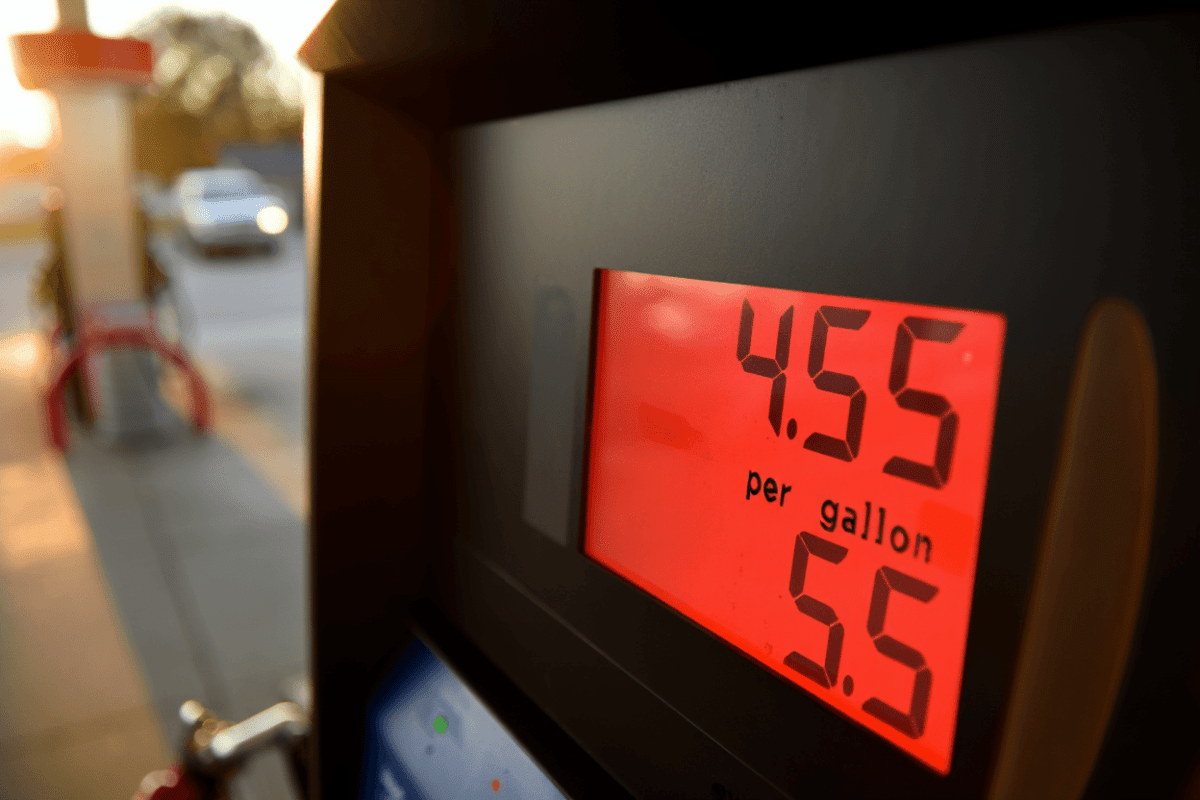
Gasoline prices have surged to $4.55 per gallon nationwide as of May 22, 2026, marking a significant acceleration toward the summer driving season. The 43.6% year-over-year increase since May 2025 reflects geopolitical tensions in the Middle East, particularly clashes near the Strait of Hormuz, which handles roughly 20% of global oil trade. Industry analysts now forecast an even higher summer average of $4.80 per gallon from Memorial Day through Labor Day, potentially hitting the highest seasonal prices in years.
🔥 Quick Facts
- National average gas price on May 22, 2026: $4.55 per gallon
- GasBuddy summer forecast: $4.80 average from Memorial Day to Labor Day
- Year-over-year increase: 43.6% (from $3.14 on May 12, 2025)
- Highest state: California at $6.147; lowest: Mississippi at $3.998
- Energy inflation surged 17.9% year-over-year in April 2026
Understanding the Current Fuel Crisis
Gasoline prices have risen sharply across all 50 U.S. states as of late May 2026, with no state remaining below the $4.00 mark. This represents a historic threshold—for the first time since 2022, gas is uniformly expensive across the nation. The current spike follows a $1.40 increase over 12 months, according to AAA data, signaling sustained pressure on American household budgets during peak travel season.
The primary driver remains geopolitical instability in the Middle East. In early May 2026, clashes between the United States and Iran near the Strait of Hormuz triggered immediate 8% jumps in crude oil futures, with Brent crude rising from $71.32 to $77.24 per barrel in March alone. Subsequent developments pushed Brent prices toward $106 per barrel by mid-May, amplifying downstream costs at the pump.
What Drives the $4.55 Pump Price?
Gasoline prices at the pump reflect multiple cost layers. Crude oil typically accounts for 55-60% of retail gas prices, with refining costs, distribution, taxes, and retailer margins comprising the remainder. When global oil supplies tighten, refineries face higher production costs, which cascade directly to consumers. In May 2026, global oil inventories fell by an average of 8.5 million barrels per day, according to the U.S. Energy Information Administration (EIA), keeping supplies constrained.
Regional variations matter significantly. California’s $6.147 average reflects stricter environmental fuel blends, state-specific taxes (totaling 68.01 cents per gallon), and limited refining capacity. By contrast, Mississippi’s $3.998 benefits from lower state taxes and closer proximity to Gulf Coast refineries. As noted in recent inflation analysis covering consumer financial pressures, energy prices drive broader economic concerns for American households beyond just transportation costs.
Summer Forecast and Market Outlook
GasBuddy, the nation’s largest gas price tracking platform, forecasted on May 20, 2026 that average gasoline will reach $4.80 per gallon during the summer travel season. This marks a $1.48 increase compared to the prior-year summer average, presenting the most expensive driving season in years. The forecast reflects current Brent crude projections near $106 per barrel and assumes continuing Middle East tensions.
However, analysts recognize volatility. Patrick De Haan, head of petroleum analysis at GasBuddy, noted that summer prices remain highly sensitive to geopolitical shifts. If the Strait of Hormuz reopened or Iran-U.S. tensions eased, prices could normalize within 3 to 6 months. Conversely, if regional instability persists, WTI crude could approach $160 per barrel, pushing retail prices substantially higher.
| Metric | Current (May 22) | Year-Ago (May 2025) | Change |
| National Avg. Gas Price | $4.55/gal | $3.14/gal | +43.6% |
| Brent Crude Oil | ~$106/barrel | ~$74/barrel | +43.2% |
| Summer Forecast Avg. | $4.80/gal | $3.32/gal | +44.6% |
| All-States Above $4? | Yes | No | Historic |
| Energy Inflation (YoY) | 17.9% | ~8.5% | +111% faster |
“Prices have breached $4 in late April and reached their highest level since 2022. The national average for a gallon of regular gasoline rose 25 cents over the past week to $4.55, marking a second consecutive week of significant gains.”
— AAA, National fuel price tracking (May 8, 2026)
Regional Disparities and Consumer Impact
The gap between the cheapest and most expensive states reveals how local policy shapes pump prices. Coastal states like California, Oregon, and Washington face premium prices—approaching $5.26 to $6.15 per gallon—due to cleaner fuel mandates, state excise taxes, and limited refining infrastructure. Gulf Coast and Great Plains states like Mississippi, Texas, and Louisiana benefit from refineries and lower taxes, maintaining prices closer to $3.99 to $4.20.
For American consumers, this disparity matters profoundly. A 500-mile round trip in California costs approximately $150-180 in fuel alone (at 20 MPG average, using 25 gallons), whereas the same journey in Mississippi costs $100-105. Over the 14-week summer season, these costs compound significantly for families planning vacations. As economists note in recent discussions on rising consumer costs, energy expenses amplify broader affordability challenges alongside housing and borrowing expenses.
What Happens If Tensions Ease or Escalate?
Market analysts sketch two divergent scenarios. In a de-escalation scenario—if Iran-U.S. negotiations succeed and the Strait of Hormuz reopens fully—crude prices could drop to $70-80 per barrel by late 2026, eventually pulling retail gas toward $2.90-3.20 by year-end. This aligns with GasBuddy’s pre-crisis baseline forecast.
Conversely, further escalation poses significant risk. A prolonged Strait closure would restrict 20% of global oil supply, potentially pushing WTI above $160 per barrel and retail prices beyond $5.50 nationwide. Such scenarios remain speculative but inform market sentiment and futures trading.
For now, May 22, 2026 marks a threshold moment: gasoline has breached $4.50 permanently across all regions, and summer driving season—traditionally America’s peak travel period—approaches with historically high costs. Consumers should monitor weekly AAA price updates and consider flexible travel timing to navigate the $4.55-$4.80 summer reality.
Sources
- AAA Gas Prices — National and state-level price tracking
- GasBuddy — Summer fuel forecast and market analysis (May 20, 2026)
- U.S. Energy Information Administration (EIA) — Crude oil projections and inventory data
- Reuters, CBS News, USA Today — Geopolitical reporting on Strait of Hormuz tensions
- Trading Economics — Real-time commodity and inflation metrics