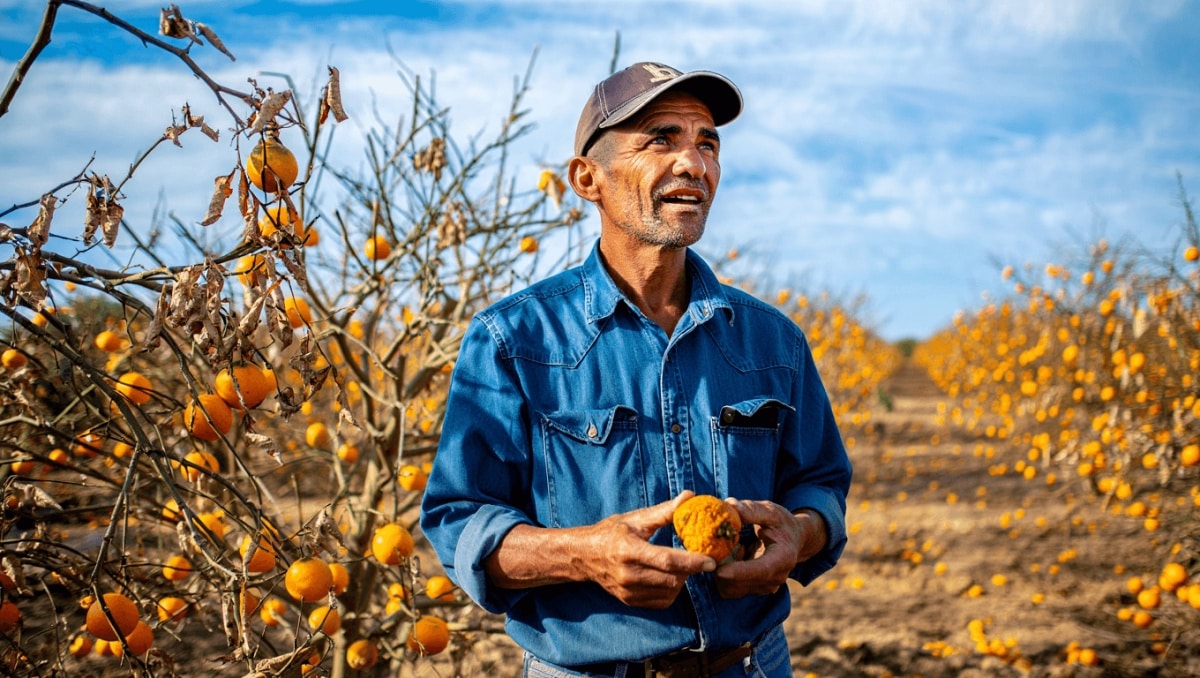
Florida is grappling with its most severe drought in a quarter-century, putting fresh strain on an already battered citrus sector and threatening jobs and supply chains across the state. The dry conditions are raising operating costs for growers and accelerating moves toward new production methods that aim to protect trees while preserving water.
Widespread drought, rising costs
The latest U.S. Drought Monitor shows the entire state in drought, with more than three-quarters of Florida classified as experiencing extreme drought. For growers who depend on pumped irrigation, that translates into sharply higher fuel and power bills just to keep orchards alive.
Florida remains a major U.S. citrus supplier — the state contributes roughly 17% of national citrus output, according to the Florida Department of Agriculture — and many rural communities still rely on the crop for income and employment.
Industry leaders note that the drought compounds long-standing problems. Over the past two decades, citrus acreage in Florida has fallen dramatically, from over 800,000 acres around 2000 to roughly 200,000 acres today, per U.S. Department of Agriculture data. That decline reflects repeated hits from disease, severe storms and other pressures.
Chronic threats: disease and storms
Citrus greening remains the dominant biological threat, weakening trees and reducing yields statewide. On top of that, frequent hurricanes and occasional freezes have repeatedly damaged groves and infrastructure, leaving many operations fragile when the weather turns dry.
Growers say the economics of irrigation are particularly painful now: pumps running on diesel or electricity are expensive to operate, and prolonged dry spells force higher water use at the worst possible moment for already-tight budgets.
How some growers are adapting
One visible response is the wider adoption of so-called Citrus Under Protective Screens (CUPS). These are enclosed, tentlike structures—typically about 10 acres each—that were introduced to reduce exposure to pests and disease. Growers report the covers also make soil moisture easier to manage during droughts, and they support more efficient irrigation systems.
Inside these pods, irrigation is delivered through a network of pipes to small emitters at each tree, allowing precise water application and reducing waste. Producers say trees in protected systems often reach productive maturity faster than those in traditional open groves.
- Pod size: Generally about 10 acres each
- Yield per pod: Growers estimate roughly 8,000–10,000 boxes
- Irrigation: Drip-style emitters at every tree for targeted watering
- Benefits: Better moisture control, reduced disease exposure, faster tree growth
One cooperative that harvests fruit from more than 10,000 acres says protective screens are one practical tool for regaining production momentum while using water more efficiently. Still, the upfront investment in structures and irrigation remains a barrier for many smaller operations.
Production snapshot and market implications
USDA production figures this season show mixed results across citrus types: lemons rose about 4%, tangerine and tangelo volumes were flat, while grapefruit fell roughly 8% and non-Valencia oranges dropped about 2%. Those shifts, combined with drought-driven cost increases, could influence retail prices and processing-supply dynamics in the months ahead.
For consumers, the immediate effects may be modest, but prolonged dry conditions and continued acreage decline would increase the likelihood of price pressure and narrower availability for certain varieties over time.
Industry officials express guarded optimism that technological fixes and protective growing systems can blunt some impacts. At the same time, the combination of drought, disease and storm damage leaves the sector vulnerable—and underlines why water availability and infrastructure support are now central to Florida’s agricultural policy discussions.