
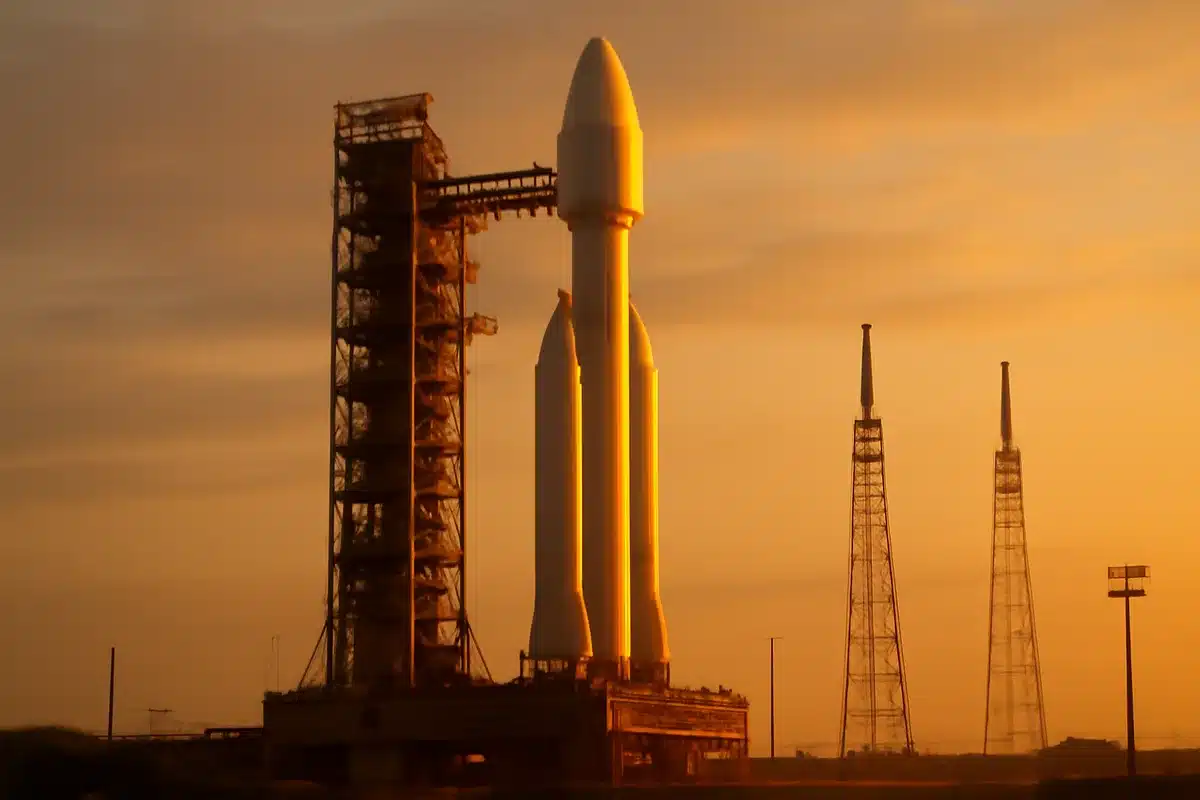
NASA’s Nancy Grace Roman Space Telescope is set to launch today at 7:26 a.m. EDT from Kennedy Space Center Launch Complex 39A in Florida aboard a SpaceX Falcon Heavy rocket. The $4.3 billion observatory represents the agency’s next flagship mission to study dark energy, discover distant exoplanets, and map billions of galaxies across the universe.
The 42-foot-long, 18,000-pound telescope is equipped with a 2.4-meter primary mirror, the same size as the Hubble Space Telescope’s, but with a field of view 100 times wider than Hubble’s infrared capabilities. This expansive view will allow Roman to conduct one of the most comprehensive searches ever for exoplanets, with NASA expecting the mission to discover thousands of new planets beyond our solar system.
After launch, the telescope will travel to a position of gravitational stability one million miles from Earth called the Sun-Earth Lagrange Point 2, or L2. From this vantage point, Roman will conduct a five-year prime mission to answer fundamental questions about the cosmos. The mission focuses on three main science areas: measuring the effects of dark energy, which makes up about 68 percent of the universe’s total energy; understanding dark matter; and cataloging exoplanetary systems to determine how common different types of planets are.
The telescope is named after Nancy Grace Roman, NASA’s first chief astronomer who served from the 1960s through the 1970s and is known as the “Mother of the Hubble Space Telescope” for her role in championing that mission. Roman’s legacy directly shaped the development of space-based astronomy, and naming this flagship observatory after her honors her foundational contributions to the field.
The Roman Space Telescope project has faced a complex development history. NASA repurposed optical technology originally built for classified government spy satellites in the late 1990s and early 2000s, transforming the hardware into a cutting-edge scientific instrument. Despite past schedule pressures and budget challenges, the mission is now launching ahead of its original timeline—eight months earlier than initially planned—and within its budgeted cost.
The launch builds on the success of the James Webb Space Telescope, which launched in December 2021 and has transformed infrared astronomy. Where Webb focuses on deep, narrow views of the early universe, Roman will conduct wide-field surveys that map the cosmic web and enable rapid discovery across vast regions of sky. Together, the two observatories will provide complementary perspectives on the universe’s largest structures and most distant objects.
Roman’s ability to monitor 100 million stars for hundreds of days and detect faint objects will enable astronomers to complete a statistical census of planetary systems around other stars, search for black holes, and discover supernovae. The mission is expected to help astronomers understand how common Earth-like planets are and refine our understanding of the universe’s composition and expansion history.
Sources
- SpaceX — confirmed launch targeting of 7:26 a.m. EDT on August 30, 2026, aboard Falcon Heavy from Kennedy Space Center Launch Complex 39A
- Space.com — reported launch time, vehicle, and location details
- NASA Science — provided mission overview, objectives in dark energy, exoplanet discovery, and astrophysics, plus destination at Sun-Earth L2 and five-year prime mission duration
- NPR — confirmed $4.3 billion mission cost and naming after Nancy Grace Roman, NASA’s first chief astronomer
- Scientific American — reported the telescope’s origin from repurposed spy satellite hardware and its deployment to L2
- National Geographic — detailed the 2.4-meter primary mirror, field of view 100 times wider than Hubble, and mission objectives
- Reuters — confirmed expected discovery of thousands of exoplanets and comprehensive exoplanet search capabilities
- Spaceflight Now — provided telescope dimensions (42 feet long, 18,000 pounds) and historical context on Nancy Grace Roman










