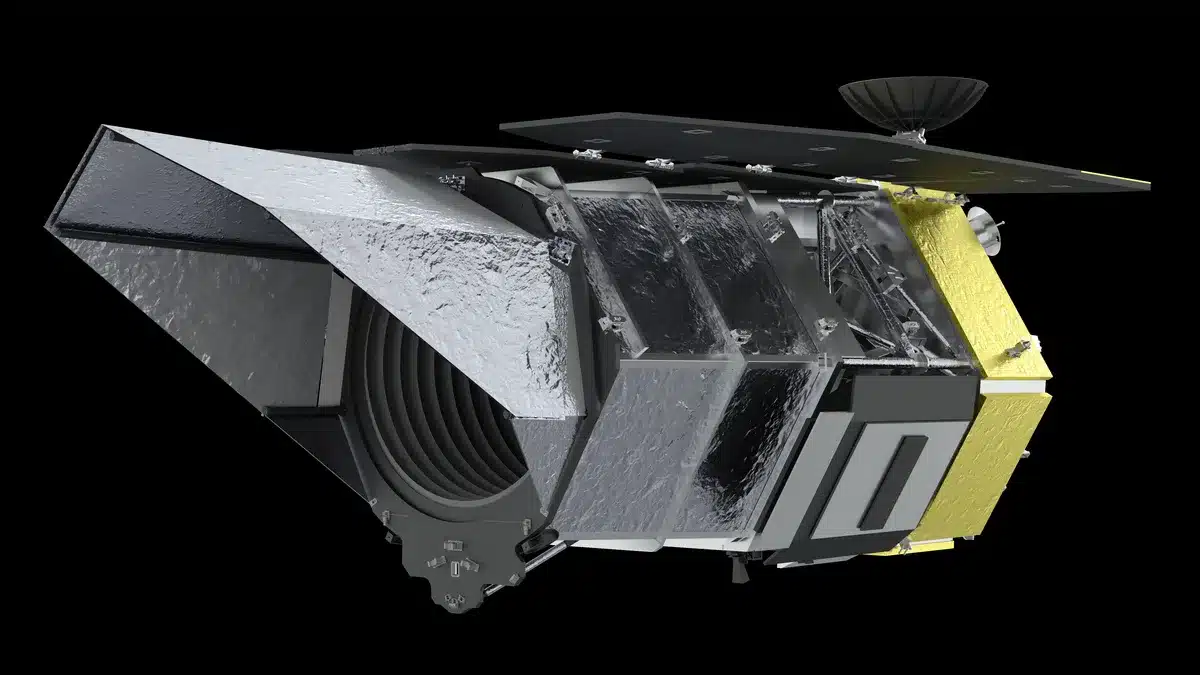
NASA’s Nancy Grace Roman Space Telescope is set to launch on August 30 at 7:26 a.m. EDT from Launch Complex 39A at Kennedy Space Center in Florida aboard a SpaceX Falcon Heavy rocket, arriving nine months ahead of its original May 2027 target date.
The $4 billion mission represents a major step forward in space-based astronomy. Named after NASA’s first chief astronomer, Roman will investigate dark energy, search for and image distant exoplanets, and conduct wide-field infrared surveys of billions of galaxies to understand the universe’s structure and evolution.
Roman’s primary mirror measures 7.9 feet (2.4 meters) across — the same size as the Hubble Space Telescope’s mirror, according to NASA. What sets Roman apart is its extraordinarily wide field of view: roughly 100 times larger than Hubble’s, enabling it to survey the sky up to 1,000 times faster while maintaining resolution comparable to Hubble’s. This combination of speed and precision will allow scientists to map vast cosmic regions in a single observation.
The telescope’s mission to study dark energy addresses one of cosmology’s deepest puzzles: the mysterious force accelerating the universe’s expansion. Roman will measure the equation of state of dark energy and track how it has evolved over cosmic time, helping determine whether it behaves as Einstein’s cosmological constant or something more complex. Beyond dark energy, Roman is projected to discover as many as 200,000 potential exoplanets and survey over 1 billion galaxies.
Construction of Roman finished in November 2025, and the telescope arrived at Kennedy Space Center in late June 2026 for final launch preparations. The accelerated timeline came as a surprise to the space community. In December 2025, NASA had indicated the mission would launch no earlier than May 2027, but the team’s efficient assembly and testing allowed the agency to move the target forward by nine months, completing the work under budget as well.
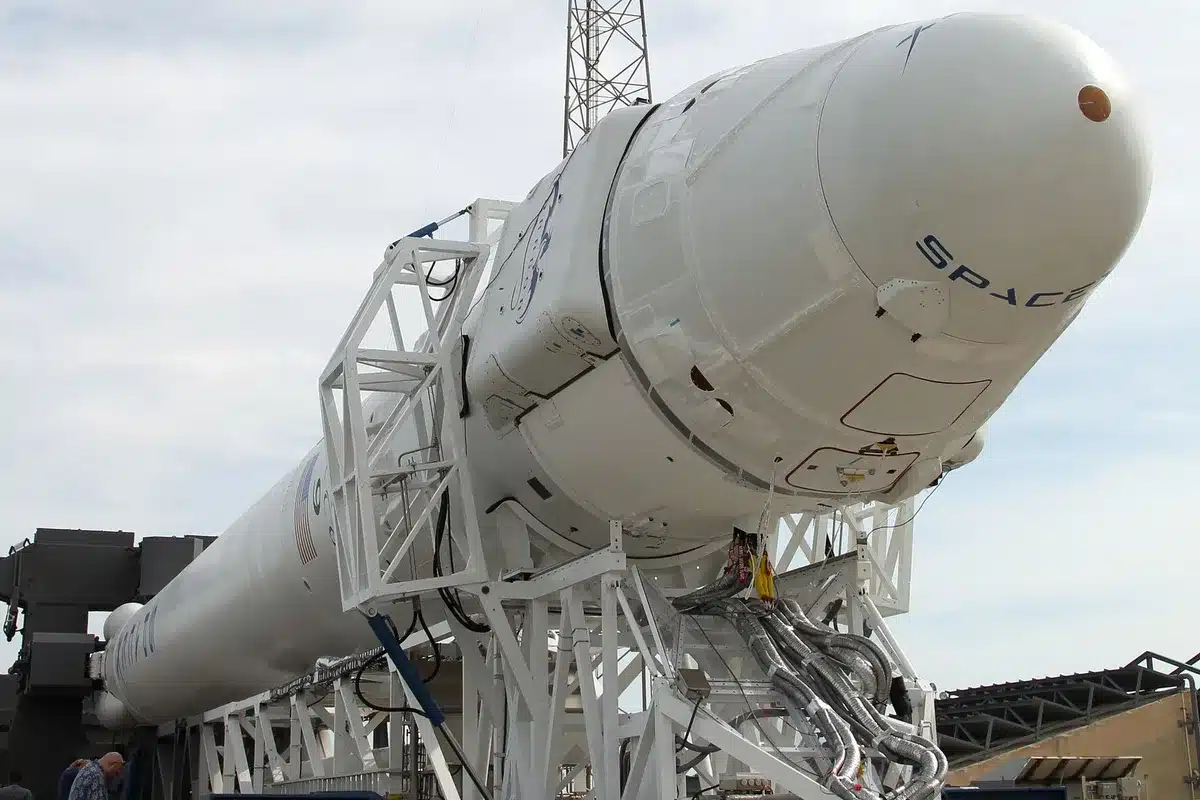
The Falcon Heavy will deploy Roman to the Sun-Earth L2 point, a gravitational balance point roughly 930,000 miles from Earth where the telescope will orbit in a stable configuration. From there, Roman’s infrared instruments will begin a multi-year science program that promises to reshape our understanding of the cosmos.
Sources
- NASA Science — official mission details, launch date, and primary mirror specifications
- Space.com — mission cost, launch date, and nine-month ahead-of-schedule status
- The Planetary Society — exoplanet discovery projections and galaxy survey scope
- Space News — confirmation of August 30 launch and nine-month acceleration
- Ars Technica — early completion timeline and under-budget status
- The Times — survey speed comparison to Hubble