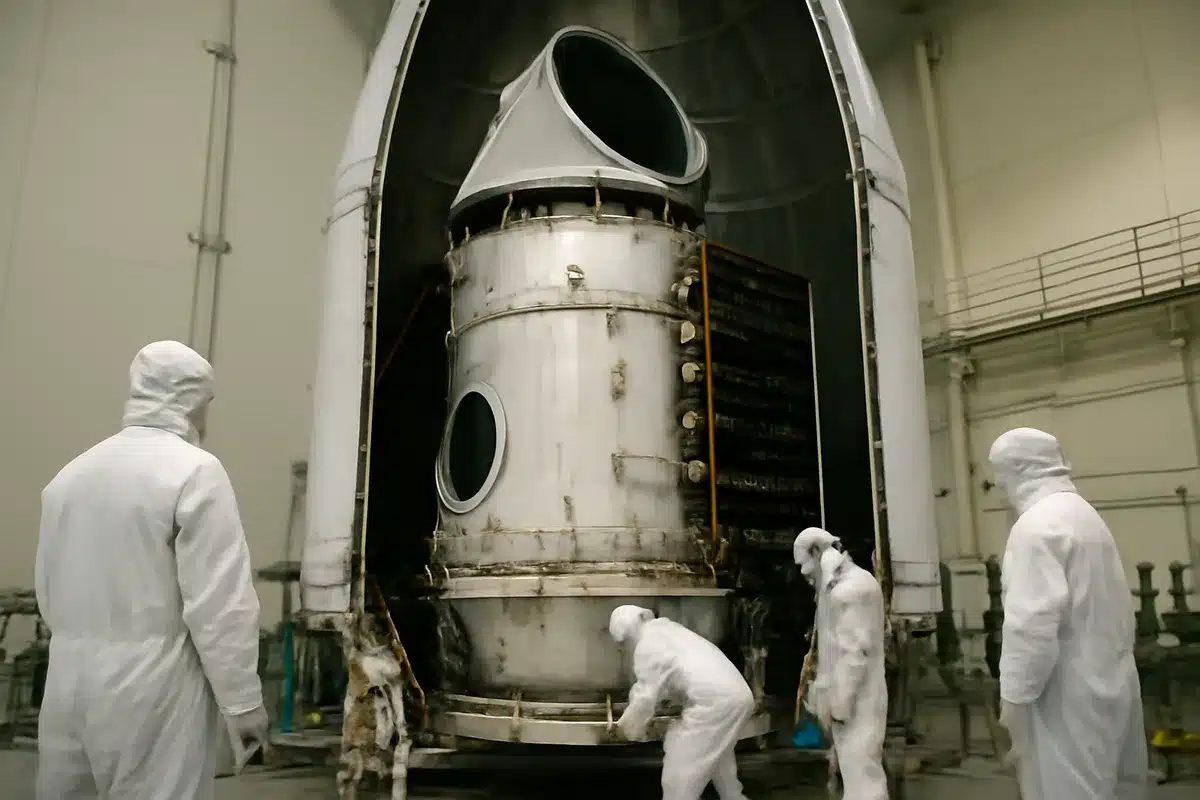
NASA’s Nancy Grace Roman Space Telescope is set to launch tomorrow morning at 7:26 a.m. EDT from Kennedy Space Center in Florida aboard a SpaceX Falcon Heavy rocket, marking the arrival of the agency’s next-generation infrared observatory designed to unlock mysteries of the dark universe.
The telescope will lift off from Launch Complex 39A, carrying a 2.4-meter mirror—the same size as the Hubble Space Telescope—but with a field of view at least 100 times wider, enabling it to survey the sky far more rapidly than its predecessor. The launch arrives nine months ahead of schedule; the mission was originally targeted for May 2027.
The Nancy Grace Roman Space Telescope carries a $4.3 billion price tag covering design, construction, and five years of operations. According to NASA, the mission will settle essential questions in three key areas: dark energy, exoplanets, and astrophysics. The telescope will observe billions of galaxies and is expected to discover thousands of new exoplanets beyond our solar system.
Roman will travel to Lagrange Point 2, a gravitationally stable location roughly one million miles from Earth, where it will conduct one of the most comprehensive cosmic surveys ever undertaken. The mission aims to map dark matter and dark energy across the sky while searching for evidence of how the universe’s expansion is accelerating.
Scientific Capabilities and Mission Objectives
The telescope’s 300-megapixel Wide-Field Instrument will enable it to capture images 100 times larger than Hubble can in a single exposure while maintaining comparable image quality. This capability means Roman will survey the sky 1,000 times faster than Hubble, according to NASA. The instrument includes a coronagraph—a tool that blocks starlight to directly detect and characterize exoplanets and planet-forming disks around distant stars.
Roman’s infrared sensors operate across wavelengths from 0.5 to 2.3 microns, allowing it to see visible light and extend into the infrared spectrum. This sensitivity will enable the telescope to detect faint light from distant galaxies, supernovae, and exoplanets. Scientists expect the mission will discover as many as 200,000 potential planets beyond the solar system and survey over one billion galaxies.
The mission builds on decades of space telescope development and represents a major step forward in infrared astronomy. When the James Webb Space Telescope launched in 2021, it demonstrated the power of infrared observation to peer deeper into space and further back in time. Roman will complement Webb’s capabilities by covering much larger areas of sky, enabling scientists to conduct statistical surveys impossible with narrower-field instruments.
NASA has confirmed that preparations remain on track and weather conditions are being monitored for tomorrow’s launch window. Live coverage of the launch will begin at 6:20 a.m. EDT on NASA’s channels.
Sources
- NASA — official mission details, launch time, location, and scientific objectives
- NASA Science — telescope specifications, field of view comparison with Hubble, mission cost
- Space.com — launch readiness updates and timeline information
- SpaceX — launch vehicle confirmation and targeting information
- New Scientist — telescope capabilities and scientific goals
- Reuters — mission objectives and exoplanet discovery expectations
- ESA (European Space Agency) — coronagraph technology and mission details