
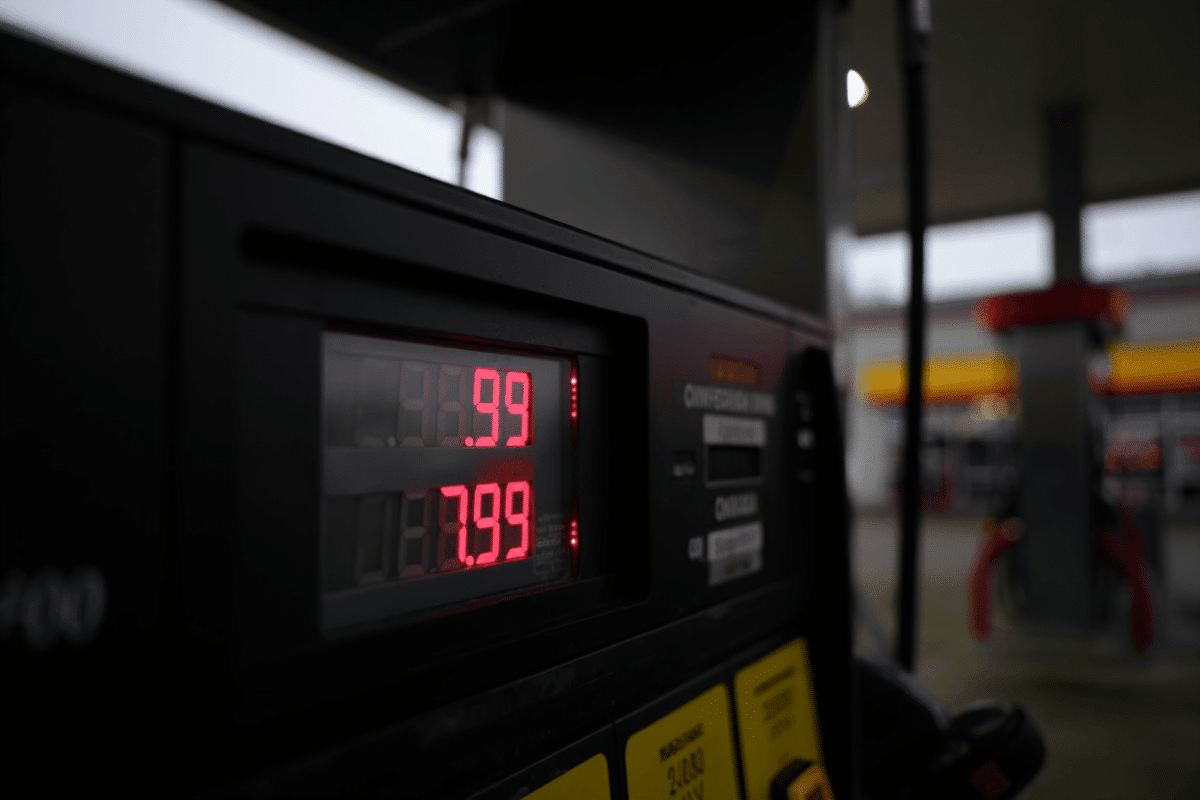
The national average price for a gallon of regular gasoline fell below $4 for the first time since late March, reaching $3.99 as of June 18, 2026, according to AAA data. The drop marks a sharp reversal from the elevated prices that have gripped the nation since the U.S.-Iran war began in February, when crude oil prices spiked on supply concerns.
The decline follows a preliminary peace agreement reached between the United States and Iran on June 14-15, 2026. President Trump announced the framework deal on his Truth Social platform, with Pakistan’s prime minister confirming the announcement. The agreement is scheduled to be formally signed in Switzerland on Friday, June 21.
Crude oil prices have fallen sharply since the deal announcement. Brent crude, the global oil benchmark, dropped to its lowest level since early March, falling to around $79-82 per barrel from a peak of roughly $113 in May. West Texas Intermediate crude settled near $80 per barrel as of mid-June. The decline reflects market expectations that the Strait of Hormuz, through which roughly 20 percent of the world’s oil passes, will fully reopen to shipping traffic once the ceasefire takes effect.
The reopening of the strait is critical to global oil supply. During the conflict, the waterway was effectively closed, choking off a major source of energy for global markets. “The number one thing that we will need to see is actual movement of ships through the strait,” said Marc Ercolao, an economist at TD Economics, in an interview with Global News. “That’s what’s been holding back global oil supply.”
However, experts caution that relief at the pump will be gradual and incomplete. David Detomasi, a professor of international business at Queen’s University’s Smith School of Business, noted that the conflict has created a “new normal” where energy shocks occur frequently. “We got comfortable with the fact that shocks were rare and that we could deal with them when they happen. Now they happen all the time,” Detomasi told Global News.
Even if the Strait of Hormuz reopens immediately, physical damage to oil infrastructure in the Persian Gulf region will slow recovery. Moshe Lander, an economics professor at Concordia University, explained that damaged facilities and bottlenecks on both sides of the strait will require repairs and agreements to allow replacement parts and materials through. “There’s going to have to be some agreement here that not just you’re opening up Strait of Hormuz, but that you’re also going to allow parts and materials in to be able to get this rebuilt. That could take itself another couple of months as well,” Lander said.
Gas prices at the pump typically adjust within days to weeks of wholesale market changes, so some immediate relief is expected. Dan McTeague, a gas price analyst at Canadians for Affordable Energy, predicted that prices could drop 10 to 15 cents per gallon over the coming weeks. However, a full normalization of energy markets will take much longer. “Crude vessels run at the speed of a small bike. And so for a country to take delivery, maybe two or three months, not to mention the damage, physical damage that’s been done to many of the oil fields in the Persian Gulf,” McTeague said in the Global News report.
Experts differ on the timeline for full recovery. Moshe Lander suggested it could take three to four months for oil prices to return to the $60 per barrel range—and that’s only if the deal holds and all facilities are repaired. Marc Ercolao at TD Economics was more cautious, stating that the entire normalization process will take months and be “uneven” and “slow,” with no drastic price decreases expected. “The deal will have to hold indefinitely for the next one to two years,” Ercolao said.
The path to pre-war gas prices is uncertain. If the peace agreement becomes permanent, prices may not return to pre-conflict levels until late 2026 or even into 2027, and some experts suggest they may never fully recover to those levels. McTeague warned that “we’re not going back to $1.30, $1.35 per litre on average in Canada, simply because the need to make up all of those shortages are going to take a very long time.” The conflict began in February 2026 when gas prices were below $3 per gallon nationally; they climbed above $4 by late March and peaked near $4.56 in mid-May before the Iran deal brought relief.
Sources
- AAA Gas Prices — Current national average gasoline price data and historical price tracking
- Reuters — Confirmation of gas prices falling below $4 for first time since mid-April; oil price movements and deal announcement
- New York Times — Oil price decline and Brent crude falling to lowest level since mid-March
- Washington Examiner — Gas prices dropping below $4 for first time since March
- Global News — Expert analysis from David Detomasi, Dan McTeague, Marc Ercolao, and Moshe Lander on gas price outlook and Iran deal impact
- BBC — U.S.-Iran peace deal framework announcement and oil price reaction
- Al Jazeera — Oil price decline following Iran peace deal and Strait of Hormuz reopening prospects










