Georgia’s Republican legislative leaders rejected Governor Brian Kemp’s call to redraw congressional and legislative districts for the 2028 elections during a special session on Wednesday, dealing a setback to both the governor and President Donald Trump’s broader push to reshape electoral maps across Republican-led states.
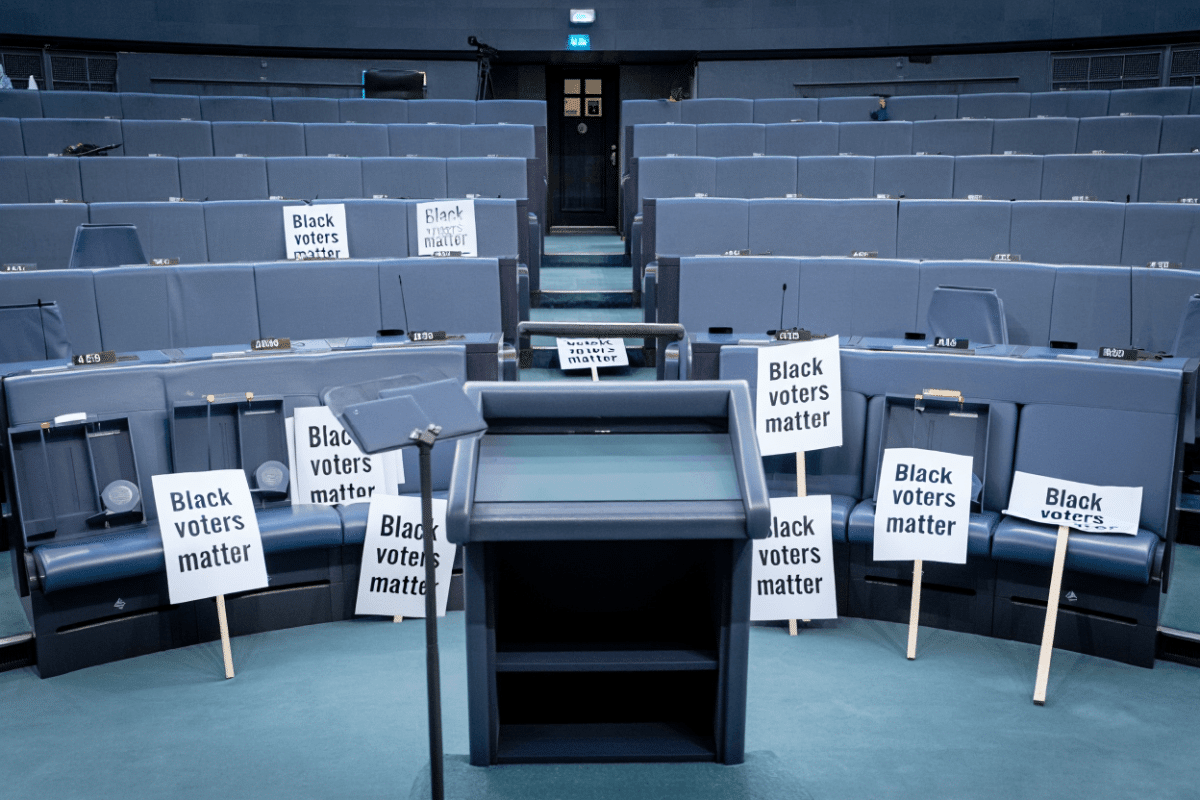
House Speaker Jon Burns sent Kemp a letter hours before the special session was set to begin, informing him that lawmakers would not take up redistricting at all during the session. Burns announced the decision publicly as demonstrators filled the Georgia Capitol with chants of “Black voters matter!”
Burns said lawmakers wanted to take their time after the U.S. Supreme Court’s Louisiana v. Callais decision, which struck down Louisiana’s congressional map as an illegal racial gerrymander and laid the groundwork for legislatures to reduce the number of districts where Black and other nonwhite voters hold most sway. He said it was more important for lawmakers to focus on economic matters rather than “partisan games.” Burns also cited pending litigation over existing Georgia districts and the need to understand the full ramifications for how race can or cannot be used in redistricting.
The decision marked a significant reversal from Kemp’s original plan. The governor had not asked his fellow Republicans to redraw Georgia districts ahead of November’s midterms. Instead, he wanted them to redraw congressional boundaries for the 2028 election and also to redraw their own legislative districts—a move that would have made Georgia the first state to apply the Supreme Court’s Callais decision to its legislature.
Trump’s Broader Redistricting Campaign Stalls
The Georgia outcome represented a setback for Trump, who has urged Republican-controlled states to gerrymander their congressional maps to shore up the GOP’s fragile House majority ahead of the midterms. Ten states already have enacted new congressional districts, and Republicans believe the redistricting efforts could net them as many as ten seats nationwide. Georgia would have been the first state to change districts specifically for the 2028 elections, signaling a new phase in Trump’s redistricting campaign.
Privately, Georgia Republicans had expressed concerns that a rushed process to diminish Black and other minority voters’ political power could trigger a backlash. They also worried that redrawn districts could unintentionally create more competitive jurisdictions that Democrats could win, especially around Atlanta. About one-third of Georgia’s 180 state representatives are Black, with Latino, Asian, and other minorities bringing the total nonwhite share to about 40%—roughly reflecting the state’s overall population. Georgia’s U.S. House delegation has five districts out of 14 total where the electorate is majority or plurality nonwhite, all of which elected Black Democrats in 2024.
The Louisiana v. Callais decision, issued on April 29, 2026, fundamentally altered the legal landscape for redistricting. A conservative Supreme Court majority concluded that jurisdictions drawn with racial makeup in mind violate the U.S. Constitution’s equal protection clause, declaring that apportionment should be “race neutral.” The decision weakened Section 2 of the Voting Rights Act, which for decades had required maps to give historically marginalized minorities a reasonable chance to select candidates of their choice. In Southern states, where party loyalty dovetails considerably with race and ethnicity, the ruling has allowed Republicans to redraw maps to boost GOP districts by redistributing nonwhite voters who tend to support Democrats.
Civil rights activists and Democrats, especially Black and other nonwhite lawmakers, celebrated Georgia’s decision. U.S. Senator Raphael Warnock, the state’s first Black senator who returned to Atlanta from Washington to be at the Capitol, said the outcome showed that ordinary people could make their voices heard. “Today showed that ordinary people don’t need to wait until November to make their voices heard and protect our democracy,” Warnock stated. “We can stand up and speak right now.”
Republican legislative leaders did not rule out revisiting redistricting later in the year, leaving the door open for a future attempt. However, the immediate rejection of Kemp’s plan marked a rare moment of Republican resistance to Trump’s broader gerrymandering push—a push that has reshaped electoral politics across multiple states in 2025 and 2026.
Sources
- PBS News — detailed coverage of the rejection, Kemp’s original proposal, the Callais ruling, and Senator Warnock’s statement
- CNN — confirmation of the rejection, Burns’s letter, and analysis of the decision as a setback for both Kemp and Trump
- DataForSEO search results — multiple outlets confirming the June 17, 2026 rejection and the timing of the special session