SpaceX recovered its Starship upper stage from the Indian Ocean after achieving the first intact soft splashdown of the spacecraft in the company’s test-flight history, marking a major milestone for the world’s most powerful rocket on Flight 13 on July 24, 2026.
The upper stage, known as Ship 40, landed gently in the remote Indian Ocean west of Australia and remained completely intact and afloat—a stark contrast to previous splashdowns that ended with explosions. SpaceX spokesperson Dan Huot called the outcome “a dream scenario” during the company’s live webcast, allowing engineers an unprecedented opportunity to inspect the vehicle’s heat shield after its journey through space.
The heat shield consists of approximately 18,000 hexagonal ceramic tiles bonded to Starship’s stainless-steel skin. During reentry, these tiles protected the vehicle as it streaked back through the atmosphere at temperatures reaching 2,600 degrees Fahrenheit (1,430 degrees Celsius). SpaceX engineers flew drones over the floating Starship to document how the tiles withstood the intense conditions, gathering critical data for future missions.
Unlike previous Starship upper stages that sank or exploded upon landing, Ship 40’s gentle impact and buoyant design allowed it to remain airtight and continue transmitting signals through SpaceX’s Starlink satellite network. The vehicle’s six Raptor engines showed no visible external damage in onboard camera footage captured as water lapped against the lens.
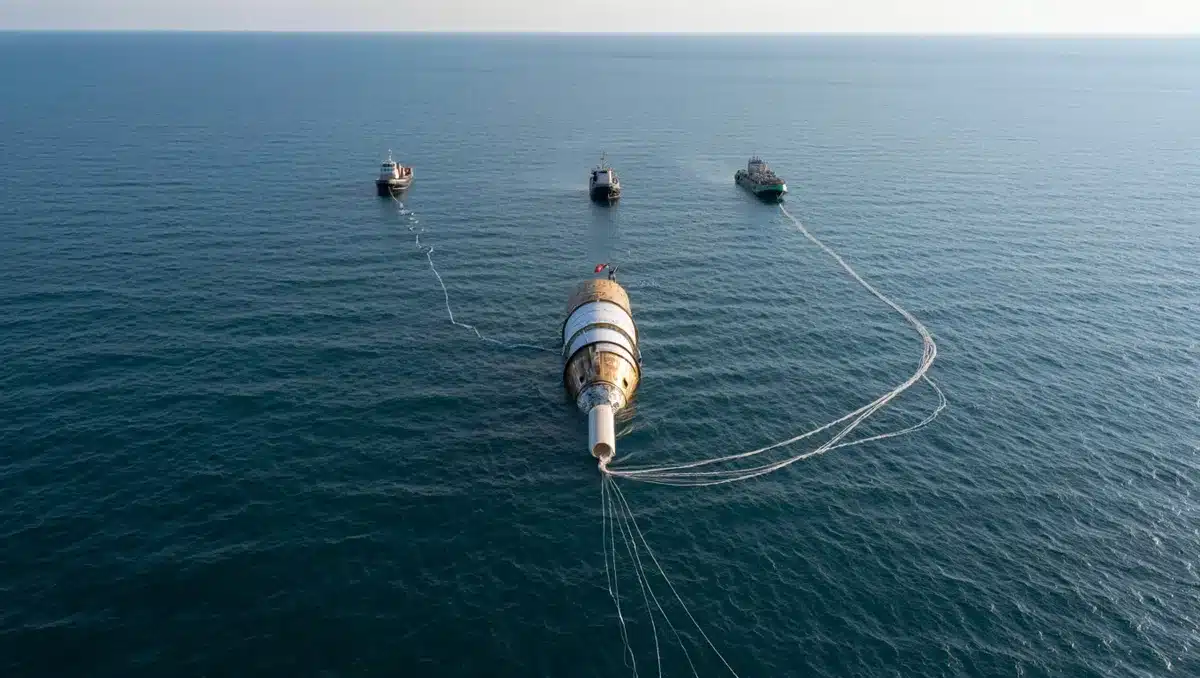
On July 28, SpaceX CEO Elon Musk confirmed the company would attempt recovery. By early August, satellite imagery showed a fleet of ships working to tow the 171-foot-tall vehicle back to shore. The Norwegian tugboats Normand Ranger and Skimmer Tide, along with SpaceX’s recovery ship Go Australis, coordinated the effort, with Australia emerging as the likely destination for closer inspections.
While the intact splashdown represents a breakthrough for the Starship program, the vehicle is unlikely to be refurbished and reused after exposure to saltwater. Instead, the recovery provides SpaceX with detailed post-flight analysis of how the heat shield and other systems performed under high-stress conditions. SpaceX’s ultimate goal is to return Starship to the launch pad for rapid reuse—a capability the company has already demonstrated with the Super Heavy booster, which landed in mechanical arms at the launch tower during earlier test flights.
The soft splashdown also signaled SpaceX’s readiness to attempt the next major milestone: catching Starship’s upper stage at the launch tower on a future flight. Elon Musk indicated the company would pursue this maneuver on the next test flight, pending a review of Flight 13 data. Achieving a tower catch would unlock the company’s path toward orbital refueling demonstrations and eventual operational missions carrying Starlink satellites and cargo to space.
Sources
- Ars Technica — detailed reporting on Flight 13 splashdown, heat shield inspection, and SpaceX’s plans for tower catch on next flight
- USA Today — confirmation of first intact upper-stage splashdown, recovery announcement, and context on Starship’s role in NASA’s Artemis program
- Yahoo News / CNN — satellite imagery of recovery fleet, ship tracking data, and timeline of towing effort toward Australia