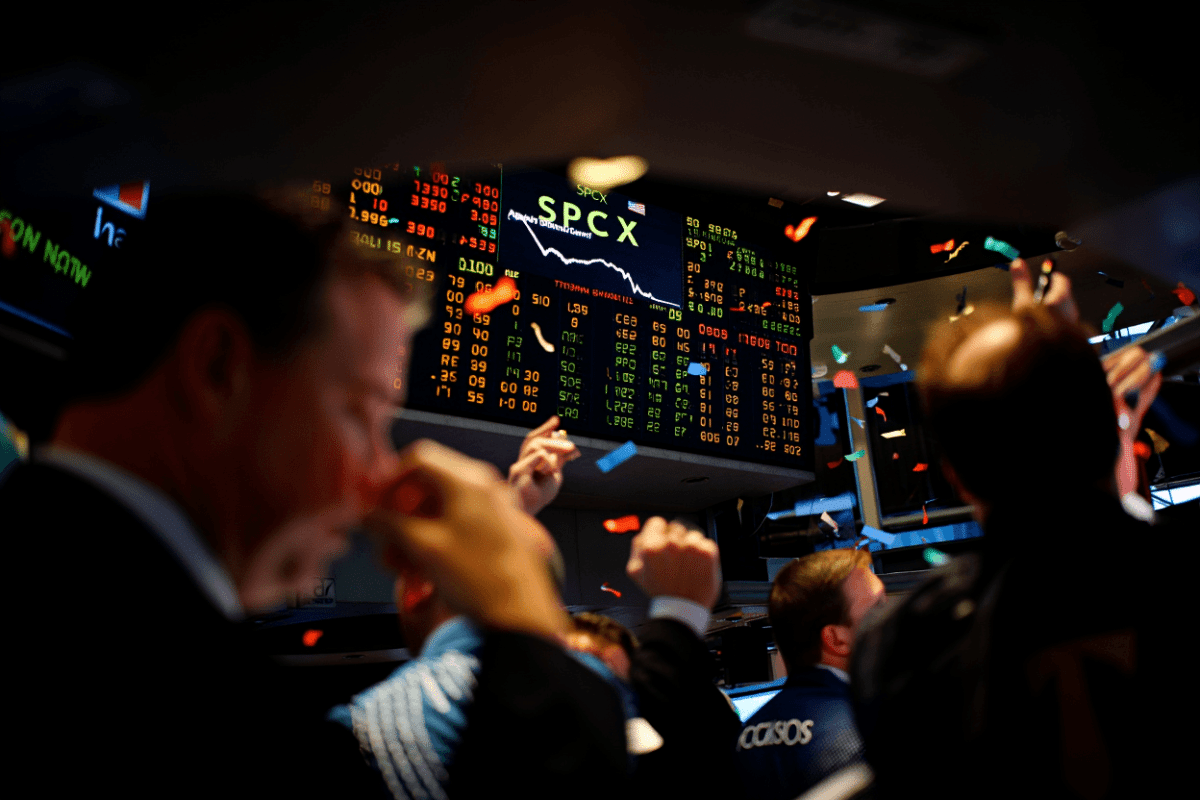
SpaceX stock soared 19% in its historic Nasdaq debut on Friday, June 12, closing at $161 after the company raised $75 billion in the largest initial public offering ever recorded, transforming Elon Musk’s rocket and satellite maker into one of the world’s most valuable public companies and creating the first trillionaire in history.
The company priced its shares at $135 each, selling 555.6 million shares to raise the record-breaking $75 billion, according to Reuters and Bloomberg. At that price, SpaceX carried an initial valuation of $1.77 trillion, instantly making it the eighth-largest U.S. company by market capitalization.
The stock’s 19% first-day gain pushed SpaceX’s valuation past $2 trillion during trading, according to CNBC and The New York Times. That surge elevated Elon Musk’s net worth above $1 trillion, making him the world’s first trillionaire—a milestone no individual had reached before.
The IPO’s scale dwarfed all previous records. Saudi Aramco held the prior record when it went public in December 2019, raising $29.4 billion, according to The New York Times. SpaceX’s $75 billion offering is roughly 2.5 times larger than Aramco’s, marking a historic shift in capital markets.
Demand for the IPO far exceeded available shares. Bloomberg reported that SpaceX’s historic $75 billion IPO drew more than $350 billion in demand from institutions and retail investors combined. Reuters noted that SpaceX allocated a record 20% of IPO shares for retail investors, a significantly higher allocation than the typical 5-10% in most offerings, allowing individual investors unusual direct access to the debut.
SpaceX’s valuation reflects investor appetite for the company’s diversified business spanning satellites, rockets, and artificial intelligence. The company posted $18.67 billion in 2025 revenue, up 33% year-over-year, according to Fortune, though it reported a net loss of $4.94 billion that year. The IPO pricing valued the company at roughly 94 times trailing sales, according to the same source, signaling that investors are pricing in substantial future growth and profitability.
The debut marks a milestone for space investment and Nasdaq, which secured the listing after competing with other exchanges. SpaceX trades under the ticker SPCX.
Sources
- CNBC — SpaceX IPO pricing, first-day gains, and market cap confirmation
- Reuters — IPO pricing details, retail allocation percentage, and institutional demand figures
- Bloomberg — Total investor demand exceeding $350 billion
- The New York Times — First-day trading results, Elon Musk trillionaire status, and Saudi Aramco comparison
- Fortune — SpaceX 2025 revenue and valuation metrics