
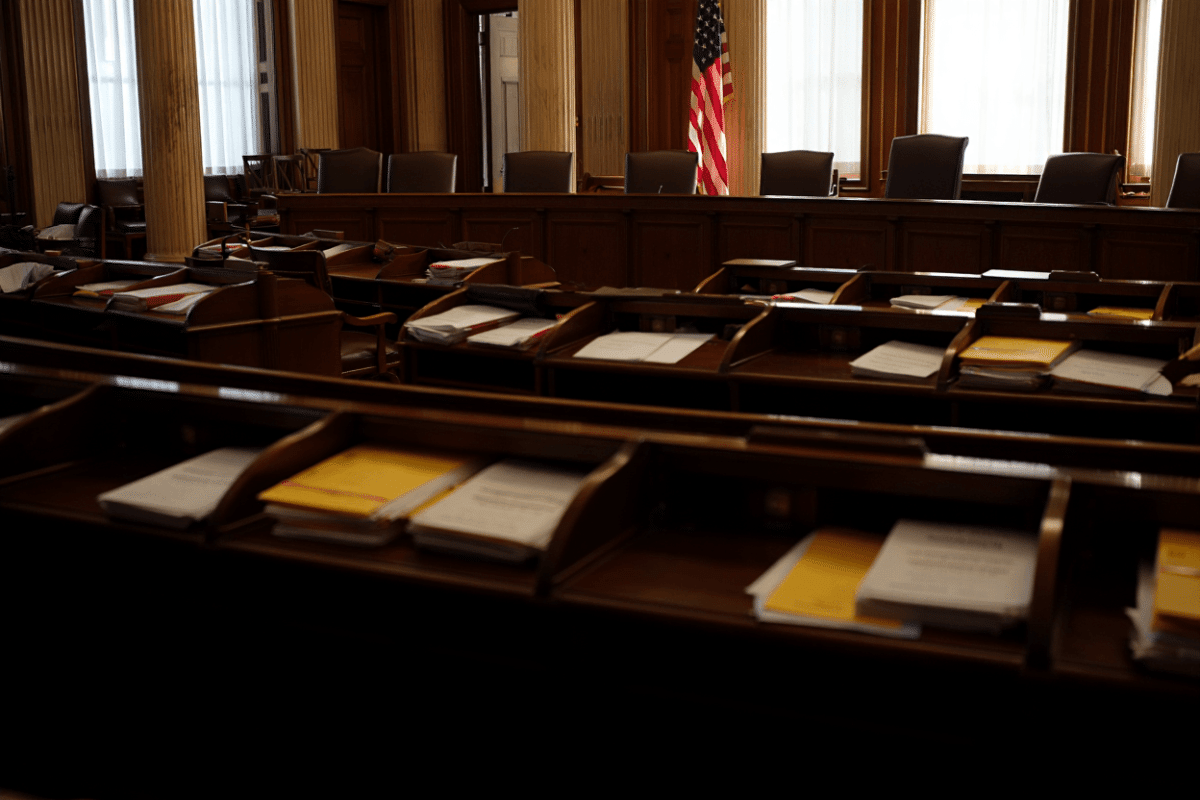
The Supreme Court is in its final stretch of the 2025-2026 term, with 23 cases still awaiting decision out of the 58 cases argued this year. The justices are racing to complete their work by the end of June or early July, marking the crunch time when decisions on some of the most consequential issues facing the nation will be handed down.
The court has already ruled on two major cases this term. In one decision, it struck down Louisiana’s congressional map, which the state had drawn with two majority-Black districts in response to a lower court ruling on the Voting Rights Act, making it much more difficult for challengers to prevail on claims that a map dilutes minority voting power. In another, the court rejected President Trump’s effort to impose sweeping tariffs on imported goods, ruling that Congress had not authorized such action and that Trump had exceeded his authority in implementing the tariff program on his own.
Among the most closely watched cases still pending is Trump v. Barbara, which concerns birthright citizenship. Trump has long maintained that the Constitution does not guarantee citizenship for babies born on U.S. soil to parents who entered the country illegally or are living here with temporary visas. The 14th Amendment, enacted after the Civil War, states that “All persons born or naturalized in the United States and subject to the jurisdiction thereof, are citizens of the United States.” Almost all legal scholars interpret that language broadly as applying to all babies born in the U.S., but Trump contends it applies only to the children of former slaves and definitely not to children of undocumented immigrants or noncitizens living here legally. After oral arguments on April 1, at least five—and perhaps as many as seven—justices appeared likely to strike down Trump’s executive order on the issue.
The court is also poised to rule on two cases involving state bans on transgender women and girls participating in women’s and girls’ sports. In Little v. Hecox and West Virginia v. B.P.J., the justices will decide whether laws in about half the states that prohibit trans athletes from competing on women’s teams are constitutional. Supporters of the bans argue they prevent athletes whose assigned sex at birth was male from gaining an unfair advantage in women’s sports, while opponents contend the laws discriminate based on sex in violation of federal law and the Constitution’s guarantee of equal protection. After oral arguments in January, the court appeared poised to uphold those laws.
On presidential power, the court is expected to rule in Trump v. Slaughter, which involves Trump’s firing of Rebecca Slaughter, a member of the Federal Trade Commission. Federal law bars the president from removing FTC commissioners except for “inefficiency, neglect of duty, or malfeasance in office”—none of which Trump cited when he fired Slaughter. The Trump administration has already received a temporary win from the Supreme Court, which allowed the government to remove her from office while litigation continues. A majority of the conservative justices appeared likely to side with Trump when the case was argued in December. In contrast, Trump’s effort to fire Lisa Cook, a member of the Federal Reserve Board, faces steeper odds. Federal law allows the president to remove Fed members only “for cause,” and after nearly two hours of oral argument in January, the justices appeared sympathetic to Cook’s challenge.
The court will also decide Watson v. Republican National Committee, which challenges a Mississippi law allowing mail-in ballots to be counted if they are postmarked by and received within five days of Election Day. Twenty-nine states count at least some ballots arriving after Election Day, including those from overseas voters and military members, provided they are postmarked on or before Election Day. The Trump administration and Republican Party argue that federal law requires all ballots to be received by Election Day itself. A majority of justices appeared ready to uphold a lower court ruling striking down the grace period for late-arriving ballots.
Two cases involving temporary protected status—Mullin v. Doe and Trump v. Miot—will determine whether the Trump administration can strip Haitian and Syrian nationals of protection under a federal program allowing foreign citizens to remain in the U.S. when it is unsafe for them to return home. Congress enacted the Temporary Protected Status law in 1990, and every president, Republican and Democrat, has embraced it until Trump. Currently, more than 300,000 Haitians have been living legally in the U.S. since a devastating earthquake in 2010, followed by a deadly cholera epidemic and ongoing gang violence and political assassinations. The court’s decision on whether the administration can eliminate TPS designations remains less clear than in some other cases.
The justices will also weigh in on geofencing warrants in Chatrie v. US, a case examining whether law enforcement can use virtual geographical fences around crime scenes to force tech companies to search millions of users’ location data. The case raises questions about whether the technique is an ingenious law enforcement tool or an Orwellian invasion of privacy affecting millions of people who were never suspected of wrongdoing.
Finally, the court will rule on gun rights in two cases. In Wolford v. Lopez, the justices are considering a Hawaii law that bars licensed gun owners from bringing firearms onto private property without explicit permission from the owner. A solid majority appeared skeptical of this restriction. In United States v. Hemani, the court will decide whether a federal law making it a crime for users of illegal drugs to possess a gun violates the Second Amendment. The federal government faced an uphill battle defending that law during oral arguments.
The Supreme Court is expected to release decisions on Thursday, June 11, with the court aiming to conclude its work by the end of June or early July.
Sources
- NPR — comprehensive overview of 23 pending cases and their details
- SCOTUSblog — reporting on the most important cases yet to be decided and the court’s likely positions based on oral arguments
- Ballotpedia — confirmed that as of June 2, 2026, the court had issued 42 opinions for the term










