California’s slow vote count stems from three interconnected factors: the state’s reliance on mail-in ballots, mandatory signature verification, and the arrival of ballots after Election Day, according to election officials and voting rights experts.
Nearly 90% of California voters cast ballots by mail in recent elections, and that volume creates a bottleneck. Every registered voter in California receives a mail-in ballot, and election officials must process millions of ballots across 58 counties. Each ballot requires intake, sorting, signature review, tabulation, auditing and reporting before it can be counted, according to the California Secretary of State.
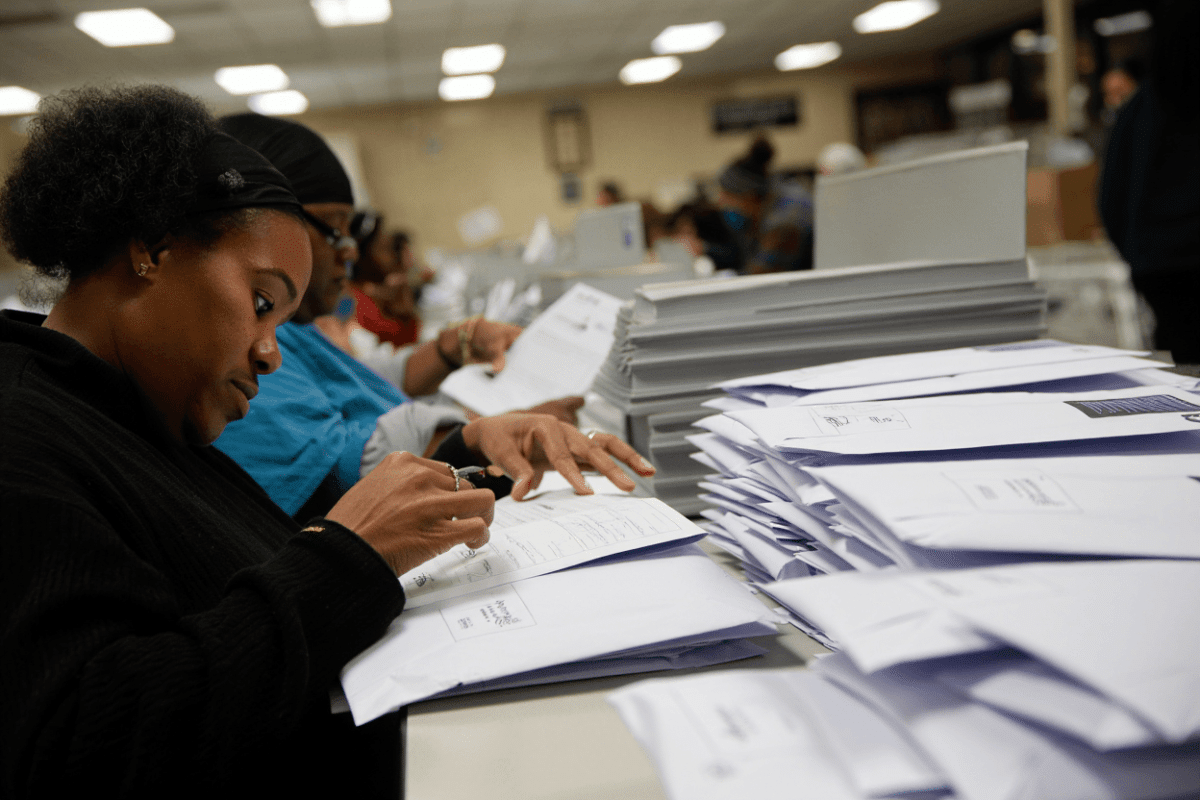
Signature verification is the most time-consuming step. County officials must compare the voter’s signature on the ballot envelope with the signature on file in the voter’s registration record, check that the voter is registered, confirm the ballot was returned on time, and verify the voter did not already cast another ballot in the same election. This security process is designed to prevent fraud and disenfranchisement, but it necessarily slows the count.
California law also allows mail-in ballots postmarked by Election Day to be counted if they arrive at county elections offices within seven days of the election. In the 2026 primary held June 2, ballots postmarked by that date can still be counted if they arrive by June 9. Many voters mail their ballots on or just before Election Day, meaning election officials cannot count those ballots until after polls close.
This year’s delay is particularly pronounced because voters waited longer than usual to cast their ballots. In the competitive governor’s race, a large surge of Democratic voters waited until the last minute to mail in their ballots, allowing them to make strategic decisions based on the most recent polling, according to The New York Times. Paul Mitchell, vice president of the voter data firm Political Data Inc., told The Guardian: “There’s not a lot of people I know who would say: ‘Nah, I would rather have known who won the race faster than have my vote count.’ The only people who complain about it are the people who lose.”
California has attempted to speed up the process. In 2025, Assembly Bill 5 reduced the window for counties to finish counting most ballots from 30 days to 13 days. However, Jesse Salinas, Yolo County’s top elections official, noted that the new law does not apply to ballots that take the most time to count, including those where a signature does not match what is on file or those filed by voters who registered on election day, because state law provides weeks-long windows for those questions to be addressed.
Thirty-one of California’s 58 counties have also begun allowing voters to bring their mail-in ballots to voting sites on Election Day and have them counted immediately as “in-person” ballots, made possible by Assembly Bill 626 passed in 2023. In Placer County, this system cut post-election processing time by about three to four days when it debuted in 2024, according to CBS News.
Kim Alexander, president of the California Voter Foundation, defended the state’s approach. “California has the most accessible, secure and verifiable election system in the country,” she said, noting that voters are given 22 days after the election to fix any errors on their ballots. California Secretary of State Shirley Weber stated: “Accuracy comes before speed. California is the nation’s largest voting state, with millions of ballots to process and count.”
Sources
- The Guardian — Detailed explanation of mail-in voting, signature verification, and why California’s count is slow, with quotes from voting rights experts and election officials
- CalMatters — Analysis of mail-in ballots, signature verification, competitive races, and recent legislative changes to speed up counting
- Democracy Docket — Comprehensive breakdown of California’s counting process, mail-in ballot rules, signature verification requirements, and ballot curing procedures
- California Secretary of State — Official information on vote counting process and timeline