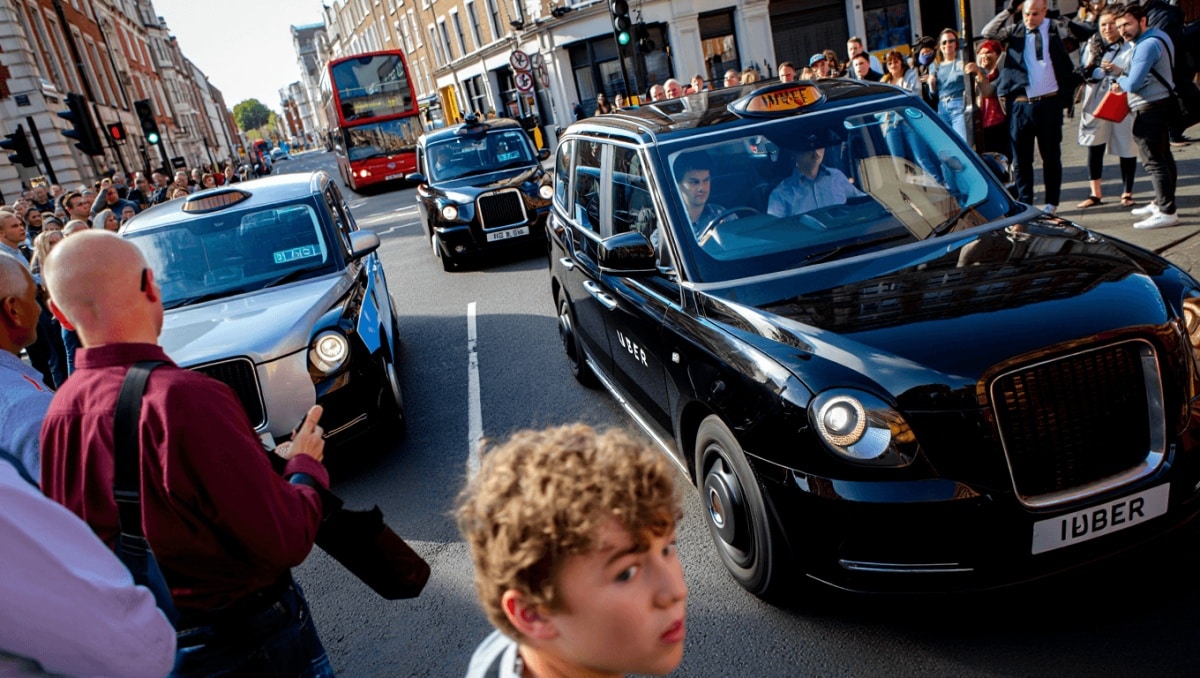
Uber has begun taking names in the U.K. for riders who want priority access to cars equipped with Wayve’s self-driving technology, a clear sign the companies are close to launching a robotaxi service in London. The move sharpens an emerging contest between Uber and Alphabet-owned Waymo as both test autonomous fleets on the city’s streets.
Uber revealed the interest list this week alongside a branded black Ford Mustang Mach-E fitted with Wayve’s autonomous hardware. While Wayve supplies the driving system, Uber has taken responsibility for the in-car experience and the app integration, including interactive screens that the company says will support multiple languages.
How the rollout will work
Riders who want a better shot at being assigned an autonomous vehicle can enable the option in their Uber profile under rider preferences. If matched to one of the vehicles, passengers will still have the ability to refuse the ride and request a conventional driver instead.
Uber says the initial phase will include a human safety operator in the driver’s seat; fully driverless trips are planned for a later stage after additional testing and approvals.
- No extra fare: Uber has said riders won’t pay more for an AV ride compared with a human-driven trip.
- Opt-in matching: Users must select autonomous vehicles in rider preferences to increase their matching probability.
- Decline option: Passengers matched with an AV can choose a human driver instead.
- Safety setup: Early operations will include a safety driver before moving to driverless service.
- Multilingual interface: Uber’s in-car screens will support dozens of languages for rider interaction.
These product choices matter for customers and regulators alike: the opt-in approach and the ability to refuse an AV reduce friction for users, while the staged safety-driver model addresses immediate safety and oversight concerns.
What’s happening on the ground in London
Waymo is already running tests in the city, deploying roughly 100 Jaguar I‑Pace vehicles across a large service area with human safety operators. The parallel presence of Wayve-equipped Ubers and Waymo cars sets up what could be a high-profile competition in one of the world’s most valuable ride-hailing markets.
The companies’ differing go-to-market strategies are notable. Waymo has allowed direct hailing of its robotaxis in some U.S. cities via its own app, while in others it has integrated with partners. Uber’s deployment will route potential robotaxi matches through its app, maintaining ride-booking control at scale.
Partnership, competition and corporate friction
Uber and Waymo have a complicated history: former litigation was followed by a 2023 agreement that led to Waymo’s vehicles appearing on Uber’s app in Phoenix. That cooperation later expanded to new U.S. markets, but the relationship shows signs of strain.
Uber has broadened its ties across the AV industry, investing in several startups — including Wayve — and creating internal units such as AV Labs and Uber Autonomous Solutions to build data and operations capabilities. At the same time, senior Uber executives have publicly criticized the behavior of other companies’ test vehicles, signaling growing public tension with former allies.
Money and incentives
Wayve raised about $1.2 billion in February from strategic backers, with a potential additional $300 million from Uber contingent on deploying robotaxis — beginning with London. That conditional funding underscores the commercial stakes: Uber has a financial interest in Wayve’s successful UK rollout, even as both firms jockey for long-term leadership.
Regulatory landscape: a moving target
The timetable for a full robotaxi face-off in London will depend heavily on government rules. The U.K. Department for Transport opened applications this spring for an AV pilot program intended to inform formal regulations. Officials say lessons from the pilot will shape the regulatory framework, leaving a degree of uncertainty about when fully driverless services will be authorized at scale.
That regulatory process is the key gating factor for operators and investors. Companies can test under existing frameworks, but permanent, widespread driverless operations require clearer legal guardrails, oversight standards and public acceptance.
For Londoners and potential riders, the coming months will reveal whether autonomous cars become a commonplace alternative to human-driven trips or remain a tightly controlled, emergent service tested mainly in limited zones. Either outcome will influence how quickly other global cities see similar rollouts.