
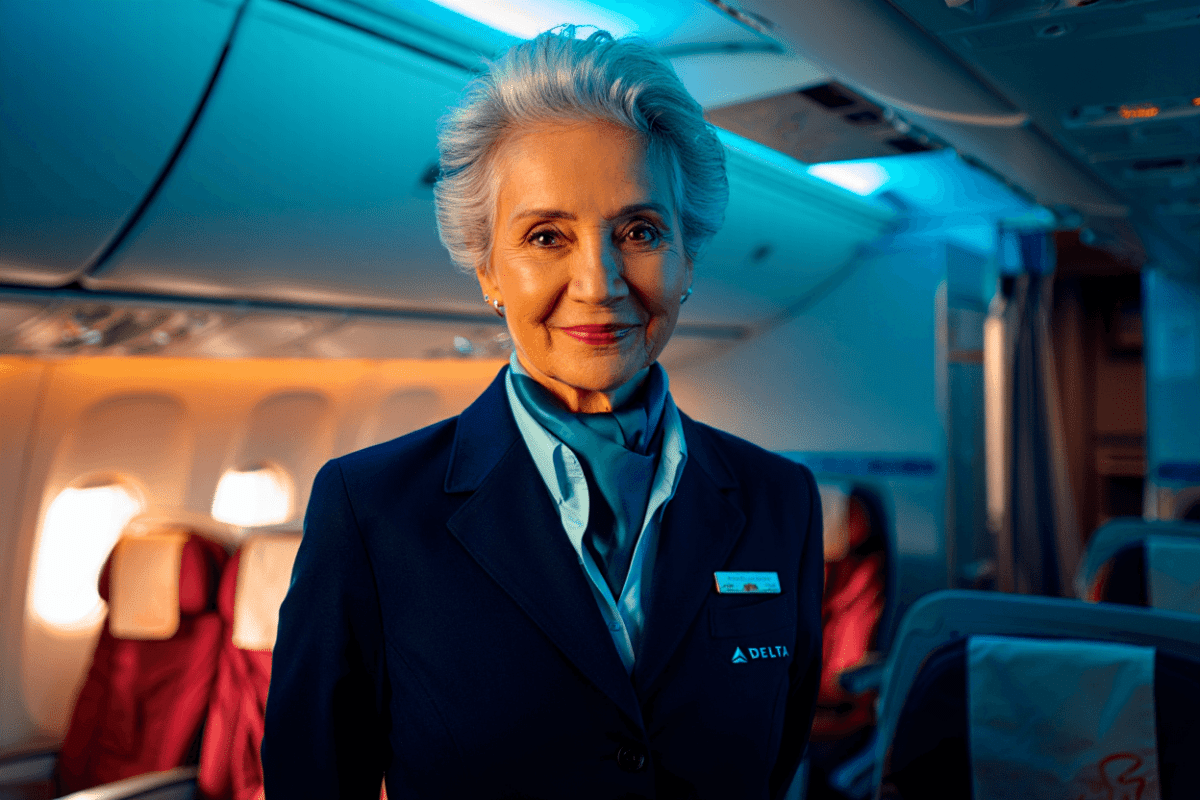
Joan Prince Crandall retires on May 30, 2026, closing out a record-breaking 66-year career as the longest-serving flight attendant in aviation history. The Delta Air Lines crew member based in Seattle has officially surpassed the previous record holder, Bette Nash, who served for 64 years and 61 days before her death in May 2024. Crandall’s seven-decade tenure spans profound transformations in civil aviation, from propeller-driven aircraft to modern jets, and represents a singular dedication to an industry where the median tenure is just 8-12 years.
🔥 Quick Facts
- 66 years of continuous service — surpassing the previous Guinness World Record
- Started in 1959 with Pacific Airlines under President Dwight D. Eisenhower
- Based in Seattle as Delta Air Lines’ most senior flight attendant
- In her 80s and still actively flying until final retirement on May 30, 2026
- Average US flight attendant career lasts only 8-12 years, making hers exceptional
A Career That Spans Seven Decades of Aviation Evolution
Joan Prince Crandall began her aviation career in 1959—the same year President Eisenhower left office, long before commercial jet travel became routine. She joined Pacific Airlines as a stewardess when the profession carried genuine prestige and glamour. The role opened doors to international travel and professional opportunity at a time when few women held comparable positions.
During her 66 years in the air, Crandall witnessed the entire modernization of commercial aviation. She has flown aircraft from the early jet age through today’s fuel-efficient wide-body jets. The industry itself transformed—from strict appearance-based hiring practices to evolving diversity standards, from mandatory retirement ages to extended active service for experienced crew members. Her persistence through these changes reflects both personal resilience and the airline industry’s gradual recognition of experienced talent.
The Exceptional Nature of a Multi-Decade Career
Industry statistics underscore just how unusual Crandall’s career duration truly is. Research shows that the typical US flight attendant serves between 8 and 12 years, with many leaving within the first 1-2 years. The profession features high turnover due to physical demands, irregular schedules, time away from family, and the rigorous nature of safety-critical work at altitude.
Within this context, Crandall’s 66 years represents not merely longevity but an extraordinary commitment. She has accumulated over five decades more experience than the typical career. Her departure marks the end of an era—the last commercial flight attendant hired in the 1950s to leave active service. Career transitions at scale are common in aviation, but individual records of this magnitude are extraordinarily rare.
Record Milestones and Historical Significance
In January 2026, Guinness World Records officially recognized Crandall as the holder of the longest career as a flight attendant. She surpassed the previous record of 64 years and 61 days, set by Bette Nash of American Airlines. Nash‘s record stood from January 2022 until her passing in May 2024 at age 88.
The transition of the record to Crandall reflects both the rarity of extended aviation careers and the exceptional caliber of a handful of dedicated professionals. Both record-holders began their careers in the 1950s, an era before mandatory retirement ages were eliminated. Crandall‘s ability to continue flying—passing age 65, then 70, and now into her 80s—represents a shift in how the industry values experienced crew and aircraft safety oversight.
| Metric | Joan Prince Crandall | Bette Nash (Previous Record) | US Average |
| Career Length | 66 years (1959–2026) | 64 years, 61 days (1955–2022) | 8-12 years (typical) |
| Starting Airline | Pacific Airlines | Eastern Airlines | Various |
| Current Age | In her 80s | 88 years (at death) | N/A |
| Hub/Base | Seattle (Delta) | Charlotte (American) | Varies by airline |
| Guinness Recognition | January 2026 (current) | January 2022 – May 2024 | N/A |
“Being a stewardess always had a certain glamour for Joan Prince Crandall. It opened doors to new experiences and gave her a chance to fly across the world at a time when the profession was distinctly aspirational.”
— Delta Air Lines Media, May 2026
The Evolving Flight Attendant Profession Over 66 Years
Crandall’s career encompasses seismic shifts in commercial aviation. When she started in 1959, flight attendants—then called stewardesses—faced strict appearance standards, mandatory retirement at age 55 in many airlines, and limited job security. The role required charm and hospitality but offered little regulatory protection.
By the 2020s, the profession had evolved dramatically. Flight attendants gained union protections, better wages (averaging $67,130 annually according to 2024 Bureau of Labor Statistics data), and seniority rights. Safety protocols expanded. Age discrimination barriers fell. Crandall benefited from these hard-won improvements, allowing her to continue flying well beyond the mandatory retirement ages of earlier decades.
Her decision to remain active—flying routes and conducting safety briefings well into her 80s—reflects confidence both in her fitness for duty and in Delta Air Lines’ recognition of her expertise. Federal Aviation Administration regulations require flight attendants to learn and execute emergency procedures, CPR, first aid, and aircraft evacuation protocols—responsibilities that demand both physical capability and mental sharpness throughout a career.
What Crandall’s Retirement Signals for Aviation’s Future
Joan Prince Crandall’s retirement on May 30, 2026, closes an exceptional chapter in aviation employment. It marks the departure of the last active flight crewmember hired in the 1950s, a generation that witnessed the birth of the modern jet age.
The milestone raises questions about knowledge transfer and institutional memory. Flight attendants like Crandall have experienced every major shift in aviation safety, from unpressurized cabin issues to modern security protocols. Their expertise, earned through thousands of flights and problem-solving across decades, cannot be easily replicated in training programs. Institutional knowledge transfer becomes critical as experienced crews retire.
Crandall’s record also highlights the sustainability of the profession. The average 8-12 year career suggests many flight attendants leave due to burnout, family obligations, or limited advancement. Crandall’s ability to sustain passion and health for 66 years indicates something unusual—either exceptional personal resilience, genuine job satisfaction, or both. For airlines seeking to improve retention and reduce costly turnover, her longevity offers insights into what keeps professionals engaged.
Will Anyone Break the 66-Year Record?
Both Crandall and her predecessor Nash began service in an era when civil aviation was entering explosive growth. They benefited from decades of expanding routes, increased demand, and stable employment. Neither experienced mass layoffs or industry consolidation early in their careers—factors that forced many of their contemporaries out of the profession.
Future record-breaking would require candidates not yet hired to match Crandall’s extraordinary combination of health, determination, and job security. Given industry-wide turnover patterns showing most new hires depart within 5-10 years, Crandall’s 66-year tenure may stand unchallenged for decades. She has set a benchmark so far beyond normal career expectations that matching it would require someone hired today to remain active until approximately 2091—far beyond conventional retirement horizons.
Sources
- CNN Travel — “After more than 66 years in the air, the industry’s longest-serving flight attendant prepares to retire” (May 30, 2026)
- Delta Air Lines Media — “Two dreams, 67 years apart: Delta flight attendants reflect International Flight Attendant Day” (May 27, 2026)
- Guinness World Records — Official recognition of longest career as flight attendant (January 2026)
- U.S. Bureau of Labor Statistics — Flight attendant occupational data and salary information (2024)
- Simple Flying — Analysis of average flight attendant career length and industry trends








God bless. It’s now time to sit back and put your feet up. Happy Retirement ✈️
Hats off to Ms. Crandall. Simply amazing. What can be accomplished with determination, devotion, and hard work. Now enjoy the rest of your life!