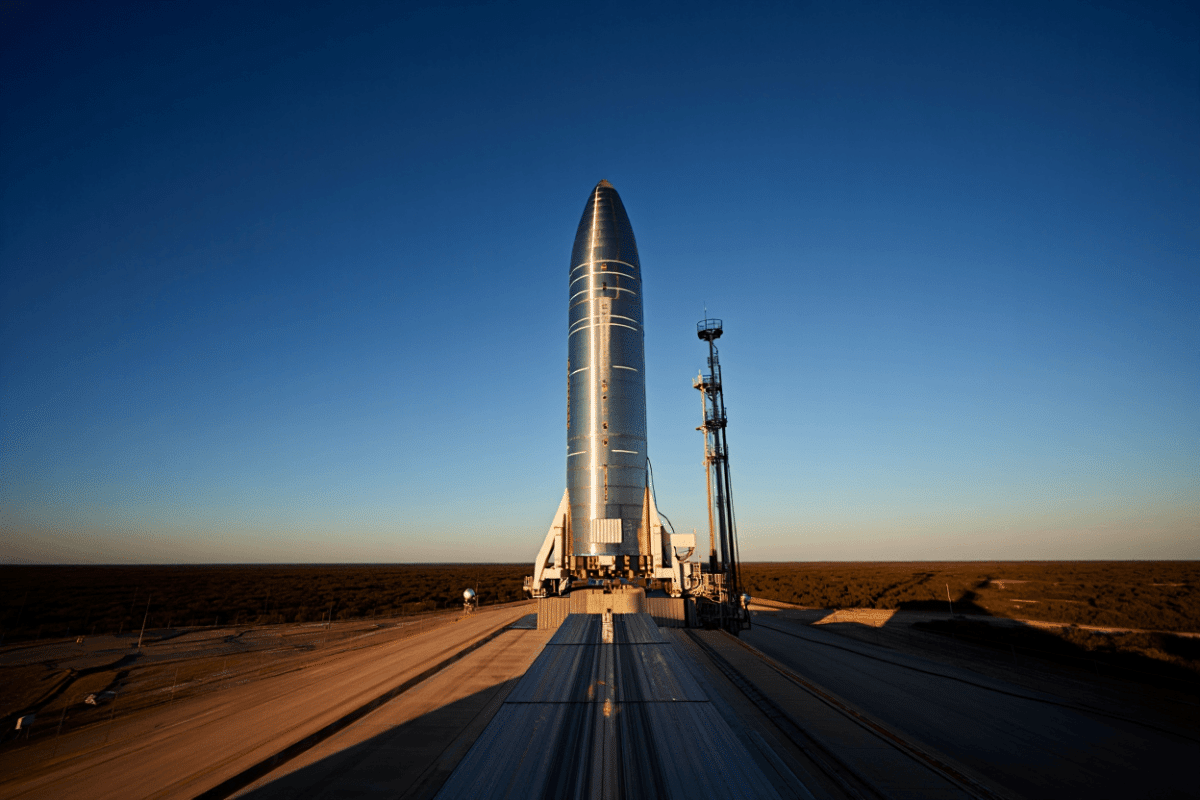
SpaceX’s Starship V3 is set to debut tonight from Starbase, Texas, marking the 12th test flight of the company’s fully reusable megarocket. The launch window opens at 6:30 PM EDT, with the mission introducing significant engineering upgrades designed to support lunar and Martian missions. This marks the first crewed-capable evolution of Starship and comes as SpaceX prepares for a record-breaking IPO later this year.
🔥 Quick Facts
- V3 features Raptor 3 engines delivering 280 metric tons of thrust per engine
- Grid fin redesign reduces booster count from 4 to 3, increases size by 50%
- Payload capacity exceeds 100 metric tons to low Earth orbit
- Launch window: 6:30 PM EDT, May 21, 2026 from Starbase, Texas
The Engineering Evolution Behind Starship V3
Starship V3 represents a fundamental redesign from previous iterations. Rather than incremental tweaks, SpaceX engineers rebuilt the Super Heavy booster and upper stage with three core improvements: enhanced engine architecture, structural optimization, and reusability infrastructure. The Raptor 3 engine, now standard across both stages, delivers greater efficiency than its predecessor while maintaining lower development costs—a critical advantage as SpaceX scales production for multiple simultaneous launches.
The grid fin configuration change exemplifies this engineering philosophy. By reducing the number of fins from four to three while increasing each fin’s size by 50%, SpaceX improves booster control authority while reducing overall drag during reentry. Engineers also integrated new mechanical catch mechanisms designed to support the booster’s capture by the launch tower’s mechanical arms—a reusability feature that shortens turnaround time between flights.
V3’s Competitive Advantage in the Launcher Market
The V3 variant’s enhanced payload capacity of 100+ metric tons to LEO positions Starship as the world’s most powerful operational rocket. By comparison, the Space Launch System (NASA’s SLS) achieves approximately 70 metric tons to the same orbit, while China’s Long March 5 reaches 25 metric tons. This advantage has direct implications for deep-space exploration, commercial satellite deployment, and point-to-point Earth transport.
SpaceX’s recent developments in technology and AI infrastructure upgrades reflect broader industry trends toward more powerful launch systems capable of deploying data-intensive payloads. Starship’s massive payload bay—measuring approximately 9 meters in diameter and 50 meters in length—accommodates both traditional satellites and emerging high-capacity missions.
Tonight’s Test Flight: Objectives and Key Milestones
| Flight Element | V3 Achievement | Historical Context |
| Booster Thrust | ~2.2 million lbs (sea-level) | First time with all Raptor 3s |
| Upper Stage Integration | Upgraded Ship 39 with extended tanks | Larger than all previous variants |
| Primary Objective | Orbital injection test + booster recovery | Demonstrates V3 as fully operational |
| Reusability Test | Tower catch landing attempt | Critical for rapid relaunch capability |
| Launch Pad | Pad 2, Starbase (recently completed) | Purpose-built for V3 operations |
“The upgraded V3 configuration features enhanced payload capacity exceeding 100 tonnes to orbit, Raptor 3 engines delivering 280 metric tons of thrust per unit, and new landing and reusability hardware designed to support rapid turnaround operations.”
— SpaceX Engineering Brief, May 2026
Strategic Implications for NASA’s Artemis Program
Tonight’s successful flight provides critical validation for Starship’s role in NASA’s Artemis lunar program. SpaceX contracted to develop the Human Landing System (HLS), which relies on orbital refueling—a capability that requires precisely choreographed tanker launches. The V3’s enhanced payload capacity and reliability metrics directly impact NASA’s timeline for returning astronauts to the Moon.
Prior test flights (Flights 1-11) demonstrated incremental progress, but V3 represents a threshold milestone by combining all proven technologies into a single, production-ready vehicle. In-orbit refueling demonstrations, originally targeted for late 2025, are now expected to occur by June 2026. Success tonight would accelerate this timeline significantly, allowing SpaceX to conduct multiple consecutive flights without hardware redesign cycles.
What Does Success Look Like for Starship V3 Today?
SpaceX has established clear success criteria for tonight’s mission: the booster must separate cleanly from the upper stage at Mach 6.5, the ship must achieve orbital velocity, and the booster must execute a controlled landing—ideally captured by the launch tower’s mechanical arms. Unlike previous test flights, this mission expends the upper stage by design, focusing entirely on booster recovery and reusability validation.
If all primary objectives succeed, Flight 13 could launch within weeks, not months. This compressed schedule would demonstrate manufacturing capability at an unprecedented scale. Historical launches of Starship have averaged 2-3 months between flights; V3’s design enables a target cadence of monthly operations, supporting both commercial and government missions simultaneously.
Will SpaceX’s V3 Debut Change the Competitive Landscape?
Success tonight positions SpaceX to dominate commercial heavy-lift for the next decade. Competitors like Blue Origin’s New Glenn and Relativity Space’s 3D-printed rockets are in development but remain 2-3 years behind Starship in operational deployment. For satellite operators, this means lower launch costs and rapid deployment windows—capabilities that were theoretical just months ago.
The IPO implications are substantial. SpaceX’s S-1 filing revealed internal projections showing profitability within 18-24 months if V3 flight reliability reaches 90%+. Tonight’s test directly impacts investor confidence in those projections. A successful launch would likely accelerate the IPO timeline; a failure would necessitate additional development delays and cost adjustments.
Sources
- Reuters (May 19, 2026) — SpaceX Starship V3 ready for debut launch
- Space.com (May 20, 2026) — V3 rocket stacked and fueling test completed
- SpaceX Official Launch Schedule — Flight 12 details and window confirmation
- NPR (May 21, 2026) — Starship launch and IPO context
- Florida Today (May 15, 2026) — Mission objectives and technical specifications