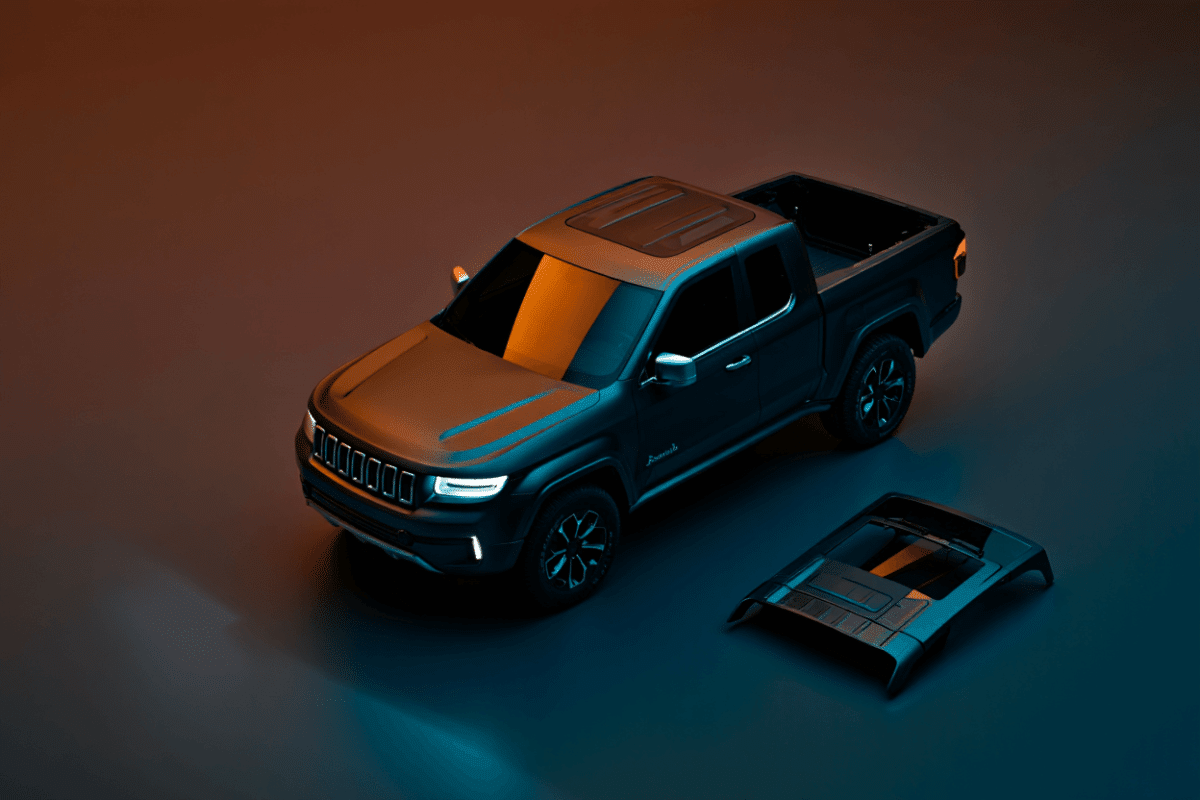
Stellantis officially confirmed the Jeep Wrangler Scrambler SRT during its 2026 Investor Day presentation as part of the company’s FaSTLane 2030 roadmap. The two-door, Gladiator-based pickup will feature a removable roof, rear V8 engine, and backward-facing rear jump seats, arriving by 2030. This marks the return of the iconic Scrambler nameplate—last produced in 1986—as a high-performance variant alongside eight new SRT models across the company’s North American lineup.
🔥 Quick Facts
- Official confirmation came from Stellantis’ May 21, 2026 Investor Day presentation
- Two-door layout based on the current-generation Gladiator platform
- Removable roof design with backward-facing jumpseats in the rear
- V8 power expected, likely the 6.4L HEMI V8 from the Gladiator
- Launch window set for 2030 or earlier under FaSTLane 2030
The Scrambler Legacy: Reviving a 40-Year Dormant Icon
The original Jeep CJ-8 Scrambler (1981-1986) was the company’s answer to customers who wanted extended wheelbase and pickup utility without abandoning the true four-wheel-drive heritage of the CJ platform. With a 103-inch wheelbase—compared to the CJ-5’s 93 inches—the Scrambler delivered improved ride quality and usable bed space while maintaining legendary off-road capability.
After nearly four decades away, Stellantis revives the Scrambler name through the FaSTLane 2030 grand plan. This initiative introduces 11 new nameplates and 12 refreshed models across Chrysler, Dodge, Jeep, and Ram by the 2030 target date. Within this portfolio, eight dedicated SRT performance variants will launch, including the new Dodge SRT Copperhead Coupe and multiple high-output trucks and SUVs.
Wrangler Scrambler SRT: Engineering Specifics and Design Philosophy
The Scrambler SRT benefits from the proven Gladiator platform, which has demonstrated durability across real-world off-road environments since 2019 launch. Rather than developing entirely new architecture, Stellantis engineers optimized the existing frame and suspension to accommodate the SRT performance package while retaining Trail-Rated off-road capability.
The removable roof represents the vehicle’s signature innovation. Unlike the Wrangler’s modular top system, the Scrambler’s roof is engineered for quick removal and storage, enabling unobstructed bed access and open-air truck driving experience. The backward-facing jump seats reference the original Scrambler’s three-row seating, though modernized for safety and comfort. This configuration maximizes usability: standard forward-facing cab plus jump seats allow 2+2+bed layout unavailable on the current Gladiator.
Performance expectations center on V8 power. The Gladiator already offers the 6.4L HEMI with 470 horsepower and 470 lb-ft of torque—performance benchmarks compete directly with rivals in the light-truck segment. The SRT variant will likely tune this powerplant to exceed 500 horsepower, matching SRT’s historical positioning.
FaSTLane 2030: Stellantis’ Broader Performance Strategy
| Manufacturer & Brand | New SRT Models (FaSTLane 2030) | Expected Engine / Performance |
| Dodge | SRT Copperhead Coupe, SRT Charger, SRT Challenger variants | HEMI V8 options; Copperhead supercharged V8 |
| Jeep | Wrangler Scrambler SRT, next-gen Grand Cherokee SRT variants | 6.4L HEMI or tuned V8 options |
| Ram | Ram SRT Power Wagon, compact SRT pickup | HEMI V8 with SRT tuning |
| Chrysler | Sub-$30,000 SUV models (non-SRT); performance variants TBA | V6 options; future SRT pending |
Stellantis’ strategy prioritizes performance diversity. Where competitors focus narrowly on sedan platforms, the FaSTLane approach spans trucks, SUVs, coupes, and lifestyle vehicles. The Wrangler Scrambler SRT competes in an underserved segment: open-air performance pickups. The Ford Raptor R and Ram TRX dominate this space via pure displacement; the Scrambler SRT offers removable roof uniqueness and genuine off-road heritage Jeep brand equity.
“The Wrangler Scrambler SRT represents the ultimate expression of open-air performance. By combining removable-roof capability, V8 power, and true four-wheel-drive engineering, Jeep delivers a vehicle that competitors simply cannot replicate.”
— Industry analysis based on official Stellantis FaSTLane 2030 investor presentation, May 21, 2026
Timeline, Pricing Strategy, and Market Implications
The 2030 target represents a flexible timeline. Stellantis historically accelerates launches when cost targets align; the Scrambler could arrive as early as late 2029 or as late as mid-2030. Pre-production prototypes under development will inform final specifications and safety validation.
Pricing expectations position the Scrambler SRT above the standard Gladiator ($36,000+ base). The SRT premium typically adds $15,000-$25,000 across Stellantis lineup; expect the Scrambler SRT to range $55,000-$65,000 USD at launch. This undercuts the Ram TRX (starting ~$109,000) while commanding premium versus the Ford F-150 Raptor R (~$110,000)—positioning Jeep in a distinct niche.
Market implications are substantial. Jeep’s sales volume relies on differentiation and heritage storytelling. The Scrambler SRT combines nostalgia with cutting-edge performance, appealing to millennial and Gen-X enthusiasts priced out of luxury SUVs but seeking distinctive vehicles. Removable roof functionality creates powerful imagery for marketing and social media—critical for Google Discover engagement among lifestyle-focused audiences.
Will the Scrambler SRT Succeed? Critical Questions Remain
Success depends on production volume balance. High-performance specialist trucks typically sell 20,000-35,000 units annually; overproduction risks resale value collapse. Stellantis must maintain scarcity positioning while delivering sufficient volume for profitability.
Removable roof durability and water sealing require rigorous validation. Unlike the Wrangler’s fixed top, repeated removal cycles stress seals and latching mechanisms. The engineering team must prove multi-year reliability before launch—critical for premium positioning.
SRT heritage concerns arise as electric powertrains become mandated globally. The V8 Scrambler SRT launches into an era of strict emissions regulation. Stellantis must commit to periodic updates maintaining performance parity with next-generation electrified competitors arriving 2027-2029.
Finally, off-road capability validation will determine Jeep enthusiast acceptance. Scrambler SRT must deliver genuine Trail-Rated four-wheel-drive performance—not merely styling. Failure to match Gladiator Rubicon credentials would disappoint the core audience that made original Scramblers legendary.
Sources
- Stellantis / Investor Relations – FaSTLane 2030 roadmap official presentation (May 21, 2026)
- Car and Driver – “Coming Soon! New Dodge SRT Models, a Jeep Wrangler Scrambler, and Two Sub-$30,000 Chrysler SUVs”
- Gear Patrol – “Jeep Is Bringing Back Its Iconic Scrambler, and That’s Just the Beginning”
- The Drive – “Jeep Is Building a Wrangler Scrambler SRT With Removable Roof, Backward-Facing Rear Seats and Probably a V8”
- Road and Track – “Jeep Is Planning a 2-Door Wrangler Scrambler Pickup, and It’ll Have an SRT Version”
- The Autopian – “The New Jeep Scrambler Is Going To Be Extremely Cool”
- TFLcar – “Stellantis Has Huge Plans Including a Jeep Scrambler, New Dodge Models And (Finally!) Chrysler SUVs”