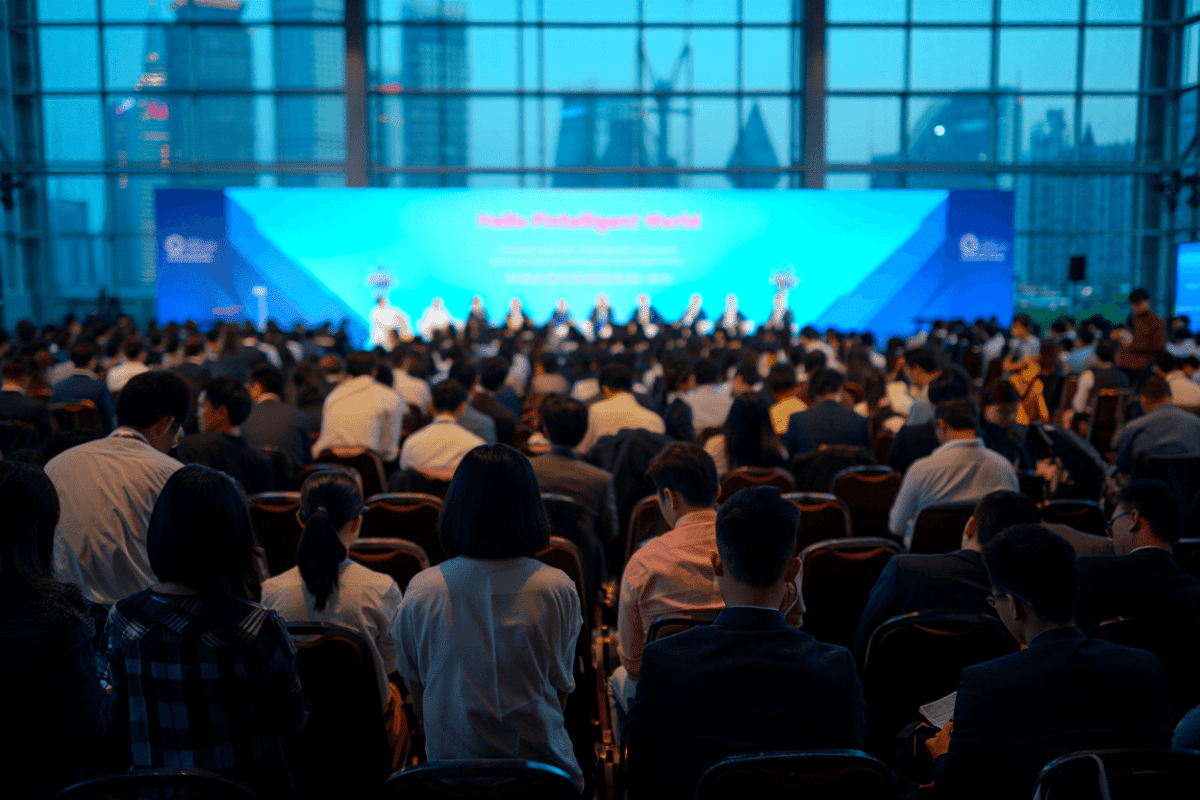
Huawei’s Intelligent Finance Summit 2026 is bringing together financial leaders, technology partners, and banking innovators in Shanghai May 20-21 to unveil comprehensive agentic banking AI strategies. The two-day event at Huawei Lianqiu Lake Campus marks the company’s most ambitious financial services conference, introducing the RONGHAI Program and exploring how banks can transition from digital transformation to autonomous, AI-driven operations.
🔥 Quick Facts
- Summit dates: May 20-21, 2026 at Huawei Lianqiu Lake Campus in Shanghai
- Theme: “Hello Fintelligent World | Beyond Digital, Advance to Agentic Banking”
- RONGHAI Program connects customers, system integrators, ISVs, and Huawei
- Focus: Agentic AI transforming transactions, risk control, and decision-making
- Audience: Board and C-level executives, financial services leaders, technology partners
Why Agentic Banking Matters Now
The financial services industry is reaching an inflection point. Traditional AI in banking has focused on automation—streamlining processes, reducing costs, improving efficiency. But agentic AI represents a fundamentally different paradigm: autonomous systems that can understand context, make decisions, and execute transactions with minimal human intervention.
Huawei’s positioning reflects broader industry recognition that the future of banking depends on infrastructure resilience, open-source AI frameworks, and ecosystem partnerships. Banks that embrace this transition will compete on speed, intelligence, and adaptability rather than legacy technology investments.
The RONGHAI Program: Building a Financial AI Ecosystem
At the core of Huawei Intelligent Finance Summit 2026 is the RONGHAI Program, an ecosystem initiative bringing together multiple stakeholder categories. The program facilitates collaboration between customers (financial institutions), system integrators (SIs), independent software vendors (ISVs), and Huawei to co-create solutions in resilient and intelligent banking.
This model reflects a shift in how technology leaders approach enterprise transformation. Rather than selling monolithic platforms, Huawei is positioning itself as a platform orchestrator connecting financial services innovators. The RONGHAI framework emphasizes open integration, modularity, and rapid deployment—critical capabilities as banks race to implement AI strategies.
According to Huawei’s Financial Services Initiative (FSI), the program has expanded to over 150 partners, signaling substantial industry adoption. The summit provides visibility into how these partnerships translate into real-world banking transformations and what technical infrastructure demands emerge from agentic AI deployment at scale.
Summit Agenda: Agentic Banking in Practice
The summit structure reflects the summit’s core message: moving beyond digital transformation toward autonomous intelligence. Attendees explore how agentic AI redefines three critical banking functions:
| Banking Function | Traditional AI Approach | Agentic AI Impact |
| Transactions & Payments | Rule-based automation | Real-time adaptive routing, fraud prevention via autonomous agents |
| Risk Management | Predictive analytics (batch) | Continuous risk agents monitoring, autonomous mitigation decisions |
| Decision-Making | ML recommendations to humans | Autonomous agents executing within guardrails, human-in-loop oversight |
Board-level sessions at the summit focus on strategic questions: How do banks govern AI agents? What regulatory frameworks are emerging? How do you build organizational trust in autonomous systems? These conversations acknowledge that agentic deployment introduces complexity beyond traditional AI implementation—governance, liability, and organizational change management become competitive differentiators.
Global AI Infrastructure Trends Shaping Financial Services
Huawei’s timing for the summit reflects broader momentum in global AI adoption. The recent OpenAI token initiatives for startups highlight how AI infrastructure and foundation models have become table stakes for innovation across industries, particularly fintech. Financial services startups now compete partly on AI modeling sophistication and infrastructure access rather than purely on domain expertise.
For established banks attending Huawei’s summit, the implication is clear: lagging on AI infrastructure puts them at competitive risk relative to agile, capital-rich fintech competitors. The convergence of open-source AI frameworks, cloud-native banking architectures, and agentic capabilities is compressing the timeline for legacy institutions to modernize. Huawei’s data storage and server solutions (heavily promoted at the summit) are marketed explicitly as foundational to AI-at-scale deployments.
Data Infrastructure as a Strategic Bottleneck
The summit’s emphasis on data storage and cloud infrastructure reflects a technical reality often overlooked in AI hype: agentic systems demand extreme reliability and low-latency data access. A trading agent making decisions in milliseconds, or a risk management agent evaluating portfolio exposure in real-time, cannot tolerate traditional batch processing or network delays. This reality explains why Huawei is positioning infrastructure resilience as a core message alongside AI strategy.
For US financial institutions and technology leaders following this summit, the infrastructure implications are significant. The vendors who control data processing capacity, storage optimization, and cloud architecture will shape which agentic AI strategies are practical versus theoretical. This competitive dynamic extends to international finance, where geopolitics increasingly influences which cloud and infrastructure providers banks select for critical operations.
What Emerges After May 21?
As the summit concludes, the financial services industry will assess whether Huawei’s agentic banking vision resonates with practitioners or remains strategic positioning ahead of institutional adoption. Key indicators to watch: Which RONGHAI Program announcements receive customer commitments? Do board-level attendees signal timeline acceleration for agentic AI deployment? Do summit insights reshape how banks vendor-select infrastructure and AI platforms for the next 18-24 months?
The broader question underlying this summit: Is the industry’s shift from digital transformation to autonomous intelligence merely rhetorical—a rebranding of existing AI capabilities—or does it represent a genuine inflection in how financial services operate? Huawei’s Shanghai summit provides one data point; evidence will accumulate over the next quarters as banks translate words into deployments.
Sources
- Huawei Enterprise Events – Huawei Intelligent Finance Summit 2026 official platform and registration materials
- Facebook / Huawei Official Accounts – RONGHAI Program announcements and summit coverage (May 20-21, 2026)
- Huawei Intelligent Finance Solution – Banking AI and agentic systems strategy documentation
- Financial IT and FinTechNews – Expert coverage of Huawei’s AI banking strategies from MWC and industry conferences
- PR Newswire – Huawei financial services AI solution announcements (March 2026)