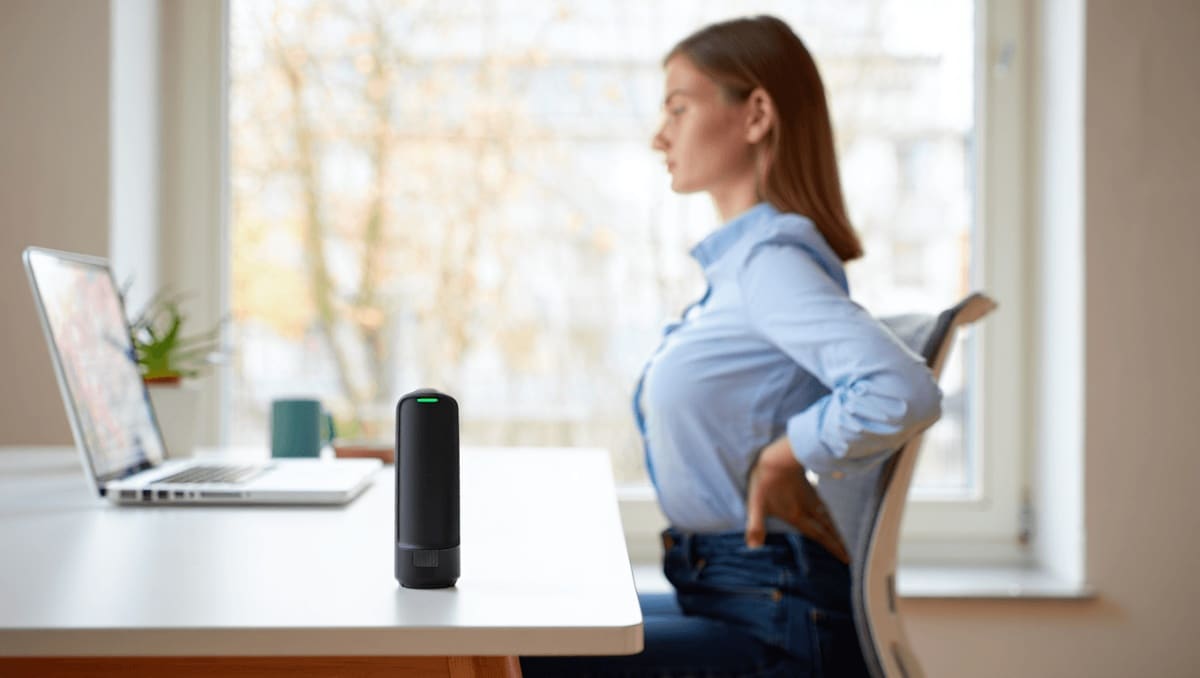
A small desk gadget from a German startup aims to nudge remote workers into better habits: correct posture, regular movement and even healthier air — all without a camera. For people spending long hours at a home desk, that blend of monitoring and privacy could change daily routines and rethink how workplace wellness hardware is used at home.
Called Isa, the device resembles a compact digital clock with a 5.5-inch IPS HD display and runs from a USB-C supply. Its makers emphasize local sensing over cloud cameras: posture, movement, drinking and environmental data are gathered by onboard sensors rather than video, a distinction that shapes both its usefulness and its limits.
The sensor suite centers on a Time-of-Flight 3D depth sensor that watches body position and motion from the desk. That same element enables experimental features such as counting sips of water. The company lists the effective range at roughly 0.15 to 1.8 meters, so Isa can detect standing or stepping away as well as seated alignment.
Complementing the 3D ToF are a 1D ToF sensor, a gyroscope, barometer, ambient light sensor, sound-level meter, a CO₂/VoC air-quality sensor, and temperature/humidity measurement. Processing happens on a quad-core 2 GHz chip inside the unit, and Wi‑Fi is used only for firmware updates if the owner enables it.
Setup is intentionally simple: you enter a few basic details about your workday and the device begins tracking. One early limitation to note: time zones are currently limited to EU and U.S. regions, a constraint the company says it will expand over time.
On the screen, posture is communicated with a rounded-square ring that fills according to how well you sit; a separate “water tank” visual keeps score of fluid intake. The device vibrates to prompt corrections when posture slips and offers short, on-screen guided exercises when you’ve been still too long. Return to the desk and the movement counter resets.
Because Isa deliberately excludes a camera, several trade-offs appear in everyday use. Objects placed between the sensor and the user, a passing pet or a family member walking by can register as presence and occasionally skew the activity log. Isa typically switches to a clock display when it determines the desk is empty, but there is no dedicated manual “away” control on the unit, which some users may miss.
On balance, these are not fatal flaws: in testing the device prompted posture checks far more reliably than untethered habit apps, and the guided movement prompts proved genuinely useful when followed.
Why this matters now: as hybrid and remote work continue, devices that encourage short behavioral changes — standing, breathing, eye breaks — are becoming part of the home office ecosystem. Isa’s sensor-first, no-camera approach raises new questions about accuracy and convenience, while also addressing privacy concerns many users care about.
- Privacy-focused sensing: no camera, on-device processing possible
- Multimodal tracking: posture, movement, drinking, light, sound, CO₂ and more
- Actionable nudges: haptic alerts and on-screen exercises
- Limitations: occasional false detections, limited time-zone support, no manual “away” button
| Specification | Detail |
|---|---|
| Display | 5.5-inch IPS HD |
| Power | USB-C, ≈2.45 W consumption |
| Processor | Quad-core 2 GHz |
| Key sensors | ToF 3D & 1D, gyroscope, barometer, light, sound, CO₂/VoC, temp/humidity |
| ToF range | ≈0.15–1.8 meters |
| Connectivity | Wi‑Fi (for updates; optional) |
| Price | €299 (about $354) |
| Subscription | Core €4.99/mo; Pro €7.99/mo |
Deep Care — founded by ex-Bosch employees along with a former Tesla engineer — originally sold Isa to businesses before opening direct sales to consumers. The shift tests whether a premium hardware device paired with a subscription plan can appeal to home users who want measurable desk wellness benefits.
Subscription tiers divide core posture and habit-tracking features from environmental monitoring. The lower tier covers posture feedback, sitting-habit tracking, drinking detection and access to an exercise library. The higher tier adds continuous monitoring of light, noise and CO₂ levels, intended to help users optimize their workspace.
Looking ahead, the company says it plans to explore mental-health signals by combining posture and chest movement with environmental readings to derive stress-related indicators. Those features, if introduced, will amplify both the potential usefulness and the privacy conversation around sensor-driven wellness tools.
Who should consider Isa? If you are regularly working from home and want persistent, passive reminders to sit better and move more, Isa is a thoughtful option that prioritizes privacy over video monitoring. The cost — upfront and ongoing — is not negligible, so weigh its features against how seriously you want to change desk habits.
For many, the device’s value will be practical: small tactile reminders and simple visual feedback that break long sitting stretches. For others, the occasional false positives and the subscription model may temper enthusiasm. Either way, Isa illustrates how hardware makers are trying to redesign the home office with health and privacy in mind.