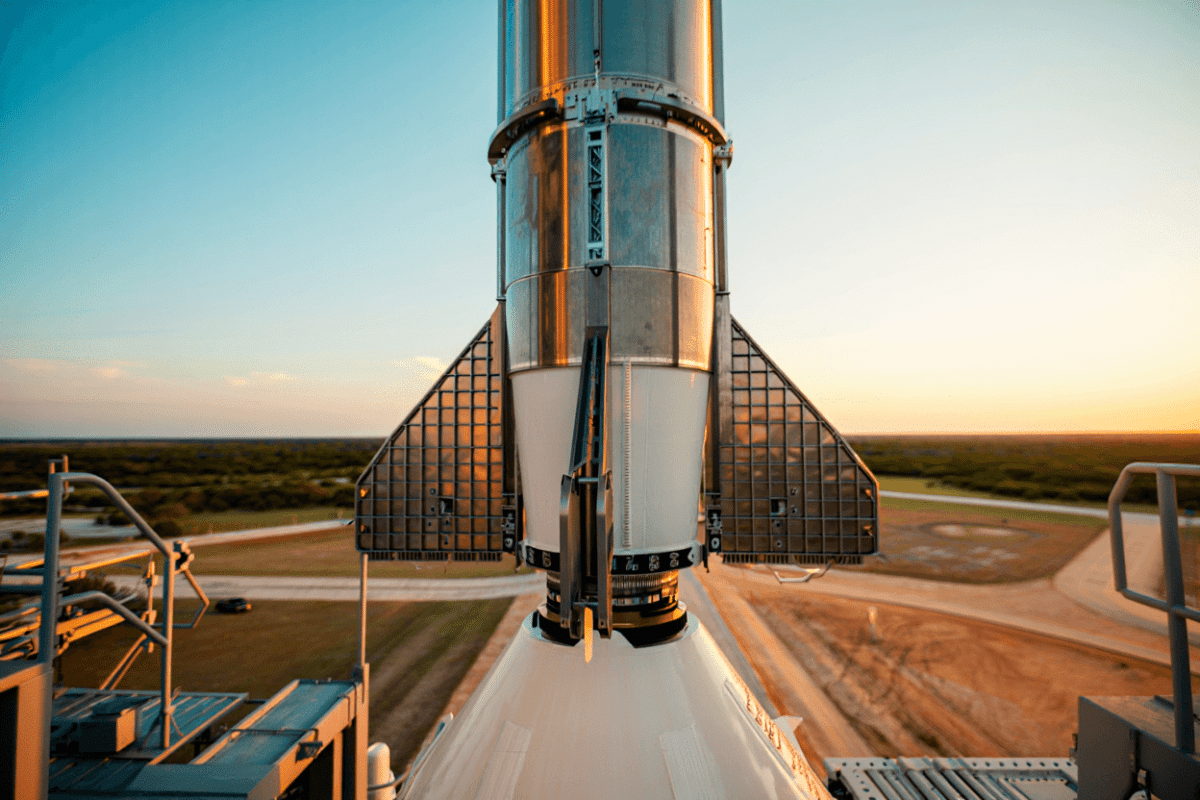
SpaceX targets May 21, 2026 for the 12th Starship test flight, marking the debut of the Starship V3 megarocket at Starbase in South Texas. This mission represents a critical engineering milestone: a ground-up redesign incorporating fewer but larger grid fins, a completely overhauled propulsion system, and increased tank capacity. Success here strengthens SpaceX’s path toward full reusability—essential groundwork before the company’s anticipated initial public offering later this year.
Key Facts
- Launch Window: Opens 5:30 PM CDT (6:30 PM EDT) on Thursday, May 21
- Vehicle: First-ever Starship V3, 282-foot Super Heavy booster (50 feet taller than V2)
- Payload Target: Over 100 tons to Low Earth Orbit with full reusability
- Flight Duration: Approximately 54 minutes coast-to-coast trajectory
- IPO Context: Test comes weeks before SpaceX’s expected summer 2026 public listing
Clean-Sheet Redesign Powers the Next Generation
Starship V3 represents the most comprehensive overhaul in the rocket program’s history. Rather than incremental updates, SpaceX fundamentally reimagined the propulsion architecture, structural layout, and grid fin configuration. The Super Heavy booster now stands 282 feet tall, stretching 50 feet beyond V2’s original height, with correspondingly expanded fuel tanks to maximize propellant volume without proportional weight penalties.
The redesigned engines introduce a new Raptor startup protocol, reducing propellant leakage during pressurization and enabling more reliable deep-throttle control during the landing burns. These aren’t merely updated versions—they’re fundamentally new units built to stricter tolerances. Weight savings across the engine bay total over 1 ton per engine, a compound advantage that multiplies across 33 Raptor engines on the booster alone.
Grid Fins Go Bold: Fewer, Larger, Stronger
V3’s most visible change replaces the four-fin grid configuration with three larger fins, each 50% bigger and 30% stronger than predecessors. This counterintuitive geometry—reducing quantity while increasing size—leverages advanced computational fluid dynamics absent from earlier generations. The new design improves supersonic stability during descent while simplifying manufacturing and reducing stress on attachment points.
This shift alone signals SpaceX’s confidence in simulation tools. Previous versions relied on four fins partly due to manufacturing constraints and conservative aerodynamic assumptions. The move to three fins requires precision that only comes from thousands of hours of computational modeling and ground testing. The vertical landing sequence will provide real-world validation of this bolder approach.
Technical Specifications: V3 vs. V2 Comparison
| Specification | Starship V2 | Starship V3 |
| Super Heavy Height | 232 feet (71 m) | 282 feet (86 m) |
| Raptor Engines | V2 Design | New Startup Protocol |
| Grid Fins | 4 Standard Size | 3 Fins, 50% Larger |
| Propellant Capacity | 850 metric tons | 920+ metric tons |
| Target LEO Payload | ~75 tons (expended) | 100+ tons (reusable) |
The increased propellant capacity combines with architectural refinements to push reusable payload capacity above 100 tons to Low Earth Orbit—a threshold historically associated only with expendable superheavy-lift vehicles. V3 achieves this as a fully reusable system, fundamentally altering the economics of space access.
“Version 3 may face some initial problems because it’s a radical redesign. But if this test is successful, and the next few flights go well, we will have the most powerful operational rocket in the world.” — According to recent statements from SpaceX leadership in media reports.
— SpaceX Leadership, on engineering risk and operational timeline
Why This Test Matters for the IPO Push
SpaceX filed confidentially for its initial public offering in April 2026, with a summer 2026 target and an expected valuation between $1.75 trillion and $2 trillion. The Starship V3 Flight 12 test lands precisely in the window when public market scrutiny is intensifying. A successful debut validates the company’s technical roadmap and demonstrates disciplined execution of the most ambitious redesign in the program’s history.
Investors will focus on several validation points: whether the larger propellant tanks perform reliably, if the three-fin configuration delivers expected aerodynamic stability, and whether the new Raptor startup sequences function without anomaly. Safe booster recovery and sustained upper-stage coast phases would signal that SpaceX has solved problems that plagued earlier flights. Each successful milestone reduces perceived execution risk ahead of share pricing.
What Happens If May 21 Launch Slips Further?
SpaceX already delayed Flight 12 from May 19 to May 21, citing the need for preflight validation checks. A backup launch window extends through May 22, providing a 48-hour target window. Weather probability for coastal South Texas in late May typically favors launch within this timeframe, though rare frontal systems occasionally force longer delays.
If the launch postpones beyond May 22, SpaceX would likely stand down for hardware inspection, propellant reconditioning, or software refinement. Multiple delays before the IPO would intensify investor questions about execution predictability—a metric essential to public market confidence.
Can Starship V3 Sustain SpaceX’s Reusability Dream?
Full reusability remains the ultimate measure of success. Flight 12 will test the booster landing sequence with V3’s new tail fins in a South Texas recovery zone, then proceed to the upper stage’s coast and controlled splashdown in the Indian Ocean. Each element—booster ascent, engine cutoff, grid fin control authority, landing leg deployment, thrust vector control during descent—must execute flawlessly to advance toward the orbital refueling missions planned for 2026.
Unlike expendable rockets, reusable systems demand extraordinary reliability not just on ascent but through multiple precise landing burns. The Starship V3 flight data will reveal whether increased scale, new engine protocols, and revised structural designs hold up under the thermal and structural stresses of orbital flight and re-entry.
What Does Success Look Like—And How Might It Change the Space Industry?
If May 21’s test achieves booster recovery, sustained upper-stage operations, and controlled splashdown, SpaceX will enter the next phase: orbital propellant transfer. This capability—transferring fuel between Starship vehicles in orbit—unlocks all downstream missions: lunar cargo, human lunar landing, and eventually Mars architecture. The test flight itself won’t include transfer demonstrations, but positive data would validate the engineering foundation required.
Success also strengthens SpaceX’s negotiating position with NASA regarding Artemis lunar missions and sets a technical baseline for commercial lunar lander contracts. Competitors, whether government-backed SLS programs or emerging private alternatives, will adjust timelines and investment strategies based on V3’s demonstrated capabilities. The ripple effects echo far beyond a single test flight; they reshape the entire commercial space ecosystem.
Sources
- Space.com – SpaceX Starship Flight 12 Technical Analysis
- Reuters – SpaceX IPO Filings and Starship V3 Specifications
- The Korea Herald – SpaceX Starship V3 Ready for Debut Launch Coverage
- Forbes – Starship’s High-Stakes Fifth 2026 Test Flight Timeline
- SpaceX Official Updates – Starship V3 Technical Redesigns and Launch Cadence