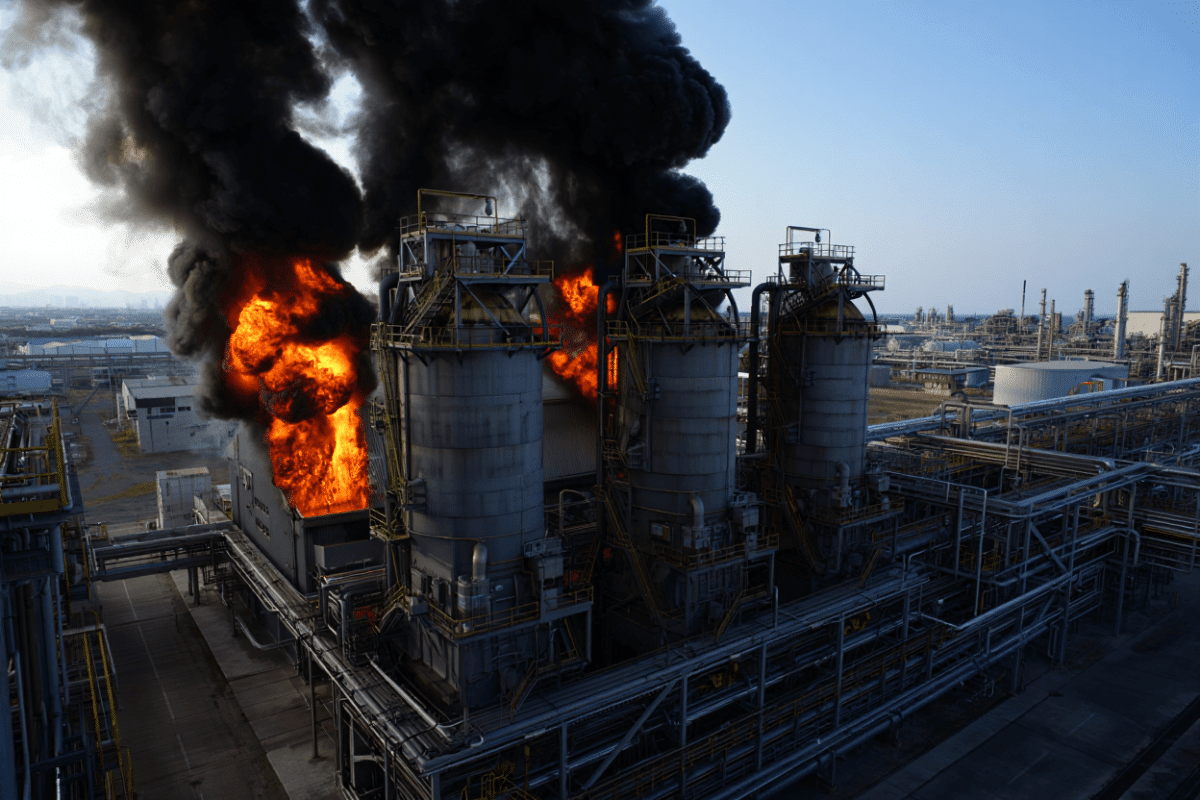
Ukrainian drones struck Russia’s Ryazan oil refinery on the night of May 15, 2026, igniting massive fires at one of the country’s largest oil-processing facilities. The General Staff of Ukraine’s Armed Forces confirmed direct hits on critical refining units, marking another significant blow to Russia’s energy infrastructure after four civilians were killed in related strikes.
🔥 Quick Facts
- Four processing units damaged: AVT-3, AVT-4, AT-6, plus diesel hydrodesulfurization facility
- Death toll: At least 4 people killed in Ryazan region during strike
- Facility capacity: Rosneft’s refinery processes approximately 80,000 barrels per day
- Strategic significance: Supplies critical fuel to Russian military operations
- 2026 campaign scale: Ukraine targeted 16 refineries January-May, doubling 2025 pace
Ukraine’s Escalating Campaign Against Russian Oil Infrastructure
The May 15 attack on Ryazan represents a dramatic intensification of Ukraine’s long-range drone strategy. According to Reuters calculations, Ukrainian strikes knocked out approximately 700,000 barrels per day of refining capacity between January and May 2026 across 16 facilities—double the eight refineries targeted during the same period in 2025.
This strategic shift reflects Ukraine’s evolution from defensive missile targets to offensive energy-sector operations. The campaign directly reduces Russia’s military fuel supply while damaging Moscow’s federal budget, where oil and gas taxes represent roughly one-quarter of annual revenue.
Technical Damage Assessment and Military Impact
Ukrainian military intelligence confirmed that vacuum distillation units AVT-3 and AVT-4, along with atmospheric distillation unit AT-6 and a diesel fuel hydrotreatment facility, sustained direct damage. These are primary processing units—the foundation of any refinery’s operations.
The Ryazan refinery, operated by state-owned Rosneft, represents one of Russia’s four largest refineries with a capacity of 80,000 barrels per day. When primary distillation units go offline, the entire facility cannot begin the crude-to-fuel conversion process, multiplying the impact beyond the damaged units themselves.
Broader Energy Crisis: Ukraine Targets 16 Refineries in 5 Months
Ukraine’s broader 2026 refinery campaign demonstrates unprecedented scale and precision:
| Metric | 2025 (Jan-May) | 2026 (Jan-May) | Change |
| Refineries Targeted | 8 | 16 | +100% |
| Refining Capacity Lost (bpd) | ~400,000 | ~700,000 | +75% |
| Primary Units Offline | 12 units (1.37M bpd) | 35 units (2.85M bpd) | +192% |
| Russia’s Crude Output Decline (y/y) | N/A | -460,000 bpd | April 2026 vs 2025 |
| Oil Product Exports (April 2026) | Higher | 2.2M bpd (record low) | -340,000 bpd vs March |
The International Energy Agency reported that Russia’s crude output fell by 460,000 barrels per day year-over-year in April 2026 to approximately 8.8 million bpd. Oil product exports dropped to their lowest recorded level at 2.2 million bpd—a 340,000 bpd decline from March alone.
“Ukraine has stepped up drone attacks on Russia’s energy infrastructure, doubling the number of oil refineries targeted since the start of the year. The strikes, which have also hit pipelines and storage facilities, have reduced Russia’s oil output—the world’s third-largest after the US and Saudi Arabia—adding pressure to Moscow’s federal budget.”
— Reuters Energy Analysts, May 14, 2026
Economic and Strategic Implications for Russia’s War Machine
The Ryazan refinery downturn creates cascading consequences for Russia’s economy and military logistics. With oil and gas taxes representing 25% of Moscow’s federal budget, sustained production losses directly constrain government spending on defense operations now in their fifth year.
Russia reported intercepting 355 drones during the May 15 strike cycle—underscoring both the scale of Ukrainian operations and Russia’s air defense strains. Yet intercepting drones before they reach their targets proves increasingly difficult, as demonstrated by the confirmed damage at Ryazan and simultaneous strikes on Gazprom’s Astrakhan gas facility.
Notably, Russia had previously halted publishing sensitive energy data since February 2022, making independent verification of production losses more difficult. However, IEA data and satellite imagery analysis provide third-party confirmation of Ukraine’s campaign effectiveness.
What Happens Next in the Energy War?
The Ryazan strike raises critical questions about Russia’s energy future and the wider conflict trajectory. How quickly can Russia repair or redirect processing to undamaged refineries? Will Moscow prioritize defensive air systems over military expenditures—a choice that stretches already-strained budgets?
Ukraine’s demonstrated capability to reach facilities deep within Russian territory—including strikes near Moscow—suggests this strategy will persist. Meanwhile, global energy markets monitor Russian export disruptions, which could drive oil prices higher. For American consumers, geopolitical energy shocks often translate into gas pump pressure—making Ukraine’s refinery campaign a financial issue above the tactical battlefield.
Sources
- Ukrinform (Ukraine’s National News Agency) — General Staff damage assessment and processing unit specifications
- Reuters — Energy production data, refining capacity calculations, and IEA crude output figures
- The Guardian, RFE/RL, The Moscow Times — Civilian casualty reports and attack confirmation
- Kyiv Independent — Video documentation of fires and facility damage
- Atlantic Council and Baker Institute — Strategic analysis of Ukraine’s energy campaign evolution