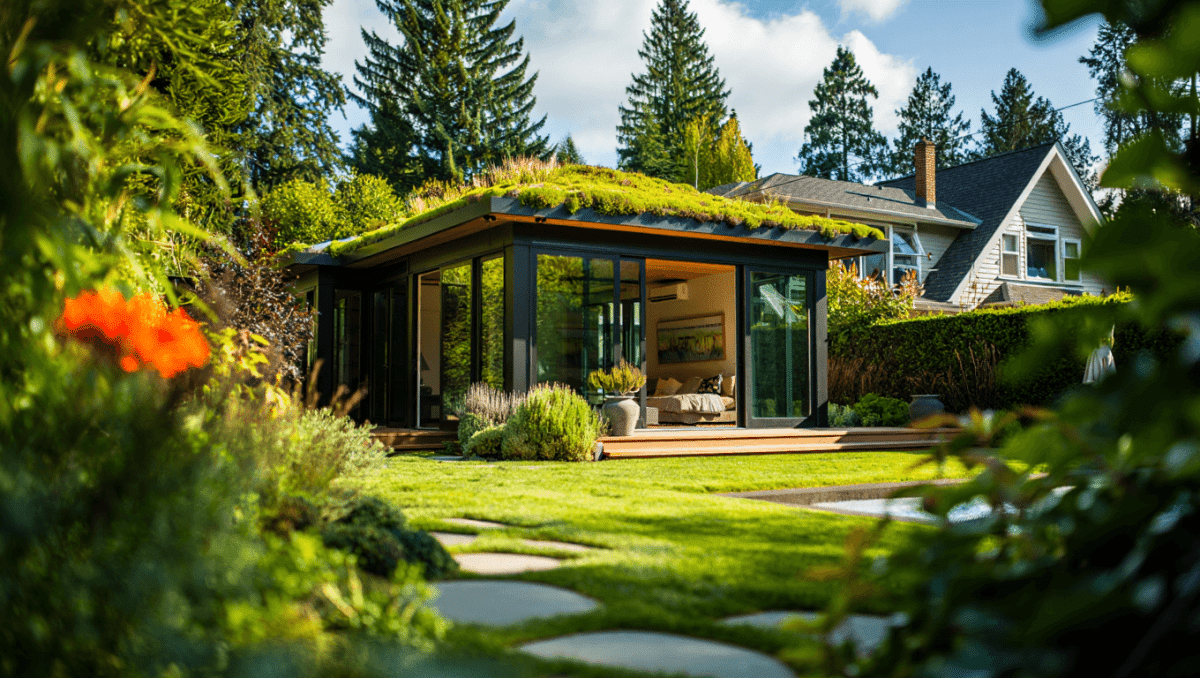
Wave incoming: the US ADU housing market has exploded to $21.45 billion in 2026. Washington state just overtook California as the national leader in permit growth, signaling a historic shift in how Americans are housing themselves. Here’s why this quiet revolution matters.
🔥 Quick Facts
- Market Valuation: ADU housing reached $21.45 billion globally in 2026, with projections climbing to $47.31 billion by 2035
- Washington Leadership: HB 1337 (effective July 2025) established the most permissive ADU regime in the US, surpassing California
- California Legacy: 127% of all new single-family construction now occurs as ADUs in California, reshaping residential development
- National Data: Over 2.8 million ADU permits issued nationwide, with 32% from California, 18% from Florida, 6% from Washington
Washington Eclipses California as the ADU Champion
Washington’s HB 1337 didn’t just legalize accessory dwelling units statewide, it rewrote the rules. Signed in 2023 and fully effective July 2025, the law mandates that cities and counties allow at least two ADUs per residential lot, with no owner-occupancy requirements and clear design parity protections not found in California law. Seattle leads the charge with ADU construction now outpacing single-family home building for the first time in major US history.
Height and setback parity provisions in HB 1337 eliminate the back-door tactics cities historically used to suppress ADU development. Street improvement prohibition removes one of the largest cost drivers, saving detached ADU builders up to $30,000 per project. This precision matters because California allowed too many local loopholes, while Washington closed them systematically.
The Market Mechanics Driving $21.45 Billion in Value
Three distinct use cases drive the ADU housing boom. The first is multigenerational housing, which accounts for roughly 44% of all ADU construction. Adult children, aging parents, and extended family members create built-in tenancy that’s both economically durable and socially resilient. The second is rental income generation, representing 30-40% of permitted units, where a typical Seattle 1-bedroom detached ADU commands $1,800 to $2,500 monthly rent, yielding 6-10% pre-tax returns on $250,000 to $350,000 construction costs.
The third emerging use case is aging-in-place strategy, where homeowners in their 50s and 60s build ADUs now with explicit intent to downsize later while renting the main house and remaining on the family lot. Washington’s removal of owner-occupancy mandates makes this trajectory substantially more flexible than previously possible under older state regimes that required property owner residency in either the main dwelling or the secondary unit.
State-by-State ADU Adoption Reveals Clear Winners and Laggards
The permitting landscape shows which states are serious about housing solutions. California dominates with 32% of nationwide ADU permits since 2018, followed by Florida (18%), Texas (8%), and Washington (6%). But raw volume obscures a crucial pattern: ADU permits as a percentage of total new housing tells a different story. California leads at 127% ADU-to-single-family ratio, meaning more accessory dwelling units are approved than traditional homes. Washington follows at 62%, Oregon at 72%, revealing that Pacific Northwest policy is fundamentally reshaping residential development.
| State | ADU Permits Since 2018 | % of National Total | Key Legislation |
| California | 429,503 | 32% | SB 1069 (2017), AB 881 (2019) |
| Florida | 240,143 | 18% | Live Local Act (2023) |
| Washington | 80,156 | 6% | HB 1337 (2023, eff. July 2025) |
| Texas | 103,140 | 8% | Local control, strong organic demand |
| Oregon | 41,910 | 3% | HB 2001 (2019) |
“Washington is now the national leader on ADU policy. California did the heavy lifting on the political playbook and built the permit pipeline. Washington’s HB 1337 took that playbook and added specific floors—size minimums, height parity, setback parity, no street improvement conditions—that remove the back-door tools cities historically used to suppress construction.”
— Chris Reis, Market Analyst, PNW Residences
Construction Economics and Real Cost of Backyard Housing
Seattle-area ADU economics in 2026 depend heavily on three variables: attachment type (detached vs. attached), utility capacity, and financing strategy. Detached ADUs (DADUs) in Seattle typically cost $250,000 to $400,000 all-in for 600 to 1,000 square foot units including design, permits, site work, and utilities. Attached ADUs, basement conversions, or garage conversions run lower at $150,000 to $300,000 depending on existing conditions. The single biggest barrier remains financing: conventional construction loans require existing home equity; some regional credit unions now offer ADU-specific construction products, but middle-income homeowners still struggle to access capital.
Property tax impact warrants budget planning. A typical $300,000 ADU construction in Seattle triggers roughly $2,800 annual tax increase under King County’s 0.93% effective rate. Appraised value premium in well-established ADU-permissive markets ranges from $200 to $300 per square foot of ADU, though Seattle market data shows newly built units typically appraise at or near full construction cost post-completion.
What Happens Next as the $21.45B Market Expands?
Three major trends shape the next 24 months of ADU development. First, additional state-level preemption laws are under active consideration in 2025-2026 legislative sessions across Massachusetts, New York, Minnesota, and Virginia, all with bills in some stage of development. Washington’s proven playbook and California’s early leadership have clarified both the political economy and the technical scaffolding required for passage. Second, Washington SB 5258 (2024) and subsequent condo reforms now focus on enabling ADU condominium conversion separate from the primary home, effectively creating a new housing product: affordable detached units sellable independently without rental operations. Third, financing innovation emerging from Fannie Mae and Freddie Mac allowing ADU rental income to count toward borrower qualification is expanding. New private-market products—dedicated ADU construction loans, equity-share models, and “buy your backyard” companies—are appearing in Bay Area, Austin, and Seattle markets with unclear but potentially significant scaling implications.
Sources
- Business Research Insights – Global ADU market valuation at $21.45 billion (2026), tracking market trends through 2035
- PNW Residences / Compass – Washington HB 1337 implementation analysis, Seattle permit trends, and Pacific Northwest ADU economics
- Shovels.ai – Comprehensive ADU permit database covering 2.8 million permits nationwide, state-by-state rankings, and county-level policy impact analysis