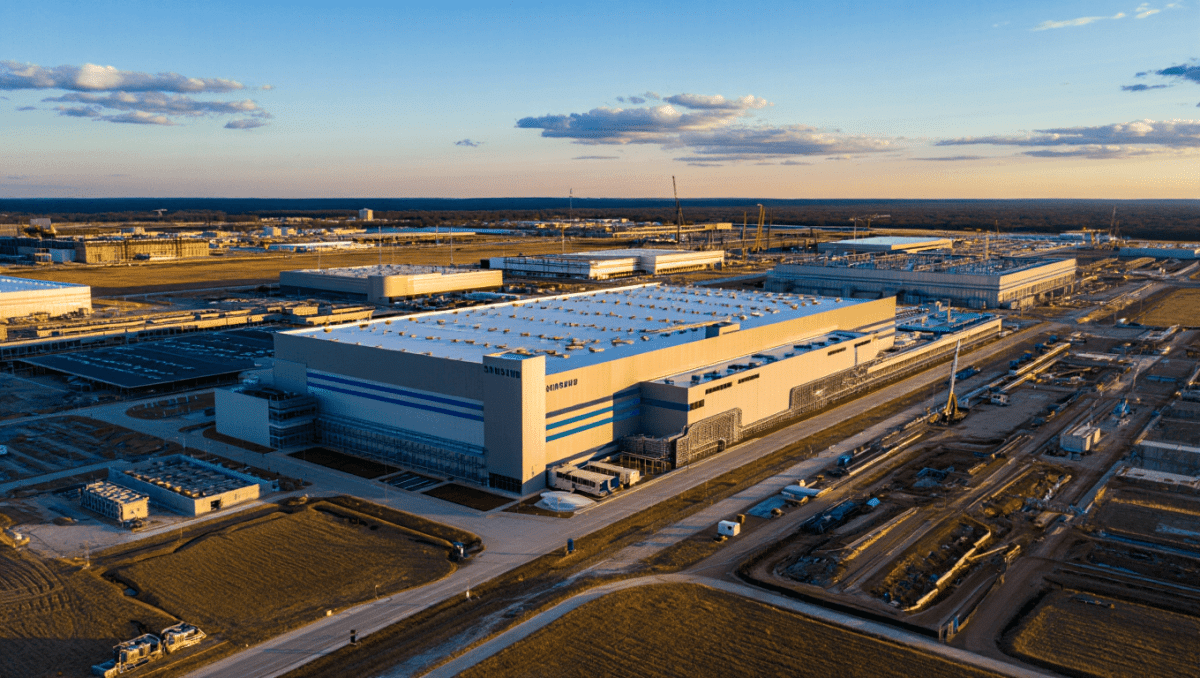
Samsung’s massive Taylor, Texas plant is finally roaring to life. After two major delays, the $17 billion fab just held its equipment move-in ceremony on April 24, officially stationing the chipmaking machines that will churn out Tesla AI chips by year-end. Engineers are now prepping the facility for mass production startup.
🔥 Quick Facts
- Facility Size: 1,200 acres in Taylor with expected 1,500 employees by end of 2026
- Investment: Samsung’s $17 billion initial plus $4+ billion federal CHIPS Act grant secured
- Tesla Partnership: $16.5 billion foundry contract covering AI5, AI6, and AI4+ chip fabrication
- Process Tech: 2-nanometer gate-all-around manufacturing for next-gen self-driving and AI infrastructure
The Long-Awaited Fab Finally Springs to Action
Samsung Electronics held its landmark equipment installation ceremony on April 24, marking a turning point for the Taylor, Texas semiconductor foundry. Executives from Han Jin-man, Samsung’s Foundry Business President, joined suppliers like ASML and Lam Research to formalize the arrival of advanced chipmaking tools. The plant closed a nearly two-year delay on the facility, which broke ground in November 2022.
This moment transforms years of construction and staffing uncertainty into tangible momentum. Samsung spokeswoman Michele Glaze confirmed the fab will achieve full operational status by year-end 2026, with 1,500 permanent employees transitioning from the Austin campus starting in November 2025.
Tesla’s Huge Chip Orders Drive Mass Production Ramp
Tesla CEO Elon Musk has become Samsung’s primary customer, having secured a $16.5 billion foundry contract signed in July 2025. This partnership funds production of Tesla’s AI5 and next-generation AI6 chips for self-driving systems and Optimus humanoid robots. Earlier today in May 2026, Musk confirmed a third chip named AI4+ is also headed to Samsung.
The AI5 design taping out on April 15 signals production readiness, while the AI6 incorporates low-power DDR memory, leveraging Samsung’s strength in memory architecture. All three chips will run on Samsung’s cutting-edge 2-nanometer process, the company’s most advanced technology.
Operators Face Critical Yield Challenges in Ramp Phase
Plant operators face a decisive test. Samsung’s 2nm yield rates sit at 50-60 percent, industry sources estimate, trailing TSMC’s 80-90 percent performance. This gap directly impacts profit margins and customer satisfaction during the critical mass production startup phase. Operators must balance equipment commissioning with training protocols for the advanced process technologies flowing into Taylor.
| Production Metric | Target |
| Current Workforce | Several hundred transitioning from Austin |
| Year-End Headcount | 1,500 permanent employees |
| Long-Term Capacity | At least 1,800 employees |
| Process Node | 2nm gate-all-around leading edge |
“Samsung’s project in Taylor plans to be operational by the end of year. A key step in our progress is transitioning employees responsible for fabrication engineering, infrastructure and support operations from our Austin campus.”
— Michele Glaze, Samsung Electronics Spokeswoman
Breaking a Streak of Delays, Finally Reaching Production Phase
Samsung initially planned a late 2024 opening, then revised to end of 2026 in April 2025. The two-year setback stemmed from slower order timelines until Tesla’s blockbuster foundry deal last July unlocked momentum. Equipment installation, which kicked off this April, represents the final construction hurdle before pilot wafer runs commence in the second half of 2026.
The Taylor facility’s $17 billion investment remains Texas’s largest foreign direct investment. Samsung also received $4 billion-plus in federal CHIPS Act funding and $250 million from the Texas Semiconductor Innovation Fund, underscoring the state’s commitment to semiconductor autonomy.
Can Plant Operators Hit Their Critical Yield Targets Before 2027?
The central question facing plant operators: can Samsung’s Taylor team match industry-leading yields during mass production startup? Samsung Securities analyst Lee Jong-wook projected the foundry division could post its first quarterly turnaround as early as Q3 2026, assuming utilization rates exceed 80 percent. Wafer prices continue climbing, supporting this outlook, but it hinges on operator execution during equipment commissioning and the critical pre-production phase. Success here positions Samsung to recapture foundry market share from TSMC, while delays could push profitability targets into 2027.
Sources
- The Korea Herald – Equipment move-in ceremony details and Tesla chip specifications
- The Korea Times – Samsung foundry operations and mass production staffing updates
- Taylor Press – Local facility timeline and Texas investment records