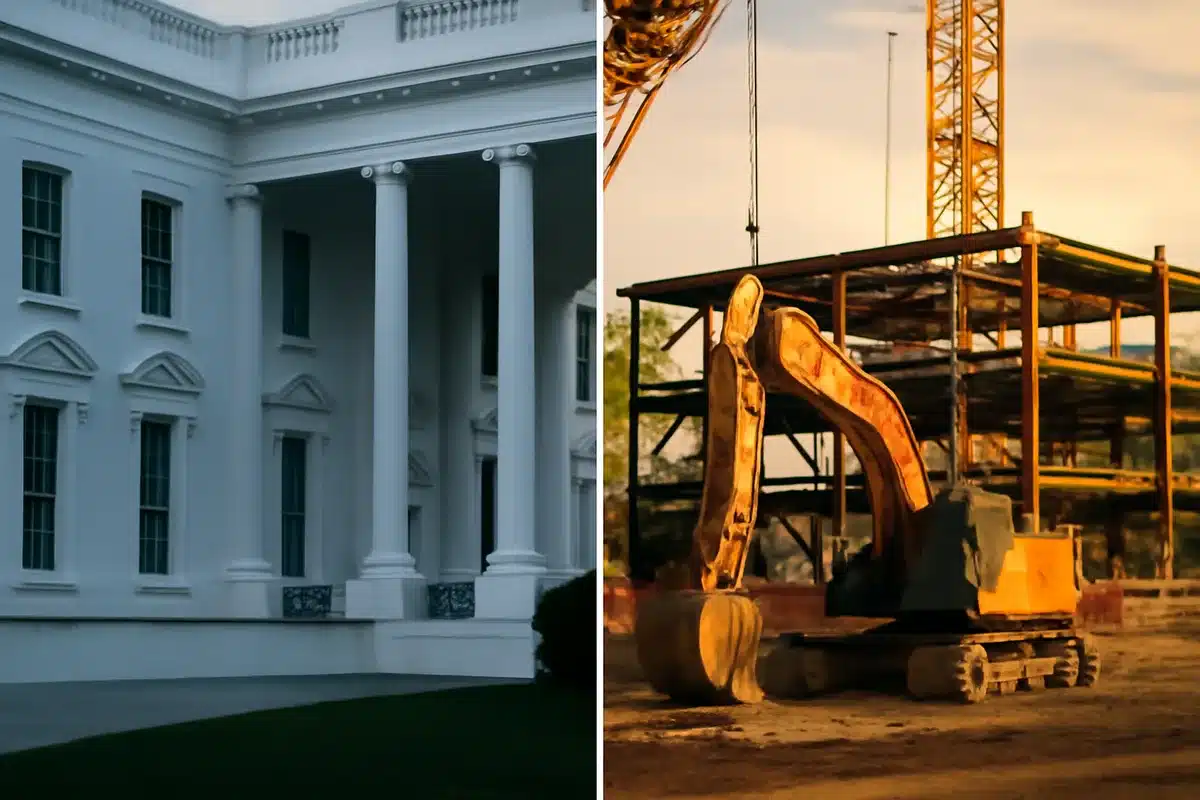
The Supreme Court on Monday allowed White House ballroom construction to continue in a 5-4 decision, clearing the way for the Trump administration to resume above-ground work on the $400 million East Wing renovation project. The ruling paused a lower court injunction that had blocked construction, handing the administration a major victory as the project approaches what officials claim is 65 percent completion.
The majority opinion, issued by the court in an unsigned decision, emphasized that it was not ruling on the project’s legality. Instead, the justices focused on whether the National Trust for Historic Preservation, the nonprofit organization challenging the ballroom, had legal standing to sue at all. The majority concluded the trust likely does not have standing to challenge the project based on aesthetic and historical concerns.

Chief Justice John Roberts broke with his conservative colleagues and joined the three liberal justices in dissent. Writing for the minority, Roberts stated that the construction “is likely unlawful” because Congress has not explicitly approved funding for the ballroom. He emphasized that the White House is not merely any building, invoking Winston Churchill’s observation that “we shape our buildings, and afterwards our buildings shape us.” Roberts argued the dissenters’ position was “no victory for the separation of powers.”
The legal battle began in December 2025 when the National Trust filed suit to halt construction. Senior U.S. District Judge Richard Leon issued an order on March 31, 2026, blocking above-ground work while allowing underground construction, such as bunkers and security facilities, to proceed. The U.S. Court of Appeals for the District of Columbia Circuit affirmed Leon’s ruling on August 7, 2026, with a 2-1 decision holding that Congress alone has the power to regulate White House construction and demolition.
The Trump administration argued that the president has inherent authority to improve the presidential residence and that Congress has already authorized the project by granting the executive broad power to make alterations and improvements to the White House. The administration also contended that the National Trust’s claims rested solely on members’ aesthetic dislike of the design—not the kind of concrete injury that permits a lawsuit to proceed. According to the administration’s filing with the Supreme Court, the project includes “a totally secure ballroom space” that is “vitally required by national security,” as part of an integrated military complex.
The National Trust countered that only Congress can decide whether a ballroom can be built on federal property. The preservation group argued that if the Trump administration believed there was a pressing need, it could seek permission and funds from Congress rather than proceeding unilaterally. The trust warned that the project was “beyond the point of return” and would cause “irreversible historical-preservation, architectural, and visual damage” to the iconic building.
The 90,000-square-foot ballroom is designed to replace the demolished East Wing and include a 22,000-square-foot state ballroom capable of seating 650 to 999 guests—more than triple the capacity of the current White House ballroom. The National Capital Planning Commission approved the final design in April 2026. The administration stated on August 13 that the project could be substantially finished by November 2026, suggesting the Supreme Court’s decision could allow the ballroom to be completed or nearly completed before the underlying legal dispute is finally resolved in lower courts.
Sources
- SCOTUSblog — Supreme Court’s 5-4 decision allowing construction, majority opinion on standing, Roberts’ dissent quoting Churchill
- Reuters — 5-4 ruling allowing construction to continue, project details and cost
- BBC — $400 million ballroom ruling, Trump administration victory
- NBC News — Roberts’ dissent stating project is “likely unlawful,” construction details
- The Hill — 5-4 decision lifting above-ground work block, Congress approval issue
- Washington Post — Supreme Court allowing construction, major victory for Trump
- Politico — Roberts dissent on “likely unlawful” project, separation of powers concerns
- PBS NewsHour — National Trust standing arguments, Trump administration authority claims