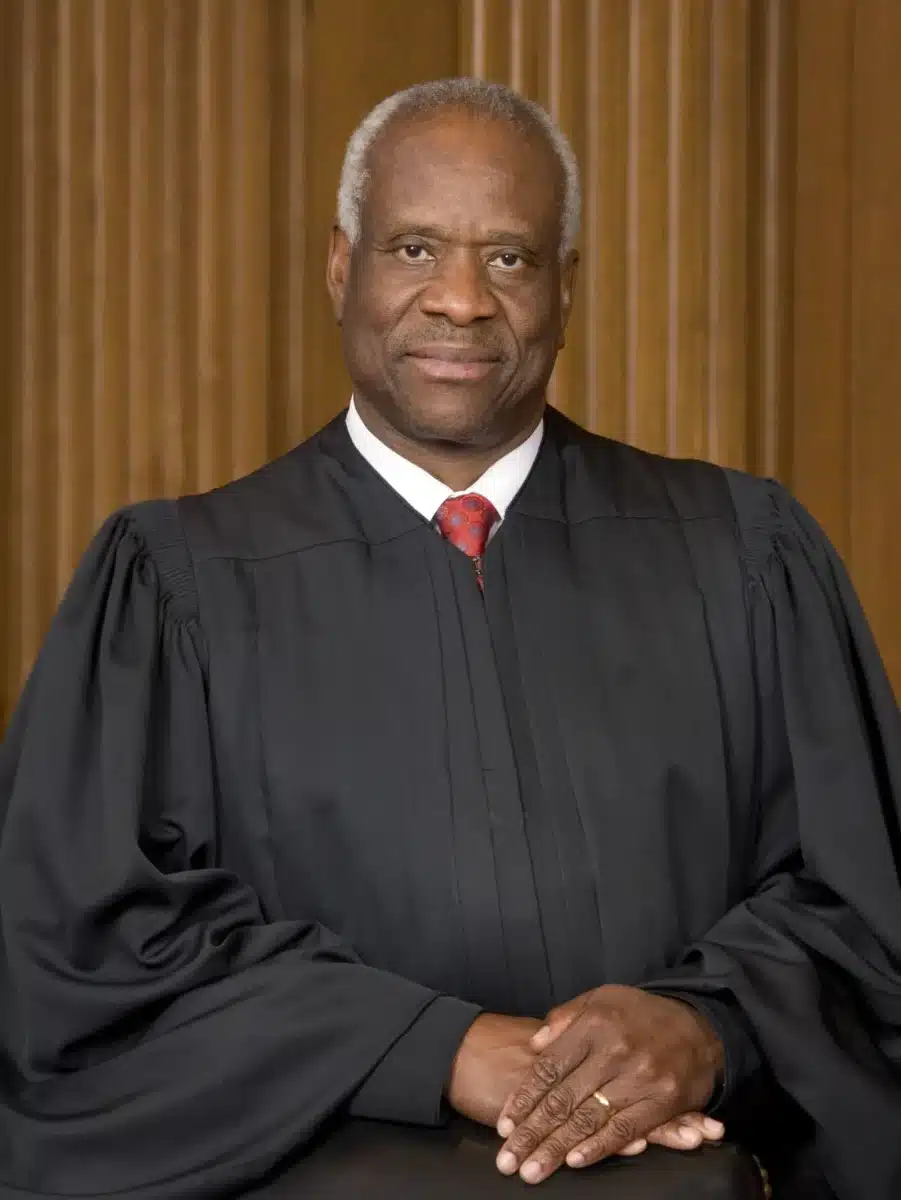
Justice Clarence Thomas remains on the Supreme Court as the second-longest-serving justice in American history, having surpassed the 34-year tenure mark on May 7, 2026. Sworn in on October 23, 1991, Thomas has served longer than any other current justice and stands behind only the late Justice William O. Douglas, who served 36 years and 209 days from 1939 to 1975.
Thomas’s milestone came as he surpassed Justice John Paul Stevens and Justice Stephen J. Field, who was appointed by Abraham Lincoln and served 34 years and 195 days until 1897. At 77 years old, Thomas shows no signs of stepping down—and if he remains on the bench through May 20, 2028, he will become the longest-serving justice in Supreme Court history.

Once considered an outlier on the nation’s highest court during his early years, Thomas has become what observers describe as a towering figure in the conservative legal movement. According to law professor Pamela Karlan at Stanford University, “The court has radically moved in his direction over the course of his time on the court.” His seniority now gives him significant power: when he’s part of a majority that excludes Chief Justice John Roberts, Thomas can decide who writes the majority opinion—a factor that can influence other justices’ votes behind closed doors.
Thomas has helped secure landmark rulings on abortion, voting rights, and Second Amendment protections. He authored a 2022 opinion that found people generally have the right to carry a gun in public, one of the most significant works of his career. His jurisprudence has remained consistent throughout his tenure, according to Scott Gerber, author of “First Principles: The Jurisprudence of Clarence Thomas.” Once known for writing solo dissents, Thomas now frequently pens majority opinions as the court’s ideological center has shifted rightward.
His influence extends beyond the bench through a large network of former clerks who have gone on to serve in Republican administrations and increasingly fill federal judgeships. Sarah Konsky, director of the Supreme Court and Appellate Clinic at the University of Chicago Law School, noted that “even as justices’ own time on the court winds down, significant influence lives on through their clerks.” John Yoo, a law professor at the University of California, Berkeley, who clerked for Thomas three decades ago, observed that the justice appears more energized now than in earlier years: “I think he’s more energized and excited now than when I first met him.”

Thomas’s tenure has not been without controversy. His confirmation in 1991 was marked by contentious hearings that included sexual harassment allegations from Anita Hill, which he forcefully denied. More recently, ethics questions have arisen over his acceptance of luxury trips from a GOP megadonor and the political activism of his wife, who promoted false claims about the 2020 election. Thomas has said he was not required to disclose the trips and has resisted calls to recuse himself from election-related cases.
The comparison to Douglas is instructive. Douglas served during an era of significant constitutional expansion, particularly regarding individual rights and privacy. Like Thomas, Douglas was known for his consistent jurisprudence and significant influence on the court’s direction. The difference in their judicial philosophies—Douglas championed liberal causes while Thomas champions conservative originalism—underscores how a justice’s longevity can reshape constitutional law for decades.
Sources
- Law.com National Law Journal — confirmation that Thomas surpassed John Paul Stevens on May 7, 2026, as second-longest-serving justice
- PBS News — Thomas’s tenure milestone, his influence in the conservative legal movement, landmark rulings, clerk network influence, and expert commentary from Pamela Karlan, John Yoo, and Sarah Konsky
- Brennan Center for Justice — timeline of Thomas reaching second-longest-serving status and his path to potentially surpassing Douglas in 2028
- SCOTUSblog — verification of Thomas’s 12,615 days of service and ranking among longest-serving justices
- Newsweek — Thomas’s age (77) and specific date (May 20, 2028) when he would overtake Douglas’s record
- Wikipedia and Supreme Court History sources — William O. Douglas tenure dates and service length (36 years, 209 days; 1939-1975) and Stephen J. Field service details