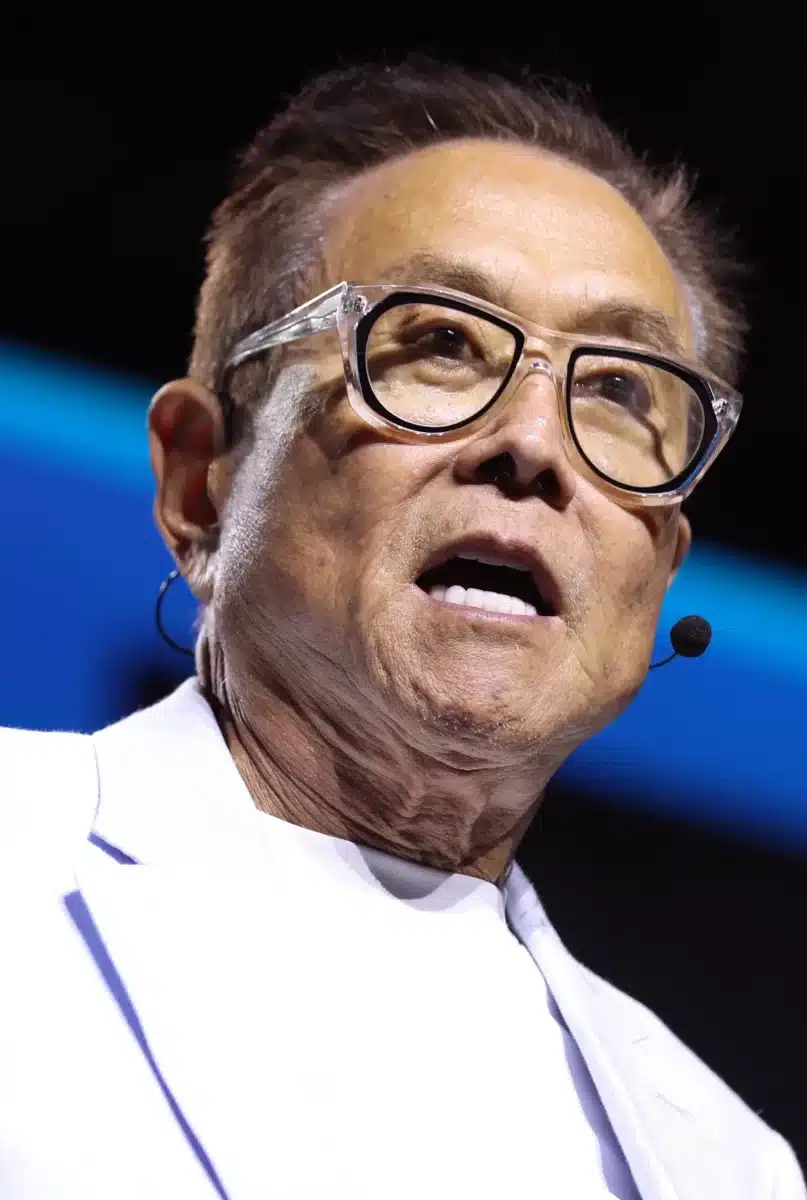
Robert Kiyosaki, author of the best-selling “Rich Dad Poor Dad,” openly acknowledges carrying $1.2 billion in debt—a figure he has championed as proof of his investment philosophy rather than a sign of financial distress. In a recent profile, Kiyosaki explained how he uses debt strategically to acquire income-producing assets, primarily real estate, arguing that this approach separates the wealthy from those stuck in financial mediocrity.
Kiyosaki’s debt strategy centers on leveraging borrowed money to control assets far larger than he could purchase outright. According to his philosophy, a 20 percent down payment allows an investor to control 100 percent of a property’s appreciation and cash flow. He frames this as “good debt”—borrowing to invest in assets that generate income—as opposed to “bad debt,” which finances consumption without producing returns.
His approach directly contradicts the debt-free philosophy championed by financial advisor Dave Ramsey, who warns that debt always equals risk. Kiyosaki has publicly stated that if he were to go bankrupt, “the bank goes bust, not my problem,” reflecting his view that lenders bear the risk when they extend large loans to investors.

Kiyosaki’s personal financial history, however, includes significant setbacks. In 2012, his company Rich Global LLC filed for Chapter 7 bankruptcy after a jury awarded $24 million in damages to Learning Annex, a former business partner that claimed unpaid royalties dating back to 2002. Despite this corporate bankruptcy, Kiyosaki personally remained solvent and continued his business operations.
The “Rich Dad Poor Dad” book, first published in 1997, has sold more than 44 million copies and been translated into at least 43 languages, making Kiyosaki one of the most influential personal finance authors globally. In the book, he contrasts lessons from his wealthy friend’s father—the “rich dad”—with his own father’s more cautious approach to money, framing debt and investment leverage as core to wealth building.

Today, at 79 years old, Kiyosaki continues to advocate for his debt-leveraged investment model, particularly in real estate and alternative assets like precious metals and cryptocurrency. He has warned repeatedly about rising U.S. national debt and economic instability, recommending that investors hold assets like gold, silver, oil, and Bitcoin to protect against inflation and currency devaluation. His recent commentary on the U.S. debt approaching $40 trillion reflects his long-standing concern about fiat currency and traditional savings vehicles.
Sources
- Vanity Fair — Profile of Robert Kiyosaki discussing his $1.2 billion debt declaration and investment philosophy, published August 26, 2026.
- Yahoo Finance — Reporting on Kiyosaki’s debt strategy and contrast with Dave Ramsey’s debt-free approach, January 2024.
- ABC News — Coverage of Rich Global LLC’s Chapter 7 bankruptcy filing in 2012 following a $24 million judgment.
- Fortune — Analysis of Kiyosaki’s debt philosophy and his stance that bankruptcy would be the bank’s problem, January 2024.
- The Daily Star — Explanation of Kiyosaki’s “good debt” versus “bad debt” framework and his investment strategy, January 2024.