President Donald Trump said Friday that he will declare the Strait of Hormuz a U.S. territory after the end of the Iran war, marking his latest escalation of rhetoric around control of the critical waterway. Trump made the remarks during a speech at the Nassau County Police Academy in New York, saying “pretty soon I’ll be declaring the Hormuz Strait a territory of the United States” after defeating Iran.
The announcement extends months of Trump administration statements about controlling the Strait, through which as much as 20 percent of the world’s oil supply flows. In July, Trump proposed making the U.S. the “guardian” of the Strait and charging a 20 percent toll on all cargo transiting the waterway, a plan he reversed the following day.
On August 12, Trump claimed the U.S. already has “total control over the Strait of Hormuz,” writing on Truth Social that the naval blockade is being called “a WALL OF STEEL” by everyone and that “there is nothing Iran can do about it.” However, expert analysis challenges that assertion. Dennis Citrinowicz, a senior researcher at the Institute for National Security Studies, wrote that “the United States does not control the Strait of Hormuz. Despite everything that has happened, Iran retains sufficient capabilities to disrupt maritime traffic through the strait.” Citrinowicz argued that Trump’s statements appear designed to frame the conflict as a victory despite falling short of stated military objectives.
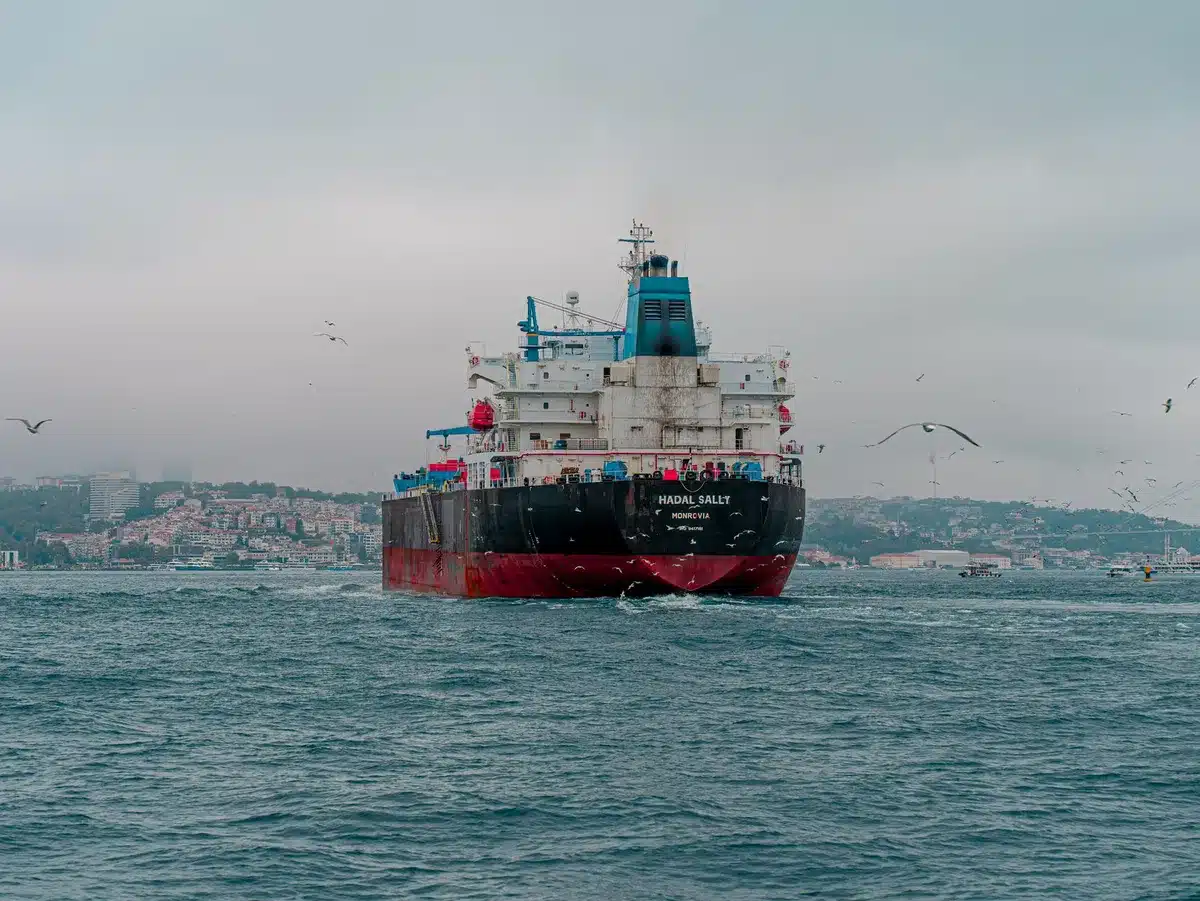
The Strait of Hormuz sits at the center of a broader conflict between the U.S. and Iran that began on February 28, 2026, when joint U.S.-Israeli strikes killed Iranian Supreme Leader Ayatollah Ali Khamenei. The U.S. imposed a naval blockade on April 13, aiming to restrict Iranian shipping. A ceasefire brokered by Pakistan in June collapsed in mid-July, and fighting has continued sporadically.
Under international law, the Strait is classified as an international strait covered by the territorial waters of Iran and Oman. The 1982 United Nations Convention on the Law of the Sea established a special “transit passage” regime that allows all ships unimpeded passage through such straits, with coastal states unable to suspend this right except in cases of national security. The U.S. correctly argues that this regime applies even to non-parties like itself, according to international custom. Iran, which has not ratified the convention, asserts it need only grant the more limited right of “innocent passage,” which can be suspended.
Recent data underscore the practical challenges to any U.S. claim of territorial control. Reuters reported that just eight ships transited the Strait on August 11, down from a pre-war average of 130 to 140 daily. The dramatic decline reflects both the ongoing blockade and heightened threats to commercial vessels, with Iran and allied Houthi forces attacking shipping in the region. In July, Secretary of War Pete Hegseth said the conflict had cost American taxpayers almost $38 billion.
Trump administration officials have signaled a desire for an off-ramp to the conflict ahead of November midterm elections, where the war remains politically unpopular. Talks between Iran and Oman on future management of the Strait have continued, though wider peace negotiations with the U.S. have largely stalled. Treasury Secretary Scott Bessent said the U.S. would impose measures on Iran “never been seen” as soon as the following week, suggesting ongoing pressure even as diplomatic efforts continue.
Sources
- Tennessee Star — Trump’s statement that he will declare the Strait of Hormuz a U.S. territory after defeating Iran, made at the Nassau County Police Academy in New York on August 14, 2026
- Al Jazeera — Trump’s August 12 claim of “total control” over the Strait and details on the naval blockade; analysis by Dennis Citrinowicz on the limits of U.S. control; data on ship transits (eight ships on August 11, down from 130-140 pre-war)
- Reuters — Trump’s August 12 Truth Social post claiming total control and describing the blockade as “a WALL OF STEEL”
- Chatham House — International law framework governing the Strait under UNCLOS, the transit passage regime, and the positions of the U.S. and Iran on maritime law
- Jewish Rhode Island / Jerusalem Post — Trump’s August 14 statement and context on Treasury Secretary Scott Bessent’s announcement of new measures against Iran