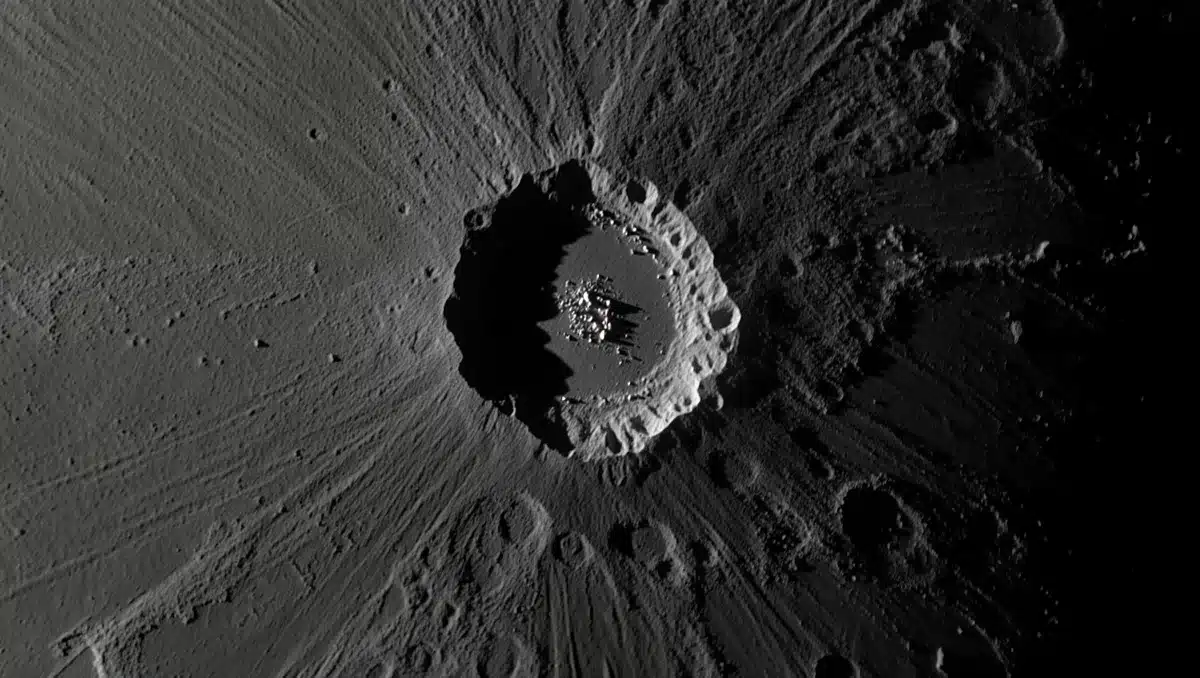
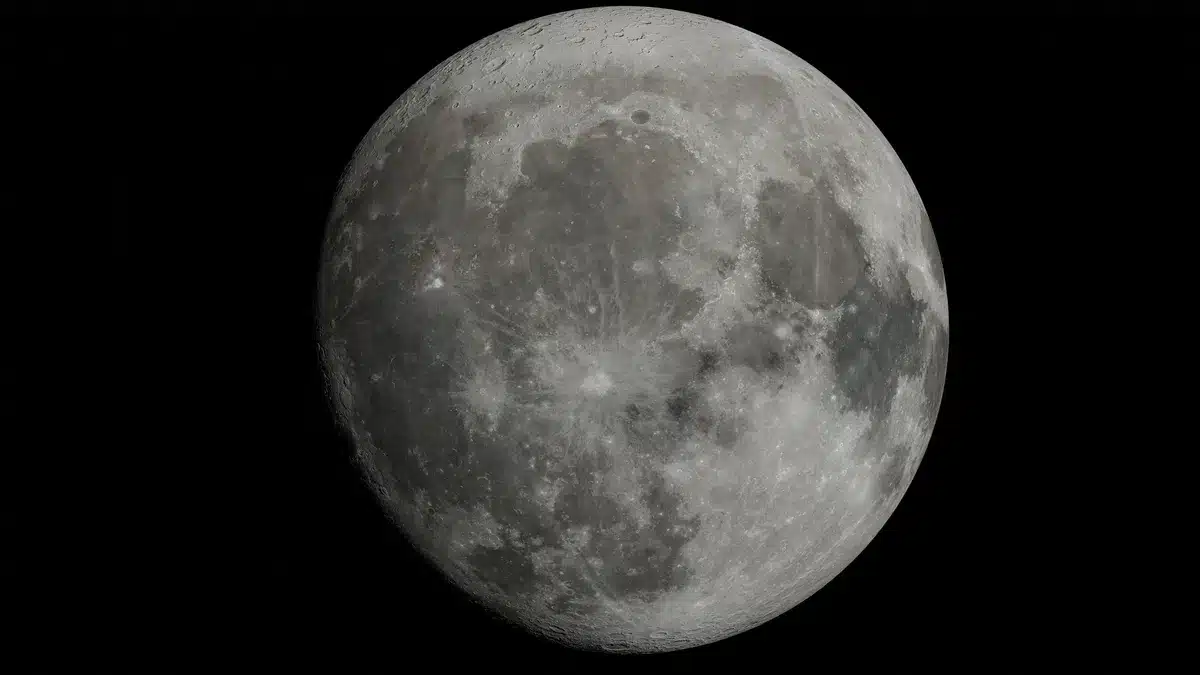
A SpaceX Falcon 9 upper stage slammed into the Moon on August 5 at 2:35 a.m. EDT, traveling at 5,436 miles per hour and striking near Einstein Crater on the lunar far side. The four-ton rocket stage, which had drifted through space for more than a year after launching two commercial lunar landers in January 2025, created an estimated crater 65 to 90 feet in diameter on the Moon’s surface.
The impact marked a rare but increasingly documented event as human spaceflight expands beyond Earth orbit. SpaceX stated that the collision resulted from a combination of solar activity and gravitational forces that altered the upper stage’s trajectory after its primary mission concluded.
Julianna Scheiman, director of NASA Science and Dragon Programs at SpaceX, explained at a Monday news conference that for high-energy missions traveling beyond low-Earth orbit, disposal procedures differ from standard practice. “We did that here for the Ispace and Blue Ghost missions’ second stage, and what has happened is essentially a mixture of solar activity and gravity forces have put it on a path towards the moon,” Scheiman said, according to CNN.
Scientific Detection and Observations
The European Southern Observatory’s Very Large Telescope in Chile detected the impact through its spectroscopic instruments, capturing direct evidence of the collision. “We can confirm that the telescope detected spectral lines of sodium and lithium gas in the impact plume lasting for 5-10 minutes after impact,” said Dr. Bárbara Ferreira, media manager for ESO’s department of communication, according to CNN. “The sodium likely originated from the lunar soil, whereas the lithium could come from the rocket itself.”
Dr. Benjamin Fernando, a postdoctoral fellow at Los Alamos National Laboratory, confirmed the detection using the Very Large Telescope’s Ultraviolet and Visual Echelle Spectrograph. Carl Schmidt, a research assistant professor at Boston University who led the observations, noted that the sodium and lithium gas plume extended several tens of kilometers across the lunar surface.
The Korean Pathfinder Lunar Orbiter and NASA’s Lunar Reconnaissance Orbiter were expected to survey the impact site in the coming days. South Korea’s space agency indicated that any imagery would be released to the public only after analysis was completed.

Future Implications for Lunar Exploration
The event underscores a growing concern as lunar exploration accelerates. Dr. Paul Wiegert, a professor of astronomy and physics at Western University in Ontario, noted that the ejected material from such impacts could travel as far as 500 miles before landing back on the lunar surface, posing potential risks to future astronauts and infrastructure. “We really want to understand that process better,” Wiegert said, according to CNN, adding that the collision provides valuable data for preparing for sustained human presence on the Moon.
NASA plans to establish a more sustained human presence on the lunar surface through the Artemis program, but the Moon’s lack of a protective atmosphere means accumulated space debris poses an increasing challenge. Unlike objects that crash into Earth and burn up during re-entry, debris striking the Moon remains a permanent hazard.
SpaceX and NASA are now exploring optimal disposal solutions for upper stages from high-energy missions. “What is the best future disposal path for high energy missions that are in the sun-Earth-moon system?” Scheiman said, according to CNN. The 2022 impact of a Chinese Long March 3C upper stage from a 2014 mission demonstrated that such collisions, while rare, represent an emerging category of lunar events that require management as space activity increases.
Sources
- CNN — provided detailed reporting on the impact event, SpaceX and NASA statements, European Southern Observatory detection of spectral lines, expert commentary from researchers at Los Alamos National Laboratory and Boston University, and implications for future lunar missions
- New York Times — confirmed the 2:35 a.m. EDT impact time and crater formation details
- Forbes — reported the impact location near Einstein Crater and noted the broader context of lunar debris accumulation
- Wikipedia — provided the official designation of the upper stage (2025-010D) and confirmation of the August 5, 2026 impact date