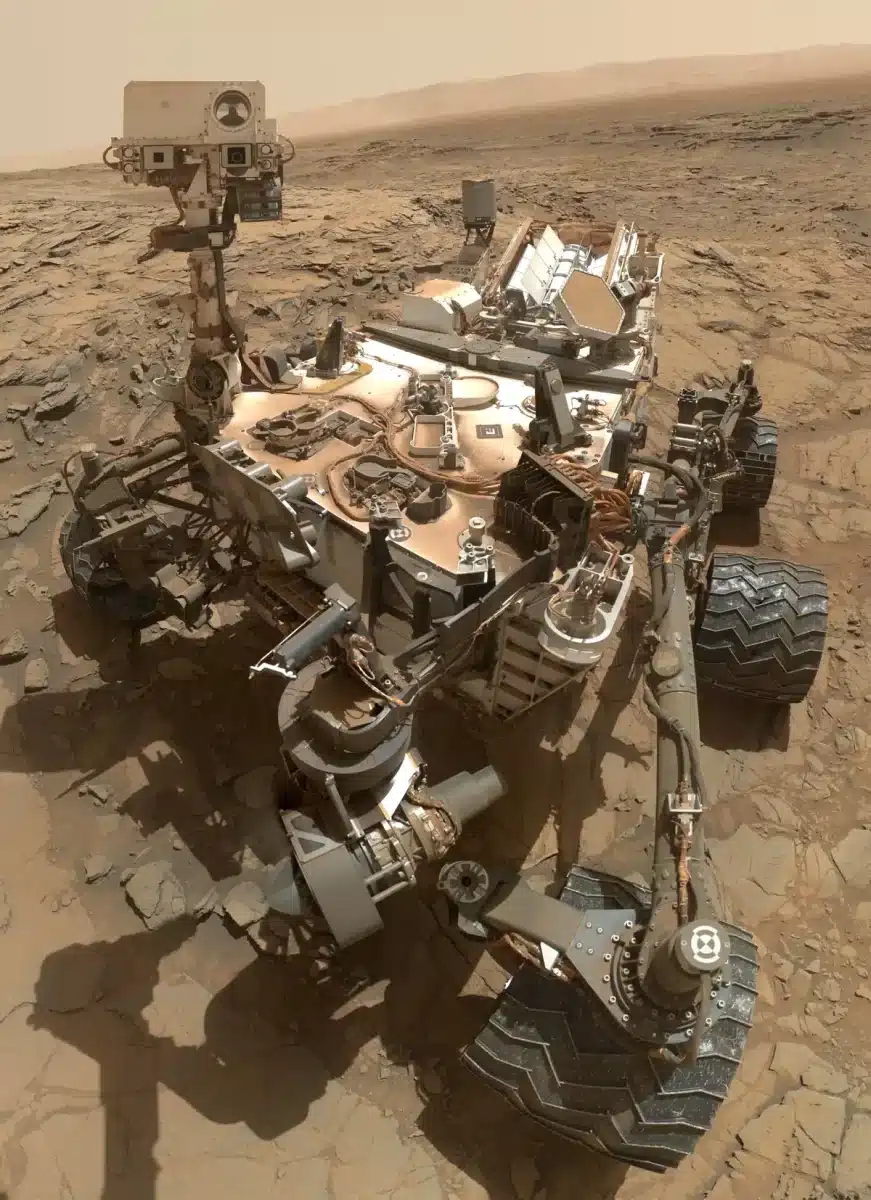
NASA’s Curiosity rover has discovered a vast field of honeycomb-like polygonal fractures covering a Martian valley nicknamed Valle Grande, marking the largest concentration of these geometric features the rover has ever encountered during its 14-year mission on Mars. The rover captured a 360-degree panorama on June 19 and 20, 2026, composed of 340 individual snapshots that reveal the terrain stretching as far as the Mast Camera could see, with each polygon measuring approximately 1.5 to 3 inches (4 to 8 centimeters) across.
Curiosity has spotted smaller patches of polygonal fractures multiple times since arriving on Mars in 2012, but nothing approaching the scale of this discovery in Valle Grande. “We’ve seen a lot of fascinating landscapes through Curiosity’s eyes, but this sea of polygons took our breath away,” said Ashwin Vasavada, the project scientist for Curiosity, according to NASA. The field wraps around a butte named Miraflores, which stands 20 feet (6 meters) tall and is crowned with a thick layer of sand.
These polygonal features form through several natural processes linked to ancient water activity on Mars. Cycles of warm and cold temperatures may have caused mud to expand, contract, and fracture, according to NASA. Alternatively, compaction that occurred while the surface was buried might have squeezed water out of the sediment, or desiccation—the drying of wet mud—could have created the cracks. Scientists studying Mars polygons have identified thermal contraction and desiccation as the dominant formation mechanisms, with both processes leaving distinct signatures in the rock record. The geometry itself is data: the size and spacing of the polygons can reveal information about the ancient environmental conditions and the presence of water.
The discovery of this extensive polygon field strengthens the evidence that Mars once harbored conditions suitable for life. Scientists believe lakes and streams covered the foothills of Mount Sharp—the 3-mile-tall (5-kilometer-tall) mountain at the center of Gale Crater—billions of years ago. Earlier this year, Curiosity detected more than 20 organic molecules in clay-rich Martian sandstones, some of which had never been seen on Mars before and may be precursors to RNA and DNA. While it remains unclear whether these carbon-based molecules stemmed from biological or geologic processes, their presence combined with evidence of ancient water systems supports the hypothesis that Mars possessed the chemistry to support life in its distant past.
Analyzing the chemistry and structure of the newly discovered polygon field in Valle Grande could yield additional insights into Mars’s long-lost water systems and its former habitability. As Curiosity continues its slow ascent of Mount Sharp, each new discovery adds another piece to the puzzle of how Mars transformed from a potentially habitable world into the cold, dry desert it is today. The rover’s wheels show signs of wear after 14 years on the Red Planet, but the mission continues to produce findings that reshape our understanding of Martian geology and history.
Sources
- Gizmodo — detailed reporting on the polygon discovery, rover specifications, and the scale of the finding
- NASA — official statement from Ashwin Vasavada, project scientist; polygon dimensions and formation mechanisms
- Scientific literature (Morphometrics of Polygonal Ground on Earth and Mars, 2025) — formation processes including desiccation, thermal contraction, and volcanic cooling
- NASA Curiosity mission background — rover arrival date, organic molecule detection, and ancient water evidence