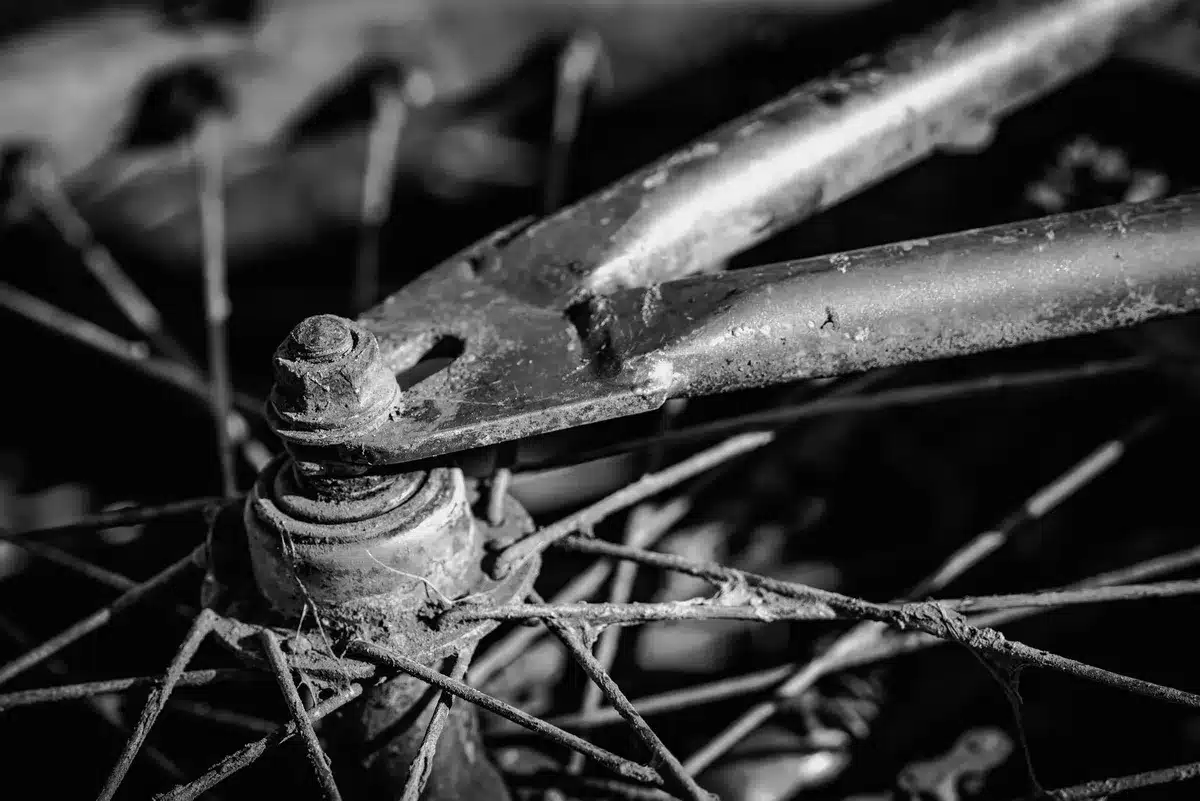
NASA’s Curiosity Mars rover shows extensive wheel damage in newly released images captured on July 23, 2026, revealing the toll of nearly 14 years exploring the Red Planet’s harsh terrain. The close-up photographs, taken by the rover’s Mars Hand Lens Imager camera on Sol 4963 of its mission, display deep cracks, dents, and damaged sections across one of the rover’s six aluminum wheels, according to Space.com and Economic Times reporting.
The damage underscores the engineering challenge of operating a machine millions of kilometers from Earth without possibility of repair. Curiosity’s aluminum wheels, each about 20 inches in diameter, were designed with specially engineered treads called grousers to provide traction on loose Martian soil. However, sharp rocks embedded in the Gale Crater region have punctured and cracked the wheels throughout the rover’s extended mission.
Curiosity landed inside Gale Crater on August 6, 2012, after a dramatic “sky crane” landing sequence that lowered the one-ton spacecraft onto the Martian surface. The rover was originally designed for a primary mission of just one Martian year, approximately 687 Earth days. In December 2012, only four months after landing, NASA extended the mission indefinitely—a decision that has allowed Curiosity to traverse more than 20 miles across Mars and make discoveries that reshaped understanding of the planet’s past.
The rover has discovered evidence that Gale Crater once contained conditions suitable for microbial life, including ancient river and lake deposits, organic molecules in Martian rocks, and evidence of past environments with water. These findings have helped scientists understand how Mars transformed from a warmer, wetter world into the cold desert planet visible today.
NASA engineers acknowledged the wheel damage early in the mission. In 2024, JPL engineers noted that Curiosity’s wheels were “holding up well” despite taking some of the harshest punishment on Mars, according to Space.com. In response to the deterioration, NASA adjusted the rover’s driving strategies—including selecting routes with less damaging terrain and carefully monitoring wheel health to prevent critical failure.

Unlike Earth vehicles, Curiosity cannot replace worn tires or visit a repair station. The rover is powered by a radioisotope power system that generates electricity from the natural decay of plutonium-238, allowing it to operate through Martian winters and dust storms. This power source has extended Curiosity’s operational life far beyond what solar-powered rovers could achieve, though engineers continue monitoring all aging components.
The wheel damage contrasts with the fate of NASA’s earlier Opportunity rover, which operated for 15 years before losing power during a global dust storm in 2018. NASA declared Opportunity’s mission complete in February 2019 after attempting over 1,000 signals to restore contact. Curiosity’s radioisotope power system provides resilience against such environmental challenges, though wheel integrity remains a long-term concern for continued operations.
NASA has not announced a fixed retirement date for Curiosity. The rover’s continued functionality depends on ongoing monitoring of its mechanical systems and wheels, which accumulate damage with each kilometer traveled across Mars’ unforgiving surface.
Sources
- Space.com — wheel damage images from July 23, 2026, mission duration and rover specifications
- Economic Times — detailed reporting on wheel cracks, aluminum composition, NASA engineering responses, and rover discoveries
- NASA JPL — rover landing date, mission extension history, power system details
- Wikipedia — mission timeline confirming December 2012 indefinite extension
- NPR — Opportunity rover mission end and comparison context