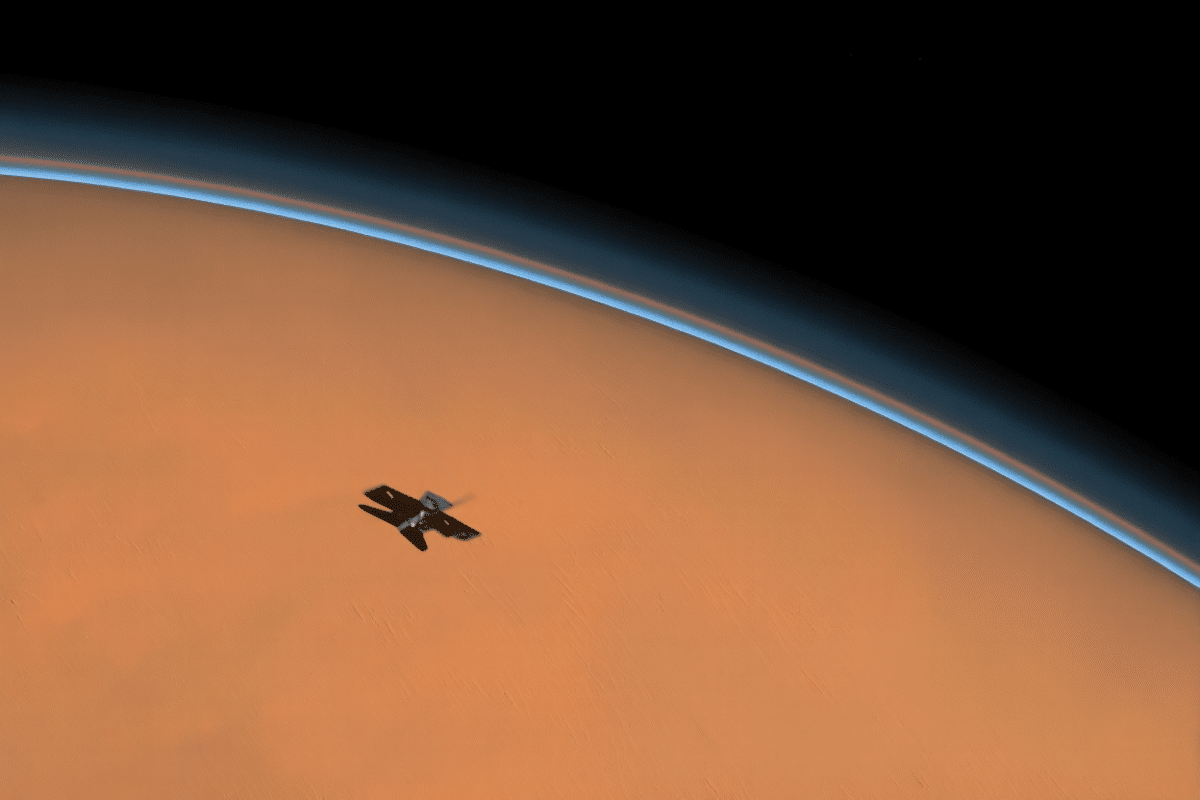
NASA’s Psyche spacecraft delivered detailed data and a time-lapse video from its Mars flyby on May 15, 2026, capturing thousands of images as it passed within 2,864 miles (4,609 kilometers) of the planet’s surface. The close approach served as a crucial gravity assist, boosting the spacecraft’s speed by 1,000 miles per hour and adjusting its orbital trajectory as it heads toward the metal-rich asteroid Psyche in the asteroid belt between Mars and Jupiter.
The flyby gave the mission team an unexpected opportunity to test all three of Psyche’s science instruments—the multispectral imager, magnetometer, and gamma-ray and neutron spectrometer—against a known planetary target before the spacecraft reaches its true destination. “The mission’s imager, magnetometer, and gamma-ray and neutron spectrometer teams worked overtime to make full use of this planetary encounter, and all instruments delivered great results,” said Lindy Elkins-Tanton, principal investigator for Psyche at the University of California, Berkeley.
The imager captured Mars from a rare perspective, approaching the planet at a high phase angle that made it appear as a thin crescent lit by scattered sunlight through its dusty atmosphere. As Psyche swept past closest approach, the cameras captured detailed surface views including windblown craters, the south polar ice cap, and the large double-ringed Huygens crater. The monthlong sequence of images, assembled into a time-lapse video, shows the spacecraft’s entire approach and departure from the Red Planet.
The gamma-ray and neutron spectrometer, designed to determine the chemical composition of asteroid Psyche’s surface, detected neutrons escaping Mars’ surface and atmosphere as anticipated. “Around the time of Mars closest approach, the neutron spectrometer detected a count-rate enhancement close to what we anticipated. It was very gratifying to see,” said David Lawrence, the science lead for Psyche’s spectrometer at the Johns Hopkins Applied Physics Laboratory. The magnetometer also recorded its first measurement of a celestial body’s magnetic field, observing the bow shock region where the solar wind collides with Mars’ magnetic field.
Navigation data confirmed the gravity assist performed exactly as planned. “We’ve confirmed that Mars gave the spacecraft a 1,000 mile-per-hour boost and shifted its orbital plane by about 1 degree relative to the Sun,” said Don Han, Psyche’s navigation lead at NASA’s Jet Propulsion Laboratory. “We are now on course for arrival at the asteroid Psyche in summer 2029.”
The asteroid Psyche, located in the main asteroid belt, is thought to be the exposed metallic core of an ancient planetesimal—a building block of a rocky planet. If confirmed, studying this object could offer a rare window into the interior of Earth-like planets. When the spacecraft arrives in late July 2029, it will enter orbit and spend approximately two years mapping the asteroid and gathering science data to test the theory that Psyche represents a planetary core.
Sources
- NASA Science — NASA’s official account of the Psyche mission’s Mars flyby data, time-lapse video, and instrument performance on May 15, 2026
- NASA Jet Propulsion Laboratory — Official confirmation of the gravity assist results, navigation data, and trajectory correction
- University of California, Berkeley — Principal investigator commentary on instrument calibration and mission objectives
- Johns Hopkins Applied Physics Laboratory — Technical details on the gamma-ray and neutron spectrometer’s performance during the flyby