Russian President Vladimir Putin’s approval rating has fallen to 65 percent, marking his lowest level since the 2022 invasion of Ukraine, as a deepening fuel crisis and expanding internet restrictions erode public confidence amid growing economic hardship.
According to Russia’s state-run polling agency VTsIOM, Putin’s approval rating dropped to 65.1 percent as of mid-July 2026, down from 70.4 percent in mid-June, according to reporting by Kyiv Post and Meduza. The decline represents the sharpest weekly drop since the partial mobilization announcement in autumn 2022, when approval fell 3.3 points over four weeks, according to Moldova1.
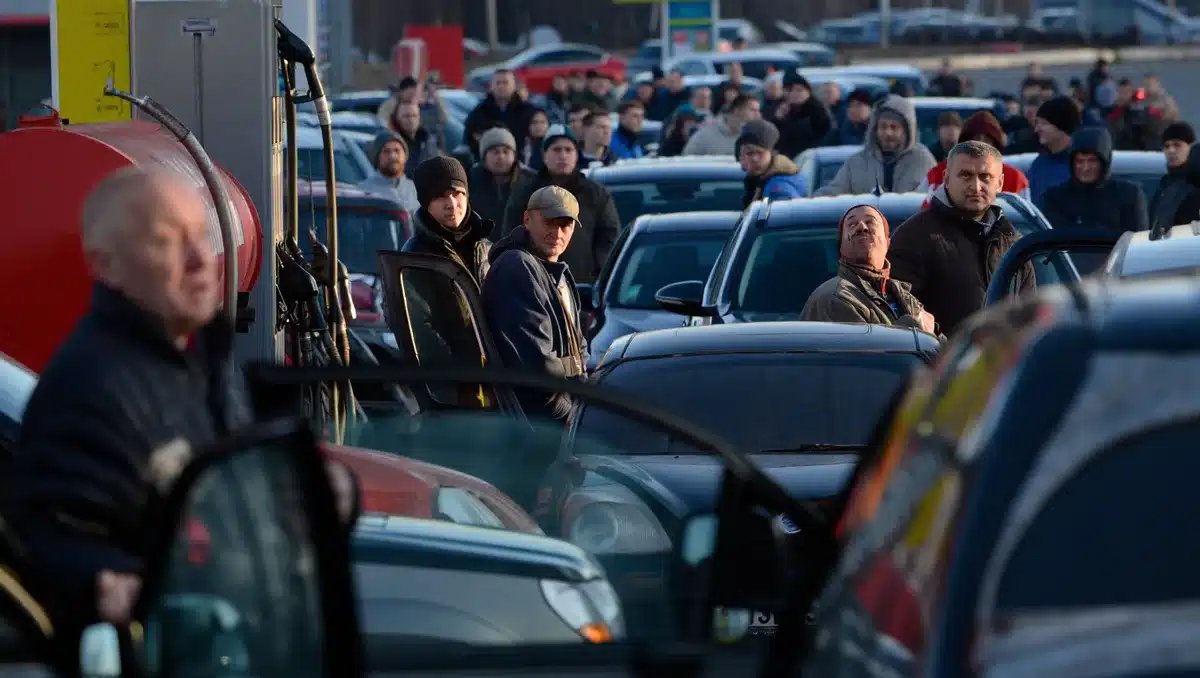
Ukraine’s sustained drone campaign against Russian oil refineries has triggered widespread fuel shortages across nearly all of Russia’s 83 regions. By July 2026, most of Russia’s regions were experiencing fuel restrictions, directly affecting 50 million people—approximately 35 percent of the Russian population, according to Wikipedia’s entry on the 2025–2026 Russian fuel crisis. Russia’s gasoline production has fallen by about 25 percent year on year, leaving filling stations struggling to meet demand, according to The Guardian.

The fuel crisis has become the first major disruption of the war to reach Russians unmediated by state control. Unlike battlefield casualties, which the Kremlin can hide or reframe, fuel queues are visible, shared, and recurring. According to CSIS analysts Maria Snegovaya and Jade McGlynn in a July 7, 2026 analysis, “a fuel queue is different: a banal, recurring inconvenience that is experienced as one of the domestic costs of a war Russia chose and continues to wage.” The analysis notes that crowdsourced mapping services like “Где бензин” (Where’s the Gas?) allow Russians to bypass official information controls and coordinate around real-time fuel availability.
Economic conditions have emerged as a far more powerful driver of public opinion than military developments. According to the CSIS analysis, surveys since 2022 have repeatedly shown that perceptions of current wellbeing and economic expectations positively correlate with war support. As Russia’s economic outlook has deteriorated and growth has stagnated since early 2026, public attitudes have shifted sharply. Between January 2024 and March 2026, the share of respondents reporting an improvement in their financial situation fell from 20 percent to 13 percent, while those reporting deterioration doubled from 20 percent to 41 percent, according to ExtremeScan polling cited in the CSIS report.
The Kremlin has simultaneously tightened control over the internet, restricting access to independent news sources and messaging services like Telegram. According to Reuters and the BBC, authorities have been blocking mobile internet in many regions, citing security concerns. In February 2026, Putin signed a law allowing telecom operators to block cellular and fixed internet access at the request of security services, according to Business Insider. These dual pressures—economic hardship and information restrictions—have compounded public discontent.

Economic Crisis Outweighs Military Shocks
Denis Volkov, director of the independent Levada Center, told El País in May 2026 that the decline is “mainly due to the economic situation.” He noted, “Inflation is the number one problem.” Levada’s own polling showed Putin’s approval falling from 87 percent in August 2025 to 79 percent in April 2026. Even after the state pollster VTsIOM revised its methodology in May—a move analysts say was intended to curtail further declines—the downward trend persisted.
The fuel crisis combines both economic and military pressure in ways previous shocks have not. Ukraine’s self-described “long-range sanctions” campaign targets Russia’s energy infrastructure, directly damaging the economy while demonstrating the state’s inability to protect basic services. According to Fortune, energy analysts estimate that 25 percent or more of Russia’s oil refining capacity has been taken offline by Ukraine’s drone attacks.
A related article on Putin canceling Navy Day parade over Ukrainian strike fears reflects the broader security pressures the Kremlin now faces. Meanwhile, reporting on Russia losing 5,000–6,000 soldiers weekly underscores the mounting human and economic costs of the war.
The Kremlin’s response has focused on narrative control rather than addressing root causes. The state has banned photographs of fuel tankers and station queues, labeled shortage reporting as disinformation, and discussed tighter VPN restrictions, according to the CSIS analysis. However, such measures have limited effectiveness once consequences become “physical, local, and personal,” the analysts wrote.
While Putin’s approval rating remains substantially above global democratic standards, the trajectory is unmistakable. For the first time since 2006, a majority of Russians surveyed by Gallup between March and May said local economic conditions are getting worse. Only 52 percent of respondents in a June Levada survey said Russia is moving in the right direction—the lowest level recorded since February 2022. For a leader who consolidated power as the “guarantor of stability,” economic crisis and visible state failure represent a fundamental challenge to his political legitimacy.
Sources
- Kyiv Post — Putin’s approval rating decline to 65.1% and the sharpest weekly drop since 2022 mobilization
- Meduza — State polling data on approval ratings and the fuel crisis timeline
- CSIS — Analysis of how economic conditions and fuel shortages affect public opinion, comparison to past shocks, and information control mechanisms
- The Guardian — Russia’s 25% year-on-year gasoline production decline and fuel rationing
- El País — Denis Volkov quote on economic causes of approval decline and polling trends
- Wikipedia — 2025–2026 Russian fuel crisis scope affecting 50 million people (35% of population)
- Reuters — Fuel shortages, internet restrictions, and government response
- Fortune — Energy analysts’ estimate of 25% refining capacity offline due to Ukrainian strikes
- Gallup — Russian economic outlook surveys showing record pessimism
- Business Insider — Putin’s February 2026 law on telecom internet blocking authority
- Moldova1 — Comparison of 2022 mobilization approval decline to current drop