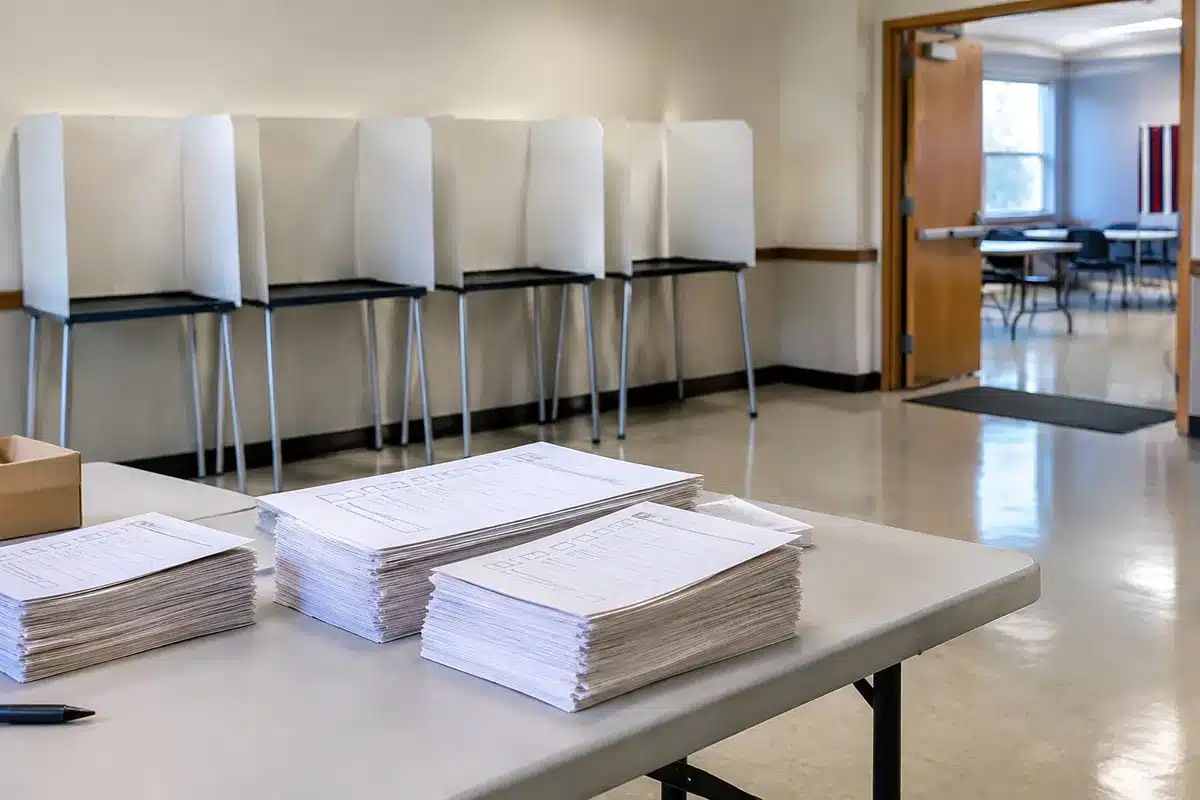
President Donald Trump fired all three remaining commissioners of the U.S. Election Assistance Commission on Thursday, July 9, 2026, leaving the federal election agency without a quorum just months before the midterms and days after a landmark Supreme Court ruling expanded his removal power.
The two Democratic commissioners, Thomas Hicks and Benjamin Hovland, were notified by email that their positions were “terminated, effective immediately,” according to Votebeat. Republican Christy McCormick was allowed to resign, three sources within the agency told the outlet. The fourth commissioner, Republican Donald Palmer, had voluntarily departed earlier in 2026 to join the Heritage Foundation.
The firings represent the first major test of the Supreme Court’s June 29 decision in Trump v. Slaughter, which struck down a 91-year-old precedent and gave the president broad power to remove leaders of independent agencies without cause. “In a 6-3 decision, the Supreme Court struck down a 91-year-old precedent that has prevented presidents from removing members of independent agencies,” according to NPR’s coverage of the ruling.
The EAC was created by the Help America Vote Act of 2002, enacted after the contested 2000 presidential election, to help states improve election administration without federalizing elections. Congress deliberately structured it as a bipartisan commission with four members, no more than two from the same party. The agency’s responsibilities include distributing federal election funds, maintaining the national mail voter registration form, testing and certifying voting systems, and providing guidance to state and local election officials.
With no commissioners in place, the EAC cannot take official action. “The firings leave the four-member commission with no commissioners, meaning it cannot take official action until new members are installed,” Votebeat reported. The agency has faced similar paralysis before: for years, vacancies rendered it unable to perform major functions, until the Senate confirmed new commissioners in 2019.
Whether the Supreme Court’s removal-power ruling extends to bipartisan election agencies remains an open legal question. “It’s an open question about the EAC and the Federal Election Commission,” said Rick Hasen, an election law professor at UCLA, according to Votebeat. “The question has not been tested as to whether political entities created with bipartisan balance might be subject to another exception.” The Supreme Court’s decision in Trump v. Slaughter addressed the Federal Trade Commission; a separate case involving the Federal Reserve recognized a different rule for that institution, pointing to central banking’s long historical independence.
Trump cannot unilaterally install new EAC commissioners. Under the Help America Vote Act, commissioners must be nominated by the president and confirmed by the Senate, with no more than two from the same party. The law also directs the president to consider recommendations from Senate and House majority and minority leaders when nominating commissioners, though Hasen noted this is “more a custom than something that’s in the statute itself.”
The Democratic Association of Secretaries of State condemned the dismissals. “The EAC plays a critical role in supporting state and local election officials, and it will again fall on Secretaries of State and other election administrators to fill the gap,” said Nevada Secretary of State Cisco Aguilar, chair of DASS, according to Democracy Docket. “From cutting funding for cybersecurity to launching baseless investigations, this pattern of behavior from the Trump administration makes it harder for our election officials to do their work and does nothing to make elections more secure.”
The Brennan Center for Justice noted that the agency “cannot lawfully make any decisions that affect how Americans vote” until bipartisan replacements are confirmed. The firings fit a broader pattern: Trump has sought to use the EAC to reshape federal voting rules, including through an executive order directing the commission to add a proof-of-citizenship requirement to the federal voter registration form—changes Congress has not approved. Voting rights advocate Max Flugrath characterized the removals as part of Trump’s effort to pressure the EAC to implement policies the Republican-controlled Congress had not passed, calling it “another power grab by a desperate president who doesn’t want a fair midterm election,” according to Democracy Docket.
Hicks, the commission’s chair, had served on the EAC since 2014 and previously worked for Democrats on the House Administration Committee. Hovland, confirmed unanimously by the Senate in 2019, had previously served as acting chief counsel to the Senate Rules Committee. McCormick, who also served since 2014, had been a senior trial attorney in the voting section of the Justice Department’s Civil Rights Division.
Sources
- Votebeat — Trump’s firing of all three remaining EAC commissioners, their backgrounds, the agency’s role, and expert legal analysis from Rick Hasen
- Democracy Docket — The dismissals, statements from voting rights groups, and context on Trump’s attempts to reshape the EAC
- NPR — The Supreme Court’s Trump v. Slaughter decision and its 6-3 vote striking down 91-year-old precedent on agency removals