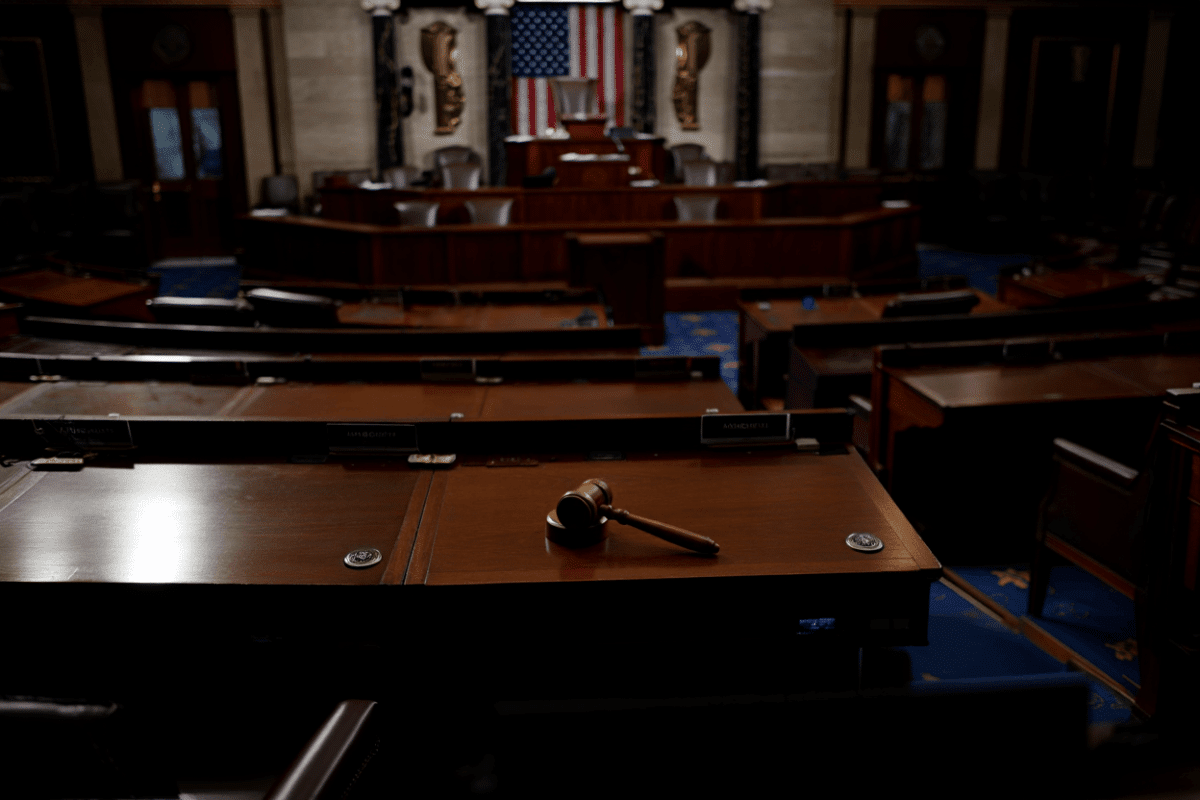
House conservatives blocked a procedural rule vote on Tuesday, stalling the National Defense Authorization Act and other legislation over their demand that the SAVE Act advance through Congress. The rule failed 224-198, with 14 Republicans joining Democrats to reject the measure as Speaker Mike Johnson’s attempt to merge the voter ID bill with the defense bill failed to satisfy hardline holdouts.
The blocked rule would have allowed debate and final votes on the annual Pentagon policy bill, a spending measure for the State Department, and a ceremonial resolution marking the one-year anniversary of the GOP’s tax-cut legislation. The vote extends a paralysis on the House floor that began last week when conservative hardliners ground most legislative activity to a halt, demanding action on the SAVE America Act, which President Trump has called his top legislative priority.
Speaker Johnson had announced Monday that he would attach the SAVE America Act to the NDAA through a process called MIRVing, which would send both measures to the Senate in a single package. However, Rep. Anna Paulina Luna of Florida and other conservatives rejected the plan. “The current plan being proposed by HOUSE GOP to ‘MIRV’ NDAA + SAVE AMERICA is a procedural head fake,” Luna posted on X before the vote. “This does not do anything but guarantee the Senate will EASILY TAKE OUT SAVE America from the NDAA.”
The 14 Republicans who voted against the rule were Tim Burchett, Eric Burlison, Eli Crane, Randy Fine, Andy Harris, Anna Paulina Luna, Max Miller, Chip Roy, Keith Self, Victoria Spartz, Mike Turner, Thomas Massie, and Lauren Boebert. House Majority Leader Steve Scalise also switched his vote to no, positioning himself to call the bill back up later. Johnson told reporters the chamber would spend “the next day-and-a-half” trying to resolve the disputes.
The SAVE America Act would require proof of U.S. citizenship to register to vote in federal elections and a photo ID to cast a ballot. It would also compel states to turn over their voter registration rolls to the federal government, according to Reuters. The House passed the bill in February 2026, but it has stalled in the Senate, where Democrats have vowed to oppose it and it lacks the votes to overcome a filibuster. Senate Majority Leader John Thune has dismissed conservatives’ calls to eliminate or reform the filibuster to pass the measure.
The standoff reflects deepening frustration among House conservatives over the Senate’s inaction. Trump last week urged House Republicans to unify and stop voting down rules after meeting with Johnson, but the hardliners continued their blockade Tuesday. Rep. Jim McGovern of Massachusetts, the top Democrat on the House Rules Committee, called the situation “unhinged” on the floor. “What on earth are we doing here?” McGovern said. “Every week, wondering if someone’s going to throw a fit, if Donald Trump is going to post something crazy and blow everything up, if Mike Johnson is going to bring something to the floor when he doesn’t have the votes.”
The House floor paralysis now threatens to derail the GOP’s legislative agenda before the scheduled July 4 recess. Johnson’s razor-thin Republican majority means he needs near-unanimous GOP support on procedural votes, leaving him vulnerable to even small groups of holdouts. The blockade underscores the tension between Trump’s election-focused priorities and the traditional legislative demands of Congress, with conservatives willing to halt routine legislative business to force action on voting restrictions that the Senate has repeatedly rejected.
Sources
- The Hill — procedural rule vote details, 14 Republicans named, Johnson’s MIRVing plan, Luna’s statement, Senate filibuster context
- Politico — rule vote failure (224-198), Luna’s demands, Johnson’s statements, impact on scheduled legislation
- Reuters — SAVE Act provisions (citizenship proof, photo ID, voter roll turnover), Trump allies’ blocking action, Luna’s rejection of Johnson’s approach