
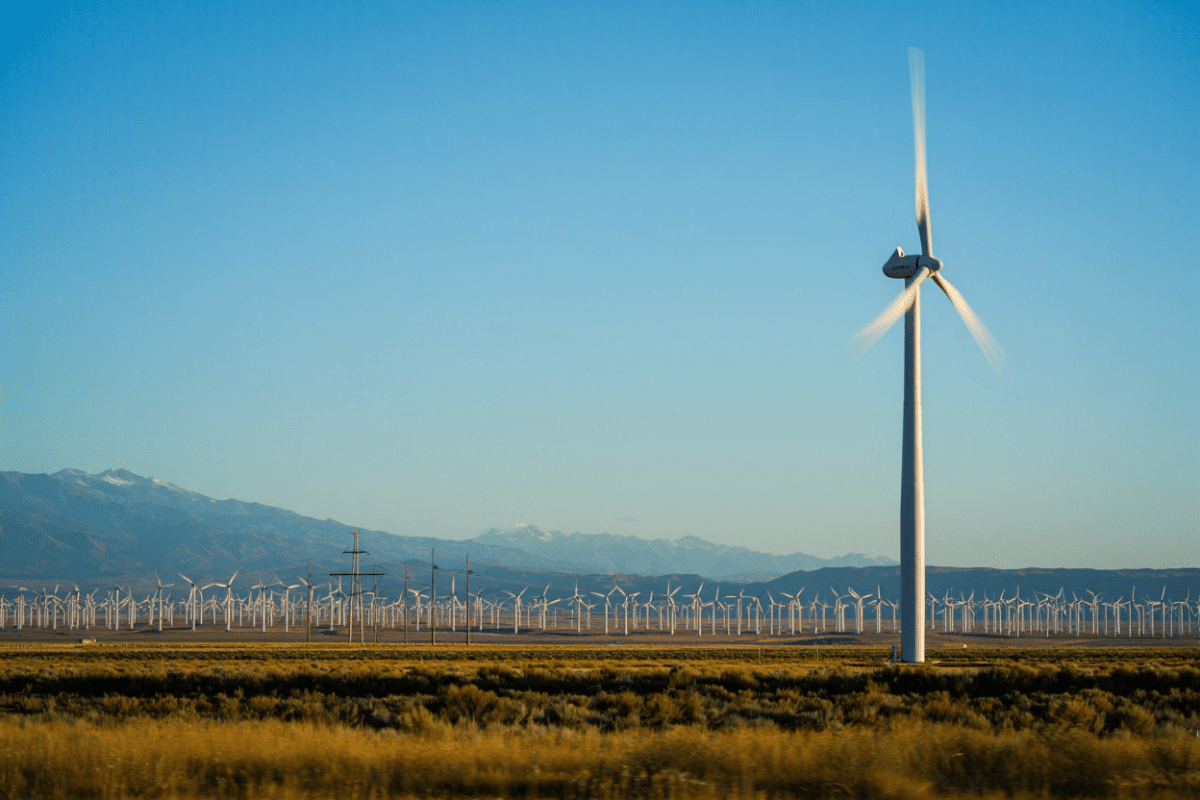
Pattern Energy’s SunZia wind farm in New Mexico is now fully operational, marking the largest renewable energy infrastructure project in U.S. history. The 3,650-megawatt wind facility and 550-mile transmission line began delivering power to Arizona and California on June 18, 2026, after nearly two decades of development and construction.
The project spans Lincoln, Torrance, and San Miguel Counties in New Mexico with 916 turbines capable of generating enough electricity to power approximately one million American homes annually. At full capacity, SunZia can deliver more power than the Hoover Dam, according to Pattern Energy. The wind farm is more than three times larger than Alta Wind in Southern California (1,098 megawatts) and Great Prairie in northern Texas (1,027 megawatts), making it the dominant wind resource in the nation.
The project began development in 2008 but faced years of permitting hurdles before Pattern Energy acquired it in 2022 and started full construction in September 2023. More than 2,000 workers supported the build at peak construction, with the company projecting over 100 permanent operations jobs across New Mexico and Arizona. The $11 billion investment will generate $20.5 billion in total economic benefit over the project’s lifetime, including $1.3 billion in direct payments to local governments, schools, counties, and landowners over the first 30 years of operations.
Crucially, SunZia includes a high-voltage direct-current (HVDC) transmission line that carries wind power from central New Mexico to a substation near Palo Verde, Arizona, where approximately two-thirds of the electricity feeds into Southern California’s grid. The transmission system represents one of the first major HVDC systems built in the United States in a generation, enabling efficient long-distance power delivery across 550 miles.
Grid Impact and Renewable Energy Transition
Since SunZia began testing in April 2026, California’s Independent System Operator (CAISO) has reported record-breaking wind generation at least five times. Wind output on May 15 hit 8,294 megawatts—nearly 1,600 megawatts higher than the previous record before SunZia power entered the state, according to energy analyst Dennis Wamsted at the Institute for Energy Economics and Financial Analysis. The project’s nighttime wind generation complements California’s abundant daytime solar power, addressing a critical gap in the state’s renewable energy portfolio.
SunZia arrives as the U.S. energy sector faces soaring demand requiring both new generation and transmission infrastructure to deliver power where it is needed. Elliot Mainzer, president and CEO of CAISO, stated that “large-scale transmission is essential to meeting the West’s growing energy needs and strengthening reliability across the grid.” The project demonstrates that transmission, long a bottleneck in renewable energy deployment, can be solved at scale.
The project took 17 years from initial conception to final permitting approval—a timeline that prompted U.S. Senator Martin Heinrich of New Mexico to call for federal permitting reform. “You should be able to get to the right answer in, you know, five, six years, not 17,” Heinrich said in an interview, describing SunZia as a model for how complex infrastructure should be built while acknowledging the need for streamlined approval processes for future projects.
Despite opposition from environmental groups and tribal nations concerned about habitat fragmentation, bird migration, and cultural site preservation, SunZia reached completion on schedule and on budget. Hunter Armistead, CEO of Pattern Energy, said the achievement “proves that we can still build the consequential infrastructure this country needs,” noting that the project succeeded through “genuine partnership with the local communities and landowners who trusted us.”
Sources
- Pattern Energy — company announcement confirming full operational status, project specifications, economic impact figures, and construction timeline
- Los Angeles Times — details on transmission line, California grid impact, record wind generation figures, and project timeline from 2008 conception
- U.S. News & World Report / Reuters — project completion confirmation, size comparison to other U.S. wind farms, and Senator Heinrich’s permitting reform comments
- U.S. Energy Information Administration (EIA) — capacity figures and comparative data on largest U.S. wind farms
- New Mexico RETA — transmission project commercial operation date and construction workforce data










